Tag: volunteering

  • Can We Reject a Volunteer?

    Rejecting a Volunteer
    courtesy of https://gratisography.com/

    We need volunteers. We say as much, in ads, to staff, to other volunteers and to the woman behind us in line as the barista makes our coffee. So, how can we justify rejecting anyone who steps forward and raises their hand? Because, as much as we want every person who even mutters the word “volunteering” to succeed, we need volunteers who will make a positive impact on our missions.

    What do you do when someone applies to volunteer and you realize they will not work out? Do you practice avoidance because you’re a nice person and nice people don’t reject other people, especially to their faces? Do you accidentally lose their paperwork? Do you string them along by saying “every job is closed right now due to an internal audit and I’m not sure when the jobs will open back up so hang in there,” in hopes they will get tired of asking?

    Or do you accept them and just hope the problems won’t be too big? Do you keep them so close that they’re practically an extension of you and then you fall behind on deadlines? Do you place them with great volunteers, hoping constructive influence will remake them?

    Ok, I’m not proud of it, but at one time or another, I’ve actually used every one of the above “strategies.” And, yes, you guessed it, every one failed. These strategies failed because they were not sound to begin with.

    We, volunteer managers are often faced with difficult choices, ones made more difficult because we are working with volunteers. Unlike an HR department that hires staff, our situation is much different in these ways:

    • Unlike staff, we do not have a limit on number of volunteers we can accept, so it becomes much harder to turn away a volunteer.
    • Qualifications for volunteering are viewed as much simpler and broader than for staff.
    • There is this perception surrounding volunteering that anyone who offers their time is already fit for the job, which is a complete opposite of the perceptions of staff hiring.
    • Unpaid work is viewed as simple, easy and can be done by anyone.

    Perceptions of volunteers and their contributions hinder our ability to be choosy, but we must. We are responsible for providing volunteers who positively impact our missions. But there’s another reason to be choosy. As we advance our volunteer engagement programs, we have to tighten up our methods for maximum impact and move away from being overwhelmed by unproductive ends.

    The first step in finding solutions is to examine our own objections to having a difficult conversation with a potential volunteer. The difficult “rejection” conversation is different from having a talk with an existing volunteer (see Difficult Conversations with Staff or Volunteers) in these ways:

    • We don’t know the potential volunteer as well as we know an existing volunteer.
    • We haven’t given the potential volunteer a chance.
    • We’ve work hard to recruit the volunteer and now we’re rescinding that invitation.
    • We don’t know the approach that works with a volunteer we barely know.
    • We feel like we’ve failed because our recruitment strategy didn’t capture the perfect person.

    We can’t keep using avoidance or risky strategies. Those counter intuitive strategies waste everyone’s time and create ill feelings when our goal is to create positive relationships. And we can actually create a relationship with a rejected volunteer.

    The first thing we need to do, is to stop using the word “reject.” Reject is a harsh word, meaning deny, eliminate and dismiss. Instead, let’s look at reshaping the potential volunteer. Let’s view every person who comes to volunteer as our chance to create organizational advocates. Not everyone has to volunteer to become an advocate. Heck, one-time volunteers or people who tour your office can be advocates.

    Volunteer managers excel at building relationships and rejection just doesn’t fit our style. Once you rethink rejection as potentially building a relationship, then prepare yourself to “reshape” the prospective volunteer by:

    • Reminding yourself that not all people will fit the volunteer role, but all people can be advocates.
    • Reassuring yourself that your goal is to create an advocate, not a person who feels mistreated because of avoidance strategies.
    • Giving yourself permission to feel disappointed, but assure yourself that you are a proactive leader who is finding the best solution for all.
    • Reminding yourself that it is more cruel to set a volunteer up for failure than it is to find an alternative solution from the start.
    • Viewing the opportunity to mold your engagement program.

    We, volunteer managers are not comfortable rejecting volunteers so let’s stop looking at it in this way. We want everyone to excel. But not everyone has to excel in the task boxes our organizations have created, so it is up to us to invent new boxes.

    If we develop a volunteer engagement system that allows for avenues, reshaping becomes much more palatable for us and for the new advocate.

    A very dear colleague used to use the phrase, “let’s part as friends,” when turning down a job applicant. We can take that one step further and say to any potential volunteer who may not be right for a particular task, “let’s advocate for a cause we believe in.”

    Next time: Systems in place to turn a rejection into a reshaping.

    -Meridian


  • Volunteering Backwards

    courtesy https://gratisography.com/

    In the U.S., the day after Thanksgiving, Black Friday signals retail’s frenzied push to profit and the beginning of the holiday season. For me it was always more of a Frazzled Friday because I was never quite prepared for the outpouring of love for mankind by hopeful one time volunteers after the stupor of eating too much turkey and mayo on leftover oven biscuits wore off.

    Ahhhh, that giving spirit warms the heart or maybe it’s indigestion from cranberry sauce with whole berries, (cause they ran out of the regular) I’m not sure. You know what I’m talking about. People are in the mood to do a good deed.

    It could be the steaming cup of hot cocoa or the search for the perfect gift for Grandma Maria or the filled seats in a place of worship that stirs the soul into thinking of others. It could be instinct and we humans, like birds migrating, have an internal clock that collectively ticks towards helping.

    No matter the reason, you brace yourself for the stampede of human kindness.

    Alicia calls to say her three kids need to come in and find out just how good they have it by seeing people less fortunate than they are. Can you pick out a few good down on their luck folks to show them?

    Mrs. Bancroft stops by, wanting to donate the leftovers from her holiday book club party. She needs help getting the half eaten cake with “Hap Hol” written on top and large tub of spoiling fruit salad out of her car. When she closes her trunk she winks, “Give it to the hungry people. They’ll love it.”

    Celia shows up with her trumpet and says she wants to “cheer up” all the poor folks with her rendition of Three Dog Night’s “Joy to the World.”

    Andre, a photography student drops in unannounced because he had this dream last night and he wants to photograph sad faces and share his work with the world.

    Yep, love for fellow man is filling up hearts like giant blow up Santas on motorcycles. You remember the last health department inspection and schlep all the food to the trash after Mrs. Bancroft has gone. You politely lie to Alicia and say you’re sorry but you’re standing knee deep in water because there’s been a water main break and no one is allowed in the building for the foreseeable future.  You tell Celia that all the “poor folks” are allergic to music and tell Andre that the sad people are down the street at city hall.

    The holidays bring out more one-time volunteers with requests than we can handle. It’s easy to dismiss their naivete and motives when you and volunteers are busy balancing the light and dark that holidays bring to your clients. Holiday one timers don’t get that we have processes; that they can’t use our clients for a feel good moment.

    We can wonder where that desire to do something nice for our fellow citizens hibernates all year. We can wave our hands in front of puzzled faces and say, “you’ve got this all wrong! If you would come in and take volunteer orientation, I can show you volunteering’s real meaning.” We can mutter under our breath, “seriously, you want to hand out pictures of your son, who has a bit part in a movie about a homeless man to our families as inspiration?”

    Can we just bottle this enthusiasm, pour it into our volunteer engagement brew, stir it up and come out with a perfect volunteer? Maybe we need to serve turkey or figgy pudding or hot cocoa all year round.

    Or maybe we can find some solace in the absurdity and know that there’s good in most everyone, even if it doesn’t show in an appropriate volunteering way.  As hopeful beings, we can continue to hand out our volunteering pamphlets and invite everyone who breathlessly calls us with a need to do something good to come and participate in a real way.

    And, we can remind ourselves nothing is perfect, we can’t make every person understand how volunteering works and we have real work to do for our clients who are both hurt and hopeful during the holidays. We can be kind but still tune out our inner voice that whispers, “you’ve got to try. Make this person see how magical volunteering can be.”

    The holidays are wonderful, stressful and overwhelming without the addition of added pressures. While you are humming “Jeremiah was a bullfrog,” formulate your strategy for making this season work for you, for your volunteers and for your mission.

    And for all the Alicias, Mrs. Bancrofts, Celias and Andres out there, you’ve got it kinda backwards, but thanks for caring.

    -Meridian

  • Resting on Nonprofit Laurels

    Resting on Non-Profit Laurels
    courtesy of gratisography.com

    I don’t remember the date, but I remember the conversation. It was the first time I’d heard the word “competition” in relation to volunteer organizations. I was in a community meeting and nonprofit experts were discussing the impact of a newly formed non-profit in the area.

    “They’ll be looking for the same resources,” one expert said.

    “Yes, we now have competition,” another added.

    Huh, competition. That’s one way to look at it. But here’s the kicker statement from the CEO of one of the established titan organizations. It’s a statement that stuck with me. “I wouldn’t worry too much, because we’ve been in this community for years and the public knows us and knows we care.”

    I might add that the start-up organization did very well.

    Do established nonprofits have a monopoly on compassion? Or on knowledge on how to solve societal challenges? I have always suspected that the underlying reason volunteers are not fully integrated is because they are seen as outsiders. By that I mean there is this nonprofit clutching to caring and knowledge as if volunteers or donors are cat burglars and they are sneaking in to try and steal it away.

    I have always suspected that this is the reason volunteers are not requested by senior management nor included in planning. You know what I’m talking about, right? You introduce a highly accomplished volunteer to senior management and you get that look. That subtle grind of the jaw that says, “who is this interloper and what will they discover, or take from me or change?”

    I remember being so excited about a volunteer, Serena. She was taking a year off work and staying in town with her mom. She came from a prestigious marketing firm in New York and I couldn’t wait to get her started helping our marketing team as a volunteer consultant.

    But they didn’t engage her. They didn’t even grab a cup of coffee and sit down with her to explore the treasure trove of experience she was willing to share. They simply sniffed and said there wasn’t that much for her to do. They clung to their area of expertise like it was a chest of gold and marauding pirates were landing.

    I’ve heard nonprofit staff disparage corporate volunteers, dismissing them as “not understanding what we do.” But, you know what? Some of these corporate volunteers exhibited more compassion on their one day of volunteering than some staff members showed all month.

    Society is rapidly evolving. What used to be exclusively in the realm of the nonprofit and even faith-based sectors is now front and center. Corporations are practicing “conscious capitalism.” Individuals are creating foundations (Bill Gates is a prime example) to tackle societal challenges. Citizen helpers are bypassing volunteer organizations.

    This is a quote from an eye opening article posted by Cureo on a philanthropic Millionare’s rant.

    They never ask me to help in ways that don’t involve a check? I know, I’m not going to volunteer at their race, but I’m sure there are other opportunities for me to help!

    And believe me, I have offered a number of times. I’ve asked for more frequent, and more relevant data. Maybe I can make new connections. Maybe I can assemble a volunteer team of some of my super talented staff to riff on a problem or deliver a solution of some kind — in areas of marketing, HR, capital projects, operational expansion — whatever!

    What are we so afraid of? That we’ll lose control? That we might not be as smart as our corporate counterparts? That we’ll admit we need help in planning and executing, not just in stuffing envelopes? That we’ll actually put our mission ahead of our own personal need to be the most compassionate person in the room?

    Now, don’t get me wrong. I’ve had these feelings too. I remember sitting in a peer group meeting and listening to another volunteer manager talk about a successful volunteer initiative and I felt jealous. Not inspired, not happy that people were being served. How selfishly insecure of me. I remember mentoring a new volunteer coordinator and feeling that twinge. “What if volunteers like him better than me and then, gasp, I won’t be the most loved volunteer coordinator ever to roam the earth!” (I still have that fantasy picture in my head-yeah, I know, seek help)

    You’ve heard the term, “founder’s syndrome.” It generally means a non-profit founder keeps their non-profit from growing by clinging to power. We don’t have to be founders to suffer from treating our work like it’s our baby and we are the only one who can sing it to sleep.

    Maybe we proudly wear the shiny sweat on our foreheads from having labored for so long at being selfless that we can’t imagine some giggly newcomer bouncing in and outperforming us. Maybe we cling to a martyr notion that caring people work for non-profits while the rest of the selfish world drowns baby animals for money. Maybe we suffer from “Non-Profit Insulation Syndrome.”

    But these insulating emotions keep us from learning something new, from moving forward, from expanding and from finding better ways to help the people we profess to help. And sadly, we become the kid in the sandbox who won’t let the other kids try the best toy truck. A very wise volunteer scolded me one day, arguing that my self-esteem had nothing to do with anyone else but me. (I fired him on the spot-just kidding)

    That’s when I began to detach myself from other people’s talents and discovered what my job really was about. Was a volunteer more compassionate than me? Heck yeah. Did another volunteer coordinator create a much better program than me? Good grief, yes. Was there any place for clinging to a warped sense of my own need to be perfect? No. (I’m still roaming the earth, though)

    We should actually be excited that more people want to get involved. We should be opening doors for them, eager to share the joy we clutch. But what I fear is, the nonprofits who rest on their laurels and continue to close their doors to all this amazing outside help will be left behind.

    I fear that cornering the market on compassion or empathy or knowledge will cause generous donors like the one quoted above, skilled volunteers and philanthropic businesses to give up or find another way. I fear they will leave us behind, raising our fists to the skies and bemoaning the unfairness of it all.

    And then, again, maybe that’s what needs to happen.

    -Meridian

  • There’s No Crying in Volunteer Management

    Does volunteer management ever make you cry? It does, doesn’t it? I mean, when you are sitting there and a volunteer recounts their struggle with being bullied as a child or they tell you about their journey through rehab or their fight to beat cancer, you just break down and cry because you care and feel their pain.

    And then there’s the pride cry when we witness volunteers wrapping a child in their arms or brushing the tear off the cheek of a grieving spouse. We well up when volunteers win an award because we witnessed their profound effect on those we serve. We weep when volunteers suffer a loss or when we see one of them grow fragile. We cry openly when they leave because they mean more to us than the hours they’ve spent.

    But do you ever cry out of frustration? When it’s all your body can do? I remember crying like that once. I was managing a resale shop with little to no resources except the great volunteers. I would borrow a hospital laundry truck to pick up donated furniture and ask an able-bodied volunteer to go along with me on the route that I had meticulously mapped out. Depending upon where the pickups were located and how much the donor had planned to donate, the route made maximum use of the truck.

    It happened during the last stop one day. It was 5:00 pm and I had to unload the truck at the shop and get it back by the hospital’s evening laundry run at 6:00 pm. The hospital had already sternly warned me that if I didn’t return it by 6, (I’d been late returning it several times already) they would not lend it out anymore, so I needed to hurry.

    My volunteer, Peter and I parked in front of the last house and got out. The donor was waiting to meet us. “I know I said I had two pieces of furniture, but we’re moving and I want you to take all of it.”

    Peter and I looked at each other. He and his wife had dinner plans with relatives who were visiting from out-of-town. “We won’t be able,” I began to say, but the donor cut in. “It has to be gone tonight. I thought we could get it into storage but we can’t. Our son was in an accident and he’s taken a turn for the worse.” His voice trembled. “We need to get to him.”

    Peter and I started to gather the furniture and haul it into the truck. The cargo space was nearly full and we had to jam the furniture in any way we could. I looked at my watch and realized that there was no way I could get the truck back in time. That meant the hospital would stop loaning it to me and the arduous task of having to find another vehicle all over again loomed.

    I knew that Peter would miss his milestone birthday dinner with his family. He didn’t say it, but I knew how important this was to him. My body was tired, my mind exhausted and thoughts of “what am I doing all this for anyway, I can’t get ahead,” began to swirl. My careful planning meant nothing now. Standing there in the back of the truck amidst all the tangled lamps and chairs, I broke down. It was so defeating.

    Peter stopped and gave me a minute and then he said, “Look, it’s ok. We’re going to do this. I can join my family when I get home, it’ll be fine.”

    “But it’s your birthday. Some birthday. I made you miss it. And they will take the truck away,” I said through tears.

    Peter nodded and said, “Yes, they probably will. But look, you’ve got us. All of us volunteers and we will figure this out. We’ve done it before and we will do it again.”

    We finished that night almost three hours late. I thanked Peter and drove the truck back to the hospital where my car was parked. After I gave the keys to an angry attendant, I got in my car and headed home. As I drove, I broke down and cried again.

    This time though, I wept because I was surrounded by volunteers like Peter.

    -Meridian


    .

  • Top 6 Volunteer Manager Lies We Tell Ourselves

    Volunteer Manager Lies We Tell Ourselves

    We all hate lying. It’s dishonest and harmful. It sucks. But it seems like we are ok with telling ourselves lies because well, we can take it or maybe because we think the truth is too scary to face or maybe we just like messing with our own heads or heck, I’m no psychologist, I honestly don’t know why we do it.

    A lot of volunteer managers, myself included have been lying to ourselves for years. And how do these lies manifest themselves? With stress, frustration, passive-aggressive behavior, shutting off, self-doubt. Lying to ourselves is destructive.

    So let’s just examine some of the top volunteer manager self-lies and put them to the volunteer manager Truth o’ Meter test. The volunteer manager Truth o’ Meter is foolproof. I know this because I paid no attention when I asked it if I should announce at the volunteer luncheon that “you volunteers should go on strike and hold out until all staff tattoo ‘we couldn’t do this without our volunteers’ on their arms.” Yeah, the Truth o’ Meter was right on that one.

    The top 6 lies we tell ourselves are:

    1. “Volunteers need my undivided attention or they will leave.”
    2. “When I can’t provide a volunteer, I’ve failed.”
    3. “If I just give it some time, problems will work themselves out.”
    4. “I have no business asking for resources or a raise or a promotion.”
    5. “I can’t make others see how important volunteering is.”
    6. “No one wants to hear my version of leadership.”

    So let’s go over these lies and see why that little voice that whispers in our ear is destructive and wrong.

    To #1,”Volunteers need my undivided attention or they will leave,” I’m thinking no. (Well, wait, when volunteer Dottie comes in and recounts her serious accident for the fifteenth time, the one that happened 10 years ago, it’s because she needs to voice her feelings and…woah, there’s that voice again..) No. Stop the voice. Volunteers are with us because they want a volunteer experience that enhances their lives. Enabling long non-productive volunteer interactions (or gabby staff for that matter, am I right?) accumulates and robs other volunteers and clients of your time. We don’t have to hear and invest in every personal story over and over. We can listen for a few moments and redirect the volunteer to their volunteering. The Truth o’ Meter proclaims this 89% false.

    To #2, “When I can’t provide a volunteer, I’ve failed.” Ok, so sometimes we’re busy doing something else and sometimes we are in a funk or can’t remember the name of that volunteer who told us during that long conversation like the ones in #1 that he played the bongos and now staff wants to get a bongo playing volunteer. Sure, once in a while it’s actually our fault and we can own that, but it’s time to realize that not every task will be filled and that doesn’t detract from the tremendous impact made by our volunteers. The Truth o’ Meter proclaims this 98% false.

    To #3, “If I just give it some time, problems will work themselves out.” Do we need to talk about avoidance? We can hope all we want that Clarence in accounting will stop calling volunteers “little nuisances” and will see the light or volunteer Ed will stop interrupting staff to tell multiple old elephant jokes, but we’d be wrong. Meeting challenges head-on saves us from bigger headaches down the road. Tactful mediation ensures solving challenges so that all sides can satisfactorily work towards meeting mission goals. The Truth o’ Meter proclaims this 99.5% false.

    To #4, “I have no business asking for a resources or a raise or a promotion.” Hmm, have you told the CEO she doesn’t know what she’s doing lately? I thought not. Why can’t we ask for a promotion or resources or a raise? We manage a huge amount of human capital that positively impacts people, have mad engagement skills and know our organizations inside and out and have ideas that will work. Yeah, we need to keep our heads down and keep telling ourselves we’re not good enough. The Truth o’ Meter proclaims this 99.8% false.

    To #5, “I can’t make others see how important volunteering is.” Ok, sure, it’s hard, no, actually it is really hard. There’s so much to engaging volunteers and how do we put that into an elevator speech or a sound bite? But our passion to see volunteers respected will lead to better ways of showing impact and as we all work towards professionalized and elevated volunteer management, it will become more clear. Hang in there for The Truth o’ Meter proclaims this 99.9% false.

    To #6, “No one wants to hear my version of leadership,” Uh huh. Yeah, why would they? We don’t inspire anyone. We don’t lead volunteers to do amazing things. Nah, who would want to hear that anyway? If your comfort zone (you know the one where fluffy pillows embroidered with “I’m just the volunteer coordinator” lay atop bean bag chairs filled with ‘keep a low profile’ nuggets and ‘no risk zone’ signs adorn the zen green walls) is holding you back, then venture out of it, one toe at a time. Speak up at a meeting, enter into discussions, offer to present some findings and showcase your style of organic leadership. You have so much to offer. The Truth o’ Meter proclaims this 100% false.

    There you have it. The top 6 lies volunteer managers tell ourselves has been debunked.

    And remember, the Volunteer Manager Truth o’ Meter never lies.

    -Meridian


  • The Volorcist Movie Review: Terrifying

    black and white black and white depressed depression
    Photo by Kat Jayne on Pexels.com

    Wow, I’m still shaking. I just got back from a midnight screening of “The Volorcist,” that indie movie from “Magician’s Hat” production company. They’re the same group that brought us “Little Shop of Volunteer Horrors” a few years back.

    Yep, my volunteer manager friends and I decided at the last minute to take in the screening. We found the theater, well, actually it wasn’t a theater, it was in the basement of an apartment building but hey, they had popcorn, so we went in and took our seats on the folding chairs. We had decided to dress up as volunteer managers for the movie and a couple of us wore magician’s hats and another carried a magic wand. I opted to wear my pack mule costume which was a mistake. I kept falling off the chair because the “junk” strapped to the back of my itchy mule costume made me top heavy.

    Anyway, the synopsis is:

    In a quiet non-profit, a pleasant volunteer Rebin, begins to change. She signs her name on the sign in sheet as “wouldn’t you like to know.” Normally soft-spoken, she starts loudly reprimanding other volunteers and pointing out their “mistakes.” She yells at one fellow volunteer for “arriving 4 minutes late,” and screams at another for “bringing in those communist homemade kolachkes for everyone to eat.”

    Good volunteers quit in frustration.

    Staff seeks answers from the newly hired volunteer coordinator, Darrius, who can’t believe things are that bad. He calls Rebin into his office for a chat. An inexperienced Darrius offers her a cup of coffee and flippantly says. “I hear you’ve been mistreating other volunteers.” He chuckles at the absurd notion.

    Enraged, Rebin shouts as she slams her cup down, “well if you did your job, then I wouldn’t have to step in!” A spray of coffee spittle hits Darrius, who takes out his handkerchief and wipes his face. Rebin continues, her eyes wild with anger. “I’m the only one here who does things right.” Just then, the room grows icy cold when the ancient building’s heater unit stopped working again. Puffs of icy breath billow in front of Rebin. The ringing of the desk phone shatters the silence but Darrius ignores it, because he knows who it is (It’s the executive secretary who always calls him when something in the building breaks). Rebin growls at him and walks out.

    The next day, Rebin comes up behind a volunteer, Buck and snatches papers from his hand. “You filed the 525 project under P,” she screams, “it goes under 5 you moron!” Shaken staff run from the room. Buck storms out and heads for Darrius’ office.

    Overwhelmed and unsure how to handle the situation, Darrius calls the former volunteer coordinator, Lannie, a crusty older woman who agrees to drive her 20-year-old camper where she’s been living since retiring on a non-profit pension back to town to help.

    She arrives with a satchel full of worn books on management the following day. Clutching the book her former boss gave her, “Workers Are Wrong, But You Can Make Them Obey,” Lannie suggests a strategy involving using the sandwich method of reprimanding (you know, the one where you praise the volunteer first, then point out that he/she has done something wrong, well, wait, now that you are here with those volunteer eyes looking at you, not really wrong, but maybe just misunderstood, or well, honestly what they did wasn’t so bad, no…wait it was actually justified, or needed and they were actually right all along and what were you thinking criticizing this perfect volunteer and then you wrap up with how great they are and how you are not worthy to have them, so nothing is ever resolved) They call Rebin in.

    She arrives, spewing accusations at them and with fear in their eyes, they ask her to sit down. Darrius begins to read out of the policies and procedures manual while Lannie attempts to use healing touch to calm Rebin down. Rebin resists. She pulls away from Lannie, her nervous leg bouncing wildly, causing her chair to move beneath her. It rattles on the floor, making an unearthly sound as she shouts, “I’m that extra layer of caring!”

    The Executive Director sticks her head in the door, asking “what is all this noise about,” and Rebin’s head whips around so quickly, it looks like it swiveled on her neck. In an other worldly voice, she hollers, ” It’s not fair! It’s Darrius’ fault! He told me I had leadership potential!” The Executive Director shuts the door and scurries away.

    All heck breaks loose. Rebin looks for Darrius’ weak spot. “You’re new. You don’t know anything at all, do you,” and for a moment Darrius freezes, feeling completely inadequate until Lannie snaps him out of it by whacking him with his ‘zen office worker’ mug. Darrius resumes reciting the policies and procedures manual while Rebin laughs maniacally.

    Together, Lannie and Darrius repeat over and over, “we have rules, we have rules.” Rebin suddenly growls, “fine, I quit,” and gets up so fast that Lannie falls off her chair. At that moment, Darrius realizes that he needs to step up because he is the best person to make this situation better. He knows what he needs to do.

    He runs to Rebin and puts his hand on her shoulder, flinching because she is electric with rage. He gently says to her, “Rebin, I’ve had some volunteers and staff come to me with complaints. I really want to hear your side of the story and work with you to make this right for you and for everyone else. Will you come back and we’ll sit down together and figure this out?”

    Rebin relaxes, and Darrius can feel all the anger leave her. She nods, and Darrius promises to call her the next day. Rebin hugs him as she leaves.

    An exhausted Darrius helps up his fallen colleague Lannie, who  mutters, “Welcome to volunteer management.”

    I would recommend this movie to any volunteer manager who:

    a) thinks they can’t work with volunteers who get into trouble

    b) thinks they have little control over volunteer engagement

    c) is not confident in their abilities to mediate challenging situations

    Please join Lisa McDee and me for a twitter chat tomorrow, Thursday, October 11th at 8pm Uk time, 3pm ET, 2pm CT, 1pm MT, 12noon PT on “Dealing with difficult volunteer behavior.” #ttvolmgrs

    We are all going to encounter difficult volunteer behavior, but it doesn’t have to be scary.

    -Meridian

    For more information on mediating difficult behavior, see my July post: Difficult Conversations with Staff or Volunteers


  • Volunteer Motivation: Past, Present and Future

    architecture building city concrete
    Photo by Juhasz Imre on Pexels.com

    Alana clicked the wireless presenter and the slide advanced. “Here,” she said, “we have a list of awards our volunteers have won.” Photos of volunteers holding certificates popped up on the screen. “As you can see,” Alana said, “the work we do is impressive.”

    A young trainee in the front row raised his hand. “When did they win those awards?” He pointed at the picture of a smiling lady, her silver hair shining in the stage lights.

    Alana glanced at the screen. “I wasn’t here at the time, but Marge won that award in 1999 I believe.”

    For some volunteers, 1999 might as well be 1899. Past performances are the equivalent of telling your children that “when I was your age, I walked to school. Five miles. Uphill. In the snow. Both ways.”

    It’s old news. But woah, hold on, wait a minute. So, when recruiting and on-boarding volunteers, should we just ditch mentioning our volunteer awards and heck while we’re at it, should we just forget about talking about our accomplishments too, because that stuff happened last week? Should we hide our best volunteers in the closet because hey, they’re so yesterday?

    No, that’s not even close to what I mean. I am all for showcasing awards and accomplishments and sharing volunteer achievements with anyone and everyone. I am all for nominating volunteers for awards. In a previous post, Awards: The Bridge to Inspire I listed reasons for nominating inspiring volunteers. I am all for exposing new volunteers to passionate and inspiring experienced volunteers. So, what do I mean?

    Past awards and achievements are like a building’s foundation. They illustrate the strength of mission worth and goals achieved. They show the new volunteer that your organization has a solid base and has worked hard to lay down an infrastructure on which to continue building.

    One thing I discovered when parading “accomplished” volunteers through training sessions was, there seemed to be a growing sense among the new volunteers of “what do the accomplishments of this seasoned volunteer mean for me? Am I supposed to duplicate their ways or will I have my own volunteering path and is there anything left to be done?”

    The modern volunteer needs to get excited about their volunteering journey. Much more than in years past, volunteers are looking at the future instead of being content with the present. It’s a subtle, but significant shift.

    What does that mean for us then, when it comes to recruiting, retaining and on-boarding new volunteers? It means balancing past volunteer awards and accomplishments with present goals and visions of the future. It means setting the foundation and then inspiring new volunteers to put up the walls, or decorate the interior or construct another floor. It means focusing on continually moving forward.

    Getting in on the ground floor of any enterprise is always exciting. There’s a sense of ownership, of possibilities, of seeing an idea take flight. As a society, we love start-up successes because those stories are filled with grit and vision and frankly, we imagine that those people could be us.

    Even though we may not work for a start-up organization, we can capture that feeling by introducing expansion, new programs and future vision to the new volunteer who may be sitting there wondering, “why, exactly do you need me when you already have all these great volunteers doing all this great work?”

    By balancing accomplishments with future goals, we infuse a sense of organizational history with a vision for the future. And nothing is more infectious than an inspiring vision. It gives new volunteers their own identity. It means that they won’t feel as though they have to mimic past volunteers in order to win an award. Instead, they will look forward to making their unique mark.

    Past infused with future looks something like this:

    “As you can see, our volunteers have won numerous awards for their work, something we are extremely proud of. Now, let me tell you about the exciting direction and future plans for our organization, which needs your passion and help to accomplish.”

    “Our volunteers have given over 70,000 hours in the past 5 years. It’s a testament to their belief in our mission. That’s why we are expanding our programs. These new programs are innovative and we’re really psyched about all the future possibilities. That’s where you come in.”

    “Thank you for listening to our volunteer, Kenya. She has been instrumental in getting that program off the ground. You may choose to volunteer in her area, or we have some new and I think, pretty out-of-the-box opportunities in the infancy stage you may find suit your skills and interests.”

    New volunteers learn a great deal about mission work and goals from the past, but they are motivated by the excitement of what’s to come and how they fit into visionary plans.

    They want to own the future. Let’s make sure we give it to them.

    -Meridian


  • Why Should We Pay Attention to Volunteering Trends?

    adult autumn beauty blue
    Photo by Pixabay on Pexels.com

    Have you ever stopped dead in your tracks and said, “I can sense it, it’s going to rain?” You felt the slight change in barometric pressure, or you heard the leaves in the trees rustle and you knew. You pulled up your collar or searched for an umbrella in your backpack.

    If we could see the coming volunteering trends, we could prepare for them, right? Thirty years ago, were there signs that volunteers wanted more episodic roles? Or did it sneak up on us, causing us to rethink our volunteering strategy? Should we even pay attention to trends? Do we need a volunteer engagement strategy umbrella?

    Can we spot trends by asking our volunteers, “Hey, what are you going to be doing differently 2 years from now?” Oftentimes, the beginning of a volunteering trend bubbles up in some pretty unrelated places. Not all trends first appear in volunteer management articles or blog posts. Rather, they evolve in other sectors and if we aren’t aware of them, these trends can rain down on us, catching us unprepared.

    One such rapidly expanding trend is corporate volunteering. Consider these recent articles, none of which appeared in volunteer management periodicals:

    Starbucks is testing a program that will allow some employees to spend half of their workweek at a local nonprofit

    The 50 Best Workplaces for Giving Back

    Why Paying Employees to Volunteer is Good For Business

    Or this article about a Chick-fil-A store owner who is paying his employees to volunteer while the store is being remodeled:

    Chick-fil-A employees in Plainfield to be paid for community service as location is closed for remodeling

    Or this article on millennial workers:

    Millennials Are Leading a Revolution in Corporate Volunteering Efforts

    The growing CSR (corporate social responsibility) trend greatly impacts volunteer managers, as more and more businesses look for avenues into volunteering for a non-profit. Where do they start? At this point in time, businesses are utilizing partnerships with non-profits to accomplish their corporate volunteering goals.

    If we wish to stay on top of this trend, it is imperative that volunteer organizations develop a corporate volunteering strategy to engage and partner with businesses who wish to increase their standing in communities. Why, we might ask? Why bother with employees who only give a couple of hours? Why take on another project that seems like babysitting? Why engage with people who are really just helping their company “look good?”

    Because, if we turn our self-righteous heads away and refuse to work with corporate volunteers, they will develop their own programs. And they have the money to do it.

    I am not suggesting that we drop everything and drool over any and every corporate volunteering request that comes our way. I’m suggesting that we need to develop a strategy that benefits our mission and works for the company we choose to partner with. By this, I mean:

    • choose a company that has shared goals and values and thoroughly understands what the mission is about
    • start with just one company and learn how to develop a solid partnership with that company before taking on another
    • control the participation as in how many volunteers you can take at a time, what they will do, when they will do it, how much onus is on them to bring any supplies they will need, etc.
    •  make impact on mission goals the primary focus, versus forging a partnership so that fund-raising can hit the company up for money
    • set guidelines or ground rules for participation and stick to them
    • follow-up to cement the relationship and plan for the future

    If organizers of corporate volunteering programs have poor experiences, or are continually turned away or can’t find anyone to partner with, they will quit trying. But here’s the scary thing. If they are really serious about volunteering in the community, they will just bypass us. They will turn their frustration into forming their own internal programs, leaving us in the dust.

    Corporate volunteering may seem like sketchy volunteering to the purist. We can dismiss it as not having pure intent, or not serious enough or existing only for show. But it’s exponentially increasing and we need to stay ahead of the trend and control it. We are the ones to shape it into the meaningful and impactful volunteering purity we wish to see.

    Think about this: When your CEO appears at your door and says, “I just got off the phone with the VP over at Expansion Architectural Designs and he said you told him we didn’t have a corporate volunteer program,” are you going to say, “But, but, corporate volunteering is just not real volunteering?”

    If we strategically embrace corporate volunteering, devise ways to successfully incorporate it into our hectic workloads and use it to further our goals, we will reap the following benefits:

    • increased organizational awareness through the partner company’s newsletter, employee word of mouth, possible press releases, etc.
    • increased donations from the satisfied partner company in the form of money, grants, in-kind donations or corporate matching (but again, donations are a bonus by-product of truly satisfied companies-we should never expect corporate volunteering to be a channel to money because that’s disingenuous)
    • increased positive word of mouth among area businesses
    • increased respect for volunteers in general due to the higher visibility of these corporate volunteers
    • more leverage when asking for an increase in volunteer budget, or additional resources, help, etc.
    • increased acknowledgement for volunteer manager creativity, skills and organizational worth

    We know volunteerism is rapidly evolving. Keeping up with trends can be daunting, so we must craft a strategy to control trend implementation and to work trends to our advantage by formulating a strategy umbrella.

    Because, it’s raining out there.

    -Meridian

    For more in-depth information on corporate volunteering from someone who has been on both sides of the equation and has workable solutions, please see Jerome Tennille’s excellent 2 part post on CSR and volunteering.


    View at Medium.com

    View at Medium.com

  • Volunteer Managers and Decision Fatigue

    adult dark depressed face
    Photo by Pixabay on Pexels.com

    Zack pushed back in his chair and stole a glance at his watch. 1:30. His lunch lay half eaten on his desk. A new volunteer, Karey was on hold, waiting for Zack’s decision on which volunteer would mentor her and what day she could start. Several new emails pinged on his screen. Task force volunteers needed an update on the choice of meeting spaces. In front of him, Nadia, the event coordinator was pointing to the unfilled volunteer slots at the Walk-a-thon this coming weekend.

    Weariness blanketed Zack. He forgot what it was the new volunteer on hold wanted. The subject lines on the newest emails blurred in his vision. He snapped at Nadia, “I told you, I was working on the event. I haven’t heard back from the volunteers I called. I will figure out who else I can call, but I can’t just make volunteers magically appear.”

    Decisions. Volunteer managers are faced with making hundreds, maybe thousands of decisions a day. Think I’m exaggerating? Let’s look at a simple request for a volunteer to fill a task and a sampling of the decisions involved.

    • Do I give this request priority?
    • Do I work on this now or put it in a queue?
    • What volunteers are best suited for this request?
    • Who should I call first?
    • How should I frame this request?
    • Do I ask for more information or do I have enough?
    • How much time should I spend on this?
    • What is the best time to call volunteers?
    • Should I also ask survey questions while I have them on the phone?
    • What points should I stress about the impact this task will have on our mission?
    • What is the best way to plead this case?
    • What recent activities has each volunteer I call been involved in and how can I acknowledge that?

    That’s 12 decisions before even starting. All day long, volunteer managers make decisions that directly impact the success of their volunteer programs. Daily major decisions include:

    • How should I answer this email and get my point across?
    • What tactic should I use when asking for more time finding volunteers for a hard to fill task?
    • How can I better explain this task to a volunteer?
    • What methods should I use when mediating the brewing dispute between a volunteer and a staff member?
    • What questions can I ask on the upcoming survey?
    • What do I want to measure on the next volunteer evaluation?
    • What can I streamline in today’s training to save some time?

    Decision fatigue occurs when the brain has made so many decisions that fatigue sets in, causing a breakdown in ability to make new decisions, or making snap decisions, or a lack of self-control and diminished willpower. It leads to poor decision-making.

    Decision fatigue can show itself with an irritated voice or a curt answer. It can show itself with “giving in” instead of standing ground for principles you believe in. It can show itself with forgetfulness or shutting down. It can show itself when you finally go home and can’t decide what to make for dinner so you order something unhealthy from that expensive take out place down the road because it’s the easiest thing to do.

    The 44th president of the United States, Barack Obama famously said:

    You’ll see I wear only gray or blue suits. I’m trying to pare down decisions. I don’t want to make decisions about what I’m eating or wearing. Because I have too many other decisions to make.

    Beyond filling volunteer tasks, a volunteer manager’s day is fraught with other carefully considered decisions.

    • How do I best approach senior management regarding an issue?
    • How do I politely extract myself from a conversation that is going on too long?
    • How do I mediate between a staff and volunteer or a volunteer and another volunteer?
    • How do I politely answer snarky questions?
    • How do I show volunteer value?
    • How can I manage all my tasks?
    • How can I remember all the small things?
    • How can I find new volunteers?
    • How can I listen to volunteers, genuinely hear them and yet not spend too much of my day in what appears to others as chit-chat?

    Volunteer management is the antithesis of assembly line work. There is no manual outlining each step because each step changes hourly. It involves careful people skills by leaders of volunteers with high emotional intelligence. Decisions are weighed and made in fractions of seconds. No wonder volunteer managers go home exhausted.

    So what can we do?

    Make the important decisions first thing: Before fatigue sets in and while your mind is clear, make your most important decisions early and stick to your decisions. Our minds are equipped to think more clearly and rationally before fatigue sets in so work on your most important projects or challenges when you first arrive. Do you have to counsel a volunteer? Do you have a yearly event? Do you have to give an important report? Work on those tasks first, set a deadline for your decisions and stick to them.

    Limit your decisions: Lay out your work clothes the night before work. Prepare your lunch or decide where you will have lunch the night before. Decide your 5 goals for the next day the night before. Put off making major decisions when you feel yourself losing willpower. There is nothing wrong with telling people you have to think about something and get back with them.

    Realize decisions will not all be perfect ones: Volunteer managers tend to hold themselves to a pretty impossible perfection standard, thinking that every decision must be the optimal one. This unrealistic standard creates paralysis when making decisions, slows down productivity and increases fatigue. Major decisions need time, but lesser decisions can be made more quickly and efficiently. Remember, after mulling over option upon option, we can still make an imperfect decision, so it’s best to leave the agonizing to major decisions.

    Carve out quiet time: Ideally, find an isolated space to work on projects. If you don’t have one, turn your computer monitor to the wall, turn the volume down, let the answering system pick up phone calls and work on your “need to do” list. One hour disconnected from the chaos will reap enormous benefits in not only making better decisions, but in your overall mental health. Two hours would be even better.

    Become a by-appointment office: It’s hard to do when you have an open door policy, but you can slowly begin to change that. Hang signs on your door that keep people from dropping in with questions or information that can wait. Signs that indicate “volunteer interview in progress,” or “volunteer strategy meeting in progress,” clearly announces that you must focus on the crucial task at hand. Having to make a major decision while constantly being interrupted with having to make smaller, snap decisions wears you down. It creates decision fatigue and robs you of any ability to make a good decision. If you find yourself continually putting off big projects, it’s a good sign that you suffer from decision fatigue and probably the effects of a chaotic office.

    Pare down the upfront work and utilize volunteer brains: For projects needing research, input from volunteers etc., ask volunteers to help you by completing the research or polling the volunteers. They can even assist by presenting you with decision options and their recommendations for best choices.

    What’s frustrating about decision fatigue is how it silently chips away at willpower. And a worn down volunteer manager will be ineffective when presenting volunteer contributions or advocating for better volunteer engagement practices.

    People who love us will tell us to take care of ourselves. They’re right. We need to take care of ourselves mentally and physically if we truly wish to create a successful volunteer program.

    So, please, while your brain is fresh and unencumbered, make a commitment to limiting the effects of decision fatigue.

    -Meridian


  • Just What is the Value of a Volunteer?

    Just what is the value of a volunteer

    Do organizations value volunteer Luis because he has this rare ability to look into the eyes of someone and open his being to receiving their pain? Do organizations value volunteer Mary because she drops everything and comes in when there’s an immediate need? Are all volunteers valued strictly for their volunteering? Or, do you sometimes get the uncomfortable feeling that certain volunteers are more highly thought of than others in your organization?

    It’s kinda true that some volunteers are more likable than others and volunteer managers have a challenge to overcome when staff doesn’t like a volunteer (see When Staff Doesn’t “Like” a Volunteer). But, besides likability, are there other reasons some volunteers are regarded more highly behind the closed wooden doors of organizational structure?

    Does a senior manager get all giddy when a volunteer bequeaths money to the organization (and then stands at your desk with a big smile spreading across her amazed face and says something like, “well, we would have gone to his funeral, but we didn’t know, why didn’t you tell us he died,”) or when a volunteer pays for that new tech equipment or that fridge for the employee lunch room?  Does the board go all a-twitter when they find out one of your volunteers is the mother-in-law of a famous actor and they are high-fiving each other because they just know your volunteer will use her mother-in-law powers to badger this actor into endorsing the organization? (I always kept this type of information buried deep in the secret compartment of my brain, it’s the one where I picture myself as the first officer aboard the star ship Enterprise, ooops – what I mean is they couldn’t pry it out of me if they tried)

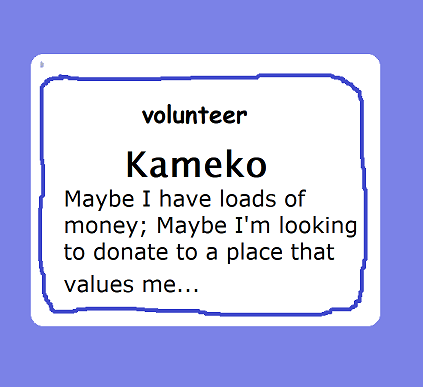
    What if a volunteer is married to a prominent lawyer or a politician, or someone who owns the swanky hotel where they have that fabulous banquet hall? Or what if a volunteer has loads of money? Does that volunteer suddenly get the VIP treatment?

    Maybe it’s subtle, but it’s there. Does the volunteer who is an absolute master at soothing clients’ hearts rate the same status or visibility as the volunteer who donates substantial money?

    Ok, ok, I’m being critical, and this is really all about human nature anyway, aka, the “what can you do for me,” expectations we all have. So, if volunteers who donate or bequeath or have connections seem to get better treatment, why don’t we, volunteer managers just use that to our advantage?

    Here’s what I propose:

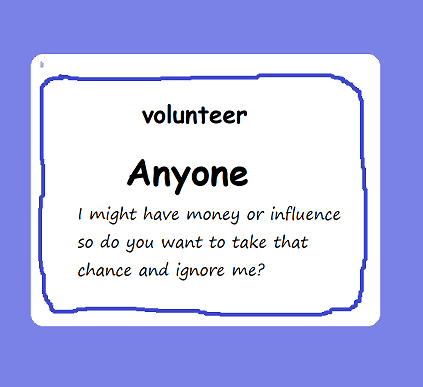
    Let’s equip every volunteer with a name badge that teases their potential value beyond the amazing volunteer work they are doing.  For example:

    badge3

    “Oh Mary,” a fund-raising specialist would say after reading the name tag, “I heard you just had a birthday. If you don’t mind me asking, I mean, you look so wonderful, how old are you again? Eighty-seven? Perfect.”

    or maybe this one…

    badge4

    “Oh, Jamal,” the social media expert would say as he stopped Jamal in the hallway,” tell me about your family. That’s nice that you have an older brother…. what does he do? Really? In Hollywood? I mean, your last name is, and well, you couldn’t be related to…oh, what, really you’re HIS brother? Bam! I knew it! I mean, how nice…”

    or even this one…

    badge5

    “Kameko,” the harried chief financial officer would coo after going over the financial report, “what adorable shoes you have on. From Italy, oh? You bought them the last time you went there? You travel extensively, I see… and your lovely engagement ring, it is so, so enormous…”

    or maybe a general one might just do:

    badge6

    I remember the day my organization got a sizable donation from the best friend of the recipient of our help. It turned out that the best friend was a well-known celebrity. Everyone was surprised at the gift and then a bit relieved that we all had done a good job. I mean any one of us, volunteers included, could have blown receiving that donation.

    There was the usual, “you never know, the person you are serving just might turn out to be someone famous,” talk as if the result of good work is not the work itself, but what it can produce.

    Organizations might get more excited when volunteers have a little extra something to give. Do they donate? Do they have influential contacts?  Will they leave money when they die?

    We, volunteer managers need to remind everyone that volunteers are there to further the mission, whether or not that volunteer has money or influence.

    But the takeaway is this: Volunteers who experience meaningful volunteer engagement and feel integrated into the organization always give more than their volunteer hours. Always.

    That means treating all volunteers as if they have money or influence lest they go elsewhere. And organizations might not want to take that chance.

    -Meridian


    This is an update from a 2016 post: Eureka, I’ve discovered the value of a Volunteer!