
Tag: volunteers

  • Oh BTW, Get 42 Permanent Vols By Next Month-Part 1


    Oh BTW, Get 42 Permanent Vols By Next Month-Part 1

    Is this the new volunteer manager job security? A dear colleague and friend to this blog, Eileen from Volunteering Counts in Dudley borough (volunteering counts.org.uk) has astutely pointed out in one of her comments that volunteer managers everywhere should be prepared to undertake new volunteer roles when budget cuts force them to supply volunteers for underfunded programs.

    Ok, sure, but how prepared? Well, I had been on the job at a hospice for less than a year when my supervisor decided to rotate the volunteer coordinators into each other’s regions and so I found myself taking my cute inspirational signs off my newly decorated office wall and settling into a care center location. Here I would be in charge of home team volunteers,  nursing home volunteers and care center volunteers for a 14 bed facility. I felt energized, perfectly jazzed until one afternoon, I was summoned to a meeting with the care center supervisor who informed me that dietary would now be volunteer run.

    “Excuse me,” I choked out.

    “Yes, volunteers will be preparing patients’ meals and you will be in charge of meal plans with the help of a dietician, and you will also be responsible for food procurement, safety, health inspections and training of the volunteers in food management.”

    I think I wet my pants a little at that point. (Maybe that’s why I kept a pair of clean skivvies in a locked drawer all those years)

    I honestly can’t remember every emotion I experienced at that moment. I think I couldn’t feel my fingers. I mean, Saturday evening, Friday evening, Sunday morning, all the traditional time slots that were hard enough to fill on occasion-now I had to fill those permanently? Why hadn’t I listened to my mother and found a real profession?

    Here’s the thing. Volunteer managers everywhere must be ready to have these types of requests dropped into their laps at any time. For most volunteer managers, a great deal of volunteer involvement is determined at meetings in which the VMs are not in attendance. Ideas for expansion, cutting costs or projects are often hammered out in board meetings and sent careening down the slope of middle managers until the edicts land in the laps of stunned volunteer coordinators. And sometimes, these ideas are conceived as a last gasp effort to save a program-“I know, we’ll get the volunteers to do it.”

    I went home and cursed my supervisor. Why me? Honestly, I was terrified, completely afraid that I would never be able to accomplish this task. I calculated that I needed to put at least 42 permanent volunteers in place for all three meals a day, seven days a week. And the God awful hard truth was that it became a long slog.

    When handed a huge project, especially with deadlines, every last millisecond of a volunteer manager’s time, energy and creative focus shifts away from other crucial duties and to the project exclusively. In order to maintain the ongoing programs, a VM has to find some balance and deputize seasoned volunteers into leadership roles.

    When you can’t do everything, you can’t do everything. Identifying key volunteers in preparation for the possibility a big project will materialize is proactive volunteer management and will save your sanity. Ease volunteers into taking leadership roles in existing programs and by ease I mean work alongside them until they are comfortable and you are comfortable in how they handle their roles. But, in my experience, don’t “turn over” a program to someone else if you are in charge. The VM must still be the ultimate person in control and checking in continuously (asking questions, offering support, intercepting challenges) establishes your leadership continuum.

    So, did my project succeed? Yes, it did. It’s still going 20 years later in multiple care centers.

    Was it bone crushing hard?  Oh, goodness, yes, even the smallest of things. I still get throbbing headaches when I smell spilled Ensure and when I see food handlers without gloves.

    Did it take time? I think I missed my son’s graduation from middle school, but he won’t say.

    Would I do it again? If I was younger, yes.

    Was I blissfully optimistic or sadly pessimistic about the possibilities? It depended upon the day I was having. Or whether or not I took my medication.

    Did I learn anything of value? Oh, goodness, so much about so many things.

    Can you share these things? Of course, I will, I promise-the good, the bad and the useable-next time:

    Coming in part two,  A perspective: Takeaways from a huge arse-busting project.

    (At least at this point, you know I survived intact!) (Well, maybe physically anyway.)

    -Meridian
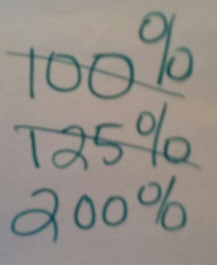
  • I Give 100%, No 125%, No, Wait More Like 200%!

    percents

    “I’m close to quitting, just walking out,” Ruby, a wispy volunteer manager says tersely. “And so are some of the other staff at my organization. I don’t know, I just feel like I have to sacrifice everything for my job. Now, whether or not I feel that because of a certain culture in my organization or if it is just self-imposed, I don’t know. But what I do know is that I feel inadequate when I choose a family outing over a fundraising event on a Saturday or when I feel that I deserve more compensation. And what’s worse is I feel so incredibly guilty having these feelings. I mean, does managing volunteers mean I forsake any and all personal life and needs?”

    Well, duh, Ruby. Or wait, does it? Once you’ve “become” a volunteer manager, does everything personal just fade away into this nirvana of blissful martyrdom?

    Coincidently, a recent article on overworked non-profit workers published in Atlantic Magazine addresses this very idea and one of the interview quotes from this article is:

    “The unspoken expectation is that you do whatever it takes to get whatever it is done for the people who you’re serving,” she says. “And anything less than that, you’re not quite doing enough.” Timm, Jonathan.  “The Plight of the Overworked Nonprofit Employee.”  The Atlantic Aug 24, 2016

    Do we, in the non-profit world sometimes wear our “commitment” like a badge of devotion on our chests? Do we secretly lap up the comments like cans of energy drinks when telling people what we do for a living? “Oh, you’re so selfless,” “I could never do that work,” “thank goodness for people like you.”

    Do we subtly feel this martyr attitude and does that translate into a self-sacrifice that is simmering under our weary feet waiting to burst into burn out? Do we feel guilty when we look at our colleagues who we imagine are selflessly working more and therefore care more? Does a nagging voice whisper, “If this is your calling, then how dare you complain (or ache or fall ill or blink)?”

    So,  are we afraid to voice the following concerns to our superiors for fear of being selfish?

    Asking for more resources (how dare we-precious money and resources need to go to the mission)

    Mindfulness about overwork (if I don’t keep going, someone, somewhere won’t benefit)

    Planning vacations, family time (family will just have to understand, THIS is more important than their needs)

    Needing help with stress over working with tragedy (How can I possibly complain, heck, I have it pretty good compared to the clients I see)

    Asking for a raise (Could I be any more selfish?)

    When the hard stuff, like not enough understanding of what volunteer managers do, or too many requests from too many departments and no way to prioritize, or challenges with staff, or no perceived support starts to whittle away at your commitment, then burnout begins.

    When we are embarrassed or afraid of asking for the help we need, we aren’t just doing a disservice to ourselves, we are actually hurting our volunteers and the very people we are here to help because we will not be any good to them if we are resentful or burned out.

    So, if you have to, tell yourself that asking for the help you need is really about providing the best volunteer management for your clients and volunteers. Frame your requests to your superiors in that way: “In order to provide the best for our clients and volunteers, I will need….”

    Because your “calling” is not to be a martyr, it’s to be a leader.

    -Meridian


  • Thank You, Thank You For That Silly Answer, Any Answer!

    painting

    Recently I went on a tour of a historical site with some friends and family. From start to finish, I made sure to ask questions of the tour leader and I frequently poked my group members in their sides so they would answer the questions he threw out. Why was that so important to me? Well, I was actually thinking of volunteer manager Jonas.

    “And then the silence was so awkward,” Jonas said one day, recalling the time he took a large, prospective group of volunteers on a tour of his organization’s headquarters. “I really, really pitched the benefits of volunteering with us. I showed them all the great opportunities to volunteer, I stopped staff in the hallway to say hi, I mean, I was passionate and threw out lots of anecdotal stories to get them thinking. But, then, when we stopped back at the lobby, I asked them what they thought and crickets! No one said anything, they just nodded and looked like they were ready to get their things and leave. I felt like a big balloon had popped.”

    Ahhhhhhhhhh, the silent group. We’ve all had them. Now, it’s not that they’re evil, or mean, or out to make us look bad, these are just groups that have a quiet dynamic. It makes it harder to connect with them, and in my humble experiences, I have found the groups that engage in honest give and take will bond with each other, with you and with the mission. But it takes skill to facilitate a group and real effort to create an atmosphere conducive to meaningful conversation.

    So, what can we do to encourage participation by the groups we train, or speak in front of, or tour with? Here are just a few methods I’ve toyed with over the years:

    Begin by establishing your expectations: Tell your group that you are not a lecturer, you are the group facilitator and that you are extremely interested in their comments and questions.

    Don’t wait until the end to ask questions: Ask several immediately and establish the give and take.

    Make it about them: Do research on their group if you can and speak to that or…
    Be an ignoramus: Ask questions about the group itself and let them school you on their interests, reason to be, etc. But keep in mind, it only works if you show genuine interest in them.

    Never start with hard questions: No one wants to be the first to be wrong. And then, when someone answers the simple questions, you can say, “see, you know more about us than you think!”

    Try a simple yes or no polling question and go around the room, capturing everyone: (thereby making everyone verbalize an answer but without having to be put on the spot) Then you can mentally calculate the stats and ask another question about the results. “Are you surprised at the results?” You can compare your group’s results to other groups or national stats to pique curiosity.

    Look for people who speak to each other and ask a question for the two of them to answer.

    Offer “This is one of the questions other groups have asked” and throw out your own question: Follow up with “what do you think?”

    Use humor and be self-effacing: Let them know you are approachable and not authoritarian.

    Break them into smaller groups: Have them discuss a topic then present to the others if you have time.

    I remember one training group I had. No matter what I did, they would not talk. It was just the wrong roll of the group dynamic roulette wheel. These were the hardest hours (over the course of six sessions) of my training life-my voice went hoarse, I started to babble and finally when I was just about to dismiss them ridiculously early, one of the group members raised their hand. “Thank you, thank you,” I silently breathed, not caring if the question was silly or redundant or even, “do you know that you have a piece of spinach in your teeth?”

    From that day forward, I made a promise to myself to never let a facilitator suffer through the silent treatment. Engaging with groups is an art form. You paint a picture and hope they can find something worth admiring or critiquing or just plain talking about. Sometimes you paint in silence, but that doesn’t mean the connection is not there.

    It just may take your best skills to bring that connection out.

    -Meridian


  • The Volunteer Management Word That Makes My Head Explode!

    explosion

    Hal, a new volunteer manager was feeling pretty good about his recent volunteer recruitment campaign when his supervisor stopped by for a chat. It seems that several senior managers from his organization had just returned from a national conference and they brought back handouts from all of the sessions, including the ones they did not attend. “I’ve got a handout for you here,” Hal’s supervisor said to him, “from the volunteer session. I’d like you to read this over, then call the presenter to learn more about her program and try to implement her recruitment method. I think it would help you.”

    Hal took the handout from the presentation entitled “Six Easy Steps to Recruiting Skilled Volunteers With Staying Power” and read the power point slides. He had heard about some of the recruitment methods before, and was in the process of implementing them, but he called anyway. The presenter was pleased that someone wanted to hear more about her program and she answered Hal’s questions. When Hal explained to his supervisor that he was in the process of implementing many of the presenter’s suggestions, his supervisor quipped, “then why don’t we have enough volunteers?”

    Wait for it, my head’s going to explode! So, ok, how did one little word cause this disconnect between Hal and his supervisor? Did you spot that fiend in the title of the volunteer management presentation?

    Six Easy Steps to Recruiting Skilled Volunteers With Staying Power.

    Did you see it? That slimy, rotten word that absolutely makes volunteer managers’ jobs a living nightmare? The evil word is easy.  Or substitute these similar back-stabbing words: Tried and true, sure-fire, simple, foolproof, fail-safe, reliable.

    My head is calming down now. Why would any decent volunteer expert do that to the rest of us? I wondered that the first time I attended a conference. Fresh faced and eager to learn from experienced volunteer managers, I sucked up the “do this and results will magically appear,” presentation like a Mai Tai on a Friday afternoon. Then I went out and tried to quickly install the methods that promised guaranteed results and failed.  I really, honestly thought I was a complete dimwit because the magic results were anything but magic. (Unless you consider the fact that after I pieced my skull together, I woke up pretty quickly to reality, but that wasn’t their intent, was it?)

    We all have a program or method that has worked out well and we want to share that with each other. That’s awesome and we need to learn from one another. But to imply that the program we’ve created will be a “breeze” to implement only makes other volunteer managers’ heads blow up, because organizational staff who do not fully understand all the skills involved in obtaining, training and retaining volunteers will key onto the words that imply managing volunteers is a “snap.”

    Sorry to rant here, but this has had my temples throbbing for years and years and I still see these treacherous words, in conference session titles, and in internet articles. Besides, my question for the presenter or author is: Why would you want to sell yourself short anyway? Why give the impression that the work you are presenting is without sweat and long hours? I’ll bet you worked your tail off to implement your methods, so why not say so?

    I remember raising my hand and asking questions about the challenges and pitfalls of presenters’ programs and some would just smile and not want to talk about it, and others would reluctantly open up and let the audience know that their programs were fraught with difficulties. How refreshing.

    So, instead of using simplistic words, how about we all give a nod to the complexities of volunteer engagement? Can we not term our offerings a bit more realistically? Instead of using the head-blow upping word easy or any of its evil twins, why can’t we use words like skilled, ambitious, or advanced, complex, or even “God awful hard but worth it?” Why would we ever give the impression that cultivating a volunteer force is simple?

    We know that volunteer management isn’t about tea parties and a few “easy” phone calls. So if instead it’s about real skills and thought and hard, hard work, let’s make sure we don’t give the wrong impression. (And by doing so, keep our heads intact).

    -Meridian (thanks, going to get a Mai Tai now)

  • They Laughed at My Wall of Binders Until…

    binders

    “I took over from a really nice older lady,” volunteer manager Meghan says, “but one thing I couldn’t understand is why she kept all these reports and sign-in sheets from meetings that were two and three years old. I shredded those in an attempt to keep a cleaner office. Then one day we needed to find a volunteer log from a couple of years ago. I had to admit that I got rid of it.” Meghan’s eyes got bigger, “I mean, what were the chances that we would need it?”

    Oh, the stacks and stacks of paper we create. Information on prospective volunteers, sign-in sheets from meetings, policies reviewed, applications, surveys, new volunteer interviews and volunteer logs are just some of the records kept in volunteer management. But are they necessary?

    For years I was teased about my “pack rat” behavior and folks laughed at my bookcase full of binders that held all the signatures and information I gathered. The binders were in addition to the personal files on past, present and future volunteers that were kept under double lock and key in several file cabinets. These files included background check results,  addresses and phone numbers.

    Did I need it all? Most of the time, no, but once in a while, it proved pretty handy,

    So here are just a few of the occasions when my “pack rat” binders helped out.

    Lawyers for a family needed access to care center front desk sign-in sheets to see if a prohibited family came to visit a client.

    A volunteer was reprimanded for breaking new policy. She claimed she and other volunteers were never informed until the policy she signed at a volunteer meeting was produced.

    The executive director wanted to know if his neighbor actually came to a volunteer informational session.

    A new volunteer insisted that she came to an advanced training but remembered that it was a meeting when shown the sign-in sheets for that training.

    Auditors arrived unexpectedly and requested proof of volunteer trainings. (the actual signatures of volunteers)

    Odd stats concerning volunteers were needed to apply for a grant application.

    A representative from a group of workers that volunteered wanted to know who actually signed in so that they could recognize those employees at the annual company picnic.

    Newer volunteer reporting systems have replaced many of the old binder systems. But the point is, the proof that signatures provide may just come in handy one day. Keeping records of meetings and asking volunteers to sign new policies help keep track of those who are and those who are not yet informed of important regulations. And if a volunteer does not attend an important informational meeting, then a copy of the meeting minutes and policies can be mailed or emailed to the absent volunteer with a request of acknowledgement. (and a friendly encouragement to ask questions or give feedback so that you can explain those regulations).

    While reports and sign-ins may not be flashy volunteer management, they do serve a useful purpose. Signatures are legal proof that you have done your due diligence when it comes to the proper training, conducting educational meetings for and providing necessary information to your volunteers.

    It’s no easy day when you have to prove something and you cannot. Binders and folders on hard drives do not take up that much room.

    Besides, when the CEO wants to know if her second cousin once removed was informed of the new dress code, those boring but carefully maintained wall of signatures will give you the answer in a pretty impressive short amount of time.

    Who’ll be laughing at the binders then?

    -Meridian


  • Where Did The Light Go?

    light_001
    Dana died a week ago today. She had been battling lung cancer for the second time and finally succumbed to it at the young age of 67. She didn’t want to die but she had been told that it was inoperable, untouchable, unstoppable…. inevitable. Did she stop volunteering? No, not Dana.

    She had come to training about twelve years before and at first, I didn’t know what to make of her, because her real passion lay in saving animals. She always resided with up to 14 rescued dogs and cats at a time, and would  happily describe the tabby with paralyzed back legs or the silver muzzled terrier who was 16 years old. I wondered how she would do with Homo sapiens, but I was an idiot to have questioned her, because Dana loved her humans as much as she loved her animals and she particularly enjoyed working with terminally ill men who had dementia. She glibly refered to them as her “guys” and could chat about a patient who thought she was a maid with the same optimism she showed a frightened stray .

    But here’s the thing. Besides being a great volunteer, Dana was a much better person than I am. I have to be honest with myself. Being around her, I knew it, felt it, experienced it. She was endlessly optimistic, carved paths of human construction and the way she handled the end of her life stripped all my self motivational pats on the back right out of me.. I was comfortable enough with her to be able to ask questions the way she wanted me to, and to not get all mushy when she didn’t want that. Her recurring cancer was not the elephant in the room or on the phone, it was a piece of her just like her frizzy hair or her gestures when she described putting a kitten into the lap of a burly man who drooled.

    When she died, a blinding light left the room, leaving a dim void. But where did that light go? Was it extinguished or does it shine on? You see, I have to know, because I think of the people who saw her as “just a volunteer.” Did they have sunglasses on?

    So, to comfort myself, I contemplate all the animals and people, including the families and friends that Dana touched throughout her life. A ray of her light lives on in them. She lessened their burdens, supported their journeys and shared their pains.They are more whole because of her and can now shine a little brighter in their worlds.

    I have a ray of her light in me. Because of her, I want to be a better person and she illuminated the path. It’s a steep and twisting passage. It consists of gracious losing, really really being with people, letting negative emotions and “poor me” feelings go and not being overwhelmed by the minutia of it all.

    This path is daunting, and constant and exhausting, but if I reach out with my hand and feel Dana in the air, a wisp of that light will guide me and live on.

    -Meridian

  • Huggable Book of Volunteering Stats or Why a Kiddie Pool Can’t Explain the Ocean

    kiddie pool

    “Stats, reports, time management sheets, I’m sick of all of them,” Clara lamented. “None of these truly depicts my day. When I include activities for volunteer retention on my day book, the entries look so superfluous. Unless I write paragraphs as to why spending time with a volunteer is necessary to retain them, it just sounds like I’m having a coffee break all day.” Clara laughs, “sometimes I think I’m just viewed as a caffeine junkie.”

    Yes, stats,  the way we justify our actions. If you, like I, have struggled with showcasing the complex work involved with attaining, training and retaining volunteers, you feel Clara’s pain. Volunteer managers everywhere keep stats on all sorts of activities-impact, volunteer retention, volunteers trained, return on investment (ROI), clients served, events staffed, recruitment efforts, etc. We include anecdotal stories, quotes, pictures and anything else to illustrate the impact of our volunteers on organizational missions and the efforts required to support that work. (Sometimes it feels like bringing a kiddie pool filled with water to describe the ocean.)

    In a recurring fantasy, my Day book  is covered with glittery gold stars and smiley faces and called, “The Doing the Right Thing Day Book.” It is frayed and loved and cherished by the CEO because she believes in doing the right thing above immediate numbers and simplistic reports . Of course in this fantasy I’m also 30 years younger and I actually know how to catch a Pikachu, but I’m off topic here.

    So what if we could report stats that revolved around doing the right thing, even if that meant traditional reporting occasionally fell short? How would that huggable soft leather day keeper look? (Sorry, in my fantasy, the day book is paper based, ’cause you can’t hug excel)

    Here is an excerpt from Week 26 in the “Do the Right Thing” Day book:

    DAY 1 at 9AM:     Trusted my instincts to spend extra time with a 5 year volunteer whose partner has just been diagnosed with cancer. I can see he needs to take some time off and I have placed him on the inactive list thus reducing the number of active volunteers. He may or may not resume volunteering, but, due to his positive experiences volunteering so far, will remain a friend to our organization forever. I will be spending some time to check in on him periodically because I truly hope he returns to volunteering, but also, because I care about him as a person.

    Day 2 at 2PM:  Realized that a situation requiring a volunteer was overwhelming for just one volunteer so took the extra time (three days) to find and enlist the right two volunteers who could support one another while dealing with a very difficult and challenging assignment. Did not meet goal of finding a volunteer in 24 hours, but instead, created a workable solution that avoided one of our excellent volunteers becoming embroiled in a difficult situation, thus retaining two good volunteers for the future and ensuring our client received excellent care.

    Day 3 at 11AM: Temporarily removed a marketing volunteer from staffing events because of recent health challenges. Although volunteer insists that he is physically able to carry boxes, his wife informed me that his doctor has prescribed no lifting or standing for three months. As a result, I reduced the number of available marketing volunteers but salvaged this volunteer’s future potential and eliminated the substantial risk for a workman’s comp situation should this volunteer injure himself while under his doctor’s orders. More importantly, we sent a message to all volunteers that their health and well-being is important to us and we view them as valuable assets. 

    Day 4 at 3:15pm: Spent 45 minutes with a prospective volunteer who admittedly can’t volunteer until sometime next year. This prospective volunteer’s father was helped by our organization and she is interested in giving back, although current commitments are preventing her from taking training. I have set reminders in my calendar for scheduled contact with her throughout the year as I perceived her as an excellent future volunteer. Rushing her at this time will only increase her overload of responsibilities and will cause her to quickly quit. As a result, no new volunteer stat has increased but time spent will pay off in future because this potential volunteer also belongs to several key civic groups that I have been recruiting.

    Day 5 at 6pmAttended funeral of long-term volunteer who retired due to health reasons more than two years ago. No stat will be affected, but please folks, this is the right thing to do.

    When you think about it, this fantasy Day Book is really a book about trust-trust that volunteer managers everywhere know how to spend their time wisely. VM’s know what to do and how to do it in order to ensure a volunteer program built on excellence, not just for the present, but for the future as well.

    If Executive Directors and CEO’s would just trust their volunteer managers to do the right thing, then stats will fluctuate at times, but will also naturally increase due to the good and hard work put into a volunteer program.

    It’s a huggable fantasy, isn’t it?

    -Meridian


  • Volunteering Ointment While the Wound Heals


    eagle

    I was reading this article on how volunteering helped a volunteer through her grief and it gave me this warm, familiar feeling, like the cracked and stained coffee cup I reach for every morning. It makes me think of all the volunteers with a story similar to this young woman’s who have applied volunteering as an ointment of sorts on their wounds while they heal.

    I think of Paul, whose beloved wife died so young. His gaping open grief was covered by a thin bandage of keeping busy. Helping others, focusing on someone else’s pain and being surrounded by kind people allowed him a chance to slather on the soothing volunteering ointment each time he came. And he stayed for almost ten years as the  ointment became less necessary, but more of a routine that he was used to and so so good at.

    I think of Judy, whose loss was long ago, but unresolved and ever fresh, who talked about the death of her son as though it had happened twenty minutes before. I think of how she instinctively avoided working with any clients, as though she knew her rawness would just get in the way. But while volunteering behind the scenes, she smeared herself in the listening ears of ever patient staff and volunteers who heard her pain and with encouragement, Judy sought out grief counseling.

    I think of Claire, who had been let go from a long-term and secure job. Her wound was to her psyche, and her face showed the lines of deep self-doubt. Every skill she possessed was slashed open, and each job rejection opened her wound again and again. Claire sought out volunteering like a lost pet who puts its nose against a stranger’s patio door in desperation. Her feelings of worth grew very slowly, but steadily until she shook the mantle of worthlessness and viewed each job rejection as a sign of the times. Eventually she gained employment and was more prepared to walk into her new place with confidence on the mend.

    It’s ironic, because each one of these volunteers was not “retained.” Each one of these “wounded healers” used volunteering as salve while delivering extraordinary work to the organizations they served.

    But they did not stay forever. Their retention lasted as long as the ointment helped them to heal enough that they did not need us anymore. Yes, they left not because we did not need them anymore but because they did not need us anymore.

    And just as we celebrate the release of a rehabilitated injured bird back into the wild, we can celebrate the fact that these volunteers were ready to fly. And we can take some solace in the fact that volunteering helped these wonderful hurting people begin to heal.

    So, should we continue to say that volunteer retention is our end game?  I don’t think so, because personally, I’ll take a soul on the mend over retention any day.

    -Meridian

  • The Conversation We Dread: Pain or Opportunity?

    The_Scream
    Or, in reality, “The Horrible, No-Good, Very Bad, Completely Upsetting, “Don’t Make Me Do It,” “I Think I’m Going to Be Sick” Day. Yes, that should pretty much cover it.

    Having that conversation with a volunteer-you know the one, the one where you have to discuss a complaint during that mean chat that will forever label you a terrible, cold person for hurting the helpless volunteer. You may as well burn the volunteer’s house down too while you’re at it-that’s how soul-less you are.

    So, how do we start a difficult conversation with a volunteer after a complaint has been made? And how do we prepare ourselves to have the confidence to do the right thing without melting down into mush? For what it’s worth, here are a few suggestions that I hope help you.

    Remember that you are the best person for this challenge: You have recruited and cultivated this volunteer. You care about them and will do what is necessary to see them succeed. And leaving them to fail is ultimately more cruel than helping them remain on track. Tip: Keep reminding yourself that clearing the air and guiding a volunteer is a growing experience for all of you and you will get through this.

    Practice your opening line: “I wanted to sit down with you today and chat about how things are going,” is fine, but volunteers really need us to get to the point. The more you dance around the topic, the more uncomfortable it becomes for you and the volunteer. It’s better if you nicely state the complaint up front. “Emma, I wanted to meet with you today, because one of the visitors to our museum called us to say that last Friday you were too busy to show their disabled son where the bathroom was located. You are one of our finest docents and have been for over five years now and I want to hear your side of the story. Do you recall this particular incident?” Tip: Tell yourself to use the exact words of the complaint-don’t water them down because the volunteer deserves the opportunity to respond to the exact charges that were brought.

    Don’t apologize for the conversation: Starting out with “I’m so sorry to call you in for this,” or “I hate that we have to talk about this” creates the impression that your organization’s ethical standards are meaningless. Tip: Tell yourself that being neutral, not apologetic helps the volunteer think and respond more clearly.

    Assure the volunteer that you are open-minded and fair but don’t put words in their mouth: “Emma, we want to hear your side of the story,” or, “Emma, let’s talk about what happened,” is better than saying, “I’m sure the complaint is unfounded,” or “this must be a misunderstanding.” Tip: Tell yourself that if the complaint is indeed a misunderstanding, then it will surely become obvious and not to worry. If the complaint is well founded, then you have an amazing opportunity to help this volunteer regain their footing.

    Don’t diminish the person(s) who made the complaint: Saying, “don’t worry, this person complains about everyone,” or “they probably just had a bad day,” negates the actual complaint. Tip: Tell yourself that bridging relationships is one of your strong skill sets and seeing both sides validated is a chance to bring both sides together.

    Allow ample time for discussion: Here is the area in which you will excel at nice-guy volunteer management. These conversations ebb and flow-but the savvy volunteer manager rides the spoken waves with the recurring message that the volunteer’s time and effort is invaluable and their concerns are worth hearing and discussing, even if their actions are in the wrong. Tip: Trust your instincts to tell you when you know the volunteer is satisfied that their feelings, opinions and aspirations are validated. That is when you can move forward with a resolution.

    Follow up with diligence: This step takes you from a manager to a leader. Speak with both parties after your initial conversation to ensure that the resolution works for both and that there are no lingering issues. Tip: Use your best mediation skills to assure both parties that your goal is to provide the finest volunteer involvement possible and that you believe in each person. Keep following up periodically until you see the resolution has been met.

    We can view difficult conversations in the same way we view traveling to a new place. We can tell ourselves that we will hate the new place by thinking things like “It’s going to be too hot,” “I will hate the food,” “the people are too strange,” etc. That usually becomes a self fulfilling prophecy. Or, like the person who welcomes traveling somewhere out of the comfort zone,  we can entertain the idea that this new experience will help us grow, both as a manager and leader.

    Choosing to grow and embrace challenging conversations will strengthen not only your program, but yourself as well. So, while it is perfectly normal to dread a difficult conversation, don’t let the opportunity to excel go to waste.

    You’re not the bad guy, you’re the leader.

    -Meridian


  • May I “Trouble” You For a Plan?

    plan
    “There was something about Jules,” Jake recalled, “something just off. She didn’t seem to connect with the program nor with other staff and volunteers. She never looked me in the eye. She made off the wall comments to other volunteers.She even started to call me after hours with odd requests about volunteering; for example, she called me one Sunday night to see if it would be okay to bake doggie cookies to bring to any staff that owned dogs . Frankly, I had an uncomfortable feeling about her but had no idea what to do about it because she passed our background check.”

    Oh boy. We deal with all types of people who are potential volunteers. And unless we are conducting clinical psychological testing sessions with each one, we have to pretty much trust our instincts and judgement when working with volunteers who set off that gnawing gut feeling that something is just “off.”

    But. on the flip side, we also walk alongside some pretty amazing people who might be going through common personal issues that render them sensitive such as:

    Loneliness/Socially ostracized

    Grief/Loss of job/Loss of home/Loss of identity

    Illness/Caregiving

    So, if the overwhelming majority of volunteers are wonderful, then isn’t it overkill to treat every volunteer as potentially snapping? On the other hand, do we blissfully think we can fix everyone’s challenges by our cheery encouragement? Or is there a professional medium?

    I recall a brand new volunteer, Kristof, who had a very strong, almost in your face personality. He passed all background checks. He said the right things in training. But a long-term volunteer, Jim, who was a fellow member of a club Kristof belonged to, told me in confidence that Kristof had threatened to hit a fellow club member.

    Now what do we do with second-hand knowledge? Could I hold that against Kristof? Was he a violent man? I hadn’t witnessed violent behavior, but proactively,  I assigned Kristof to a seasoned, mentoring volunteer. Also, in the agreement that Kristof and all other new volunteers signed, it stated that he was under a six month probationary period during which he would be evaluated and could be terminated at any time for rule violation, including threatening or inappropriate behavior.

    Sure enough, after about three weeks, one of the mentoring volunteers came to me and said that Kristof had made a threatening gesture towards him. It seems that Kristof did not appreciate being told that he could not go and do whatever he wanted.

    So, I called the head of security, Charles and asked him to accompany me and a senior manager in a meeting with Kristof. Thank goodness for Charles. He stood like a statue in the closed doorway, saying nothing, but speaking volumes about our seriousness. I talked with Kristof about the presumed threat. He got angry and said to me, “I see what this is about. I know what you are doing.” I reiterated our policy and he looked at Charles. “I don’t want to be here anyway,” he said. “I quit.”

    We walk a fine line here. Being proactive with volunteers prevents surprises and even tragedy down the line. Here are a few things to keep in mind when those little red flags start to flutter before your eyes:

    1. Be aware and monitor-enlist trusted volunteer mentors to help monitor all new volunteers
    2. Have expectations and rules written out and signed by each volunteer
    3. Put probationary periods in place for all new volunteers
    4. Never counsel volunteers alone
    5. Involve security if necessary
    6. Document all “red flag” behavior
    7. Create a step by step procedure to address situations before one arises
    8. Script a conversation that is neutral, professional yet firm
    9. Involve appropriate staff members within the organization
    10. Know risk management assessments, volunteer rights and legal pitfalls

    While volunteer managers excel at coaching, inspiring, mentoring and cultivating volunteers, we cannot stick our heads in the sand. Nice people and nice organizations can sadly sometimes be a place that feels right for folks with less than honorable intentions.

    Was Jake wise to be concerned about Jules? Yes, because he trusted his instinctive ability to lead. With his heightened awareness, he could then proceed to monitor and/or cultivate Jules’ volunteering. Having a plan in place to act quickly and professionally does not mean that you are suspicious of everyone and everything. It just means that you are prepared to handle difficult situations should they arise. And you are prepared to be a leader.

    -Meridian