
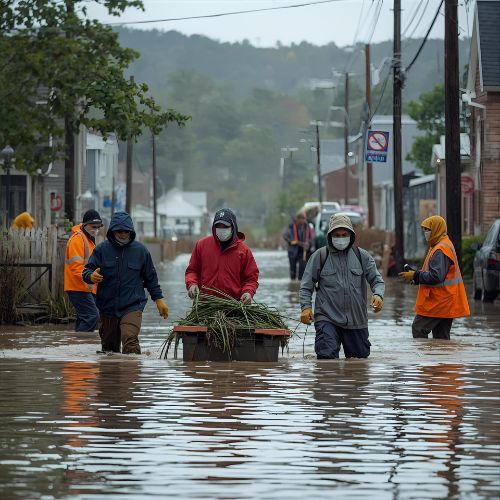
Although I like new descriptive words, I don’t think a word like ‘communit-eer’ should replace volunteer. It makes me think of other “teers” like the swashbuckling three musketeers, a puppeteer, or more recently, the mouse-ears wearing folks over at Disney. However, the definition of a communiteer, someone involved in their community, works because new paths to volunteering are emerging. Social media, new generational thinking, the embracing of global issues, disaster response, and a pandemic have all contributed to seismic shifts in volunteering’s structure. Communities mobilizing when a critical need strikes has become an efficient and effective answer to our current model of relying solely on traditionally recruited, vetted, trained and deployed volunteers. Does this mean the end of formal volunteering? Or can we embrace community partners, learn how to harness their enthusiasm and make it work for everyone?
The signs are everywhere
This article, “Volunteers flock to help search efforts after Texas floods even as officials warn them away,” says it all. The systems we have in place require formalized volunteering, including background checks, adherence to policies and procedures, the ability to record volunteer hours, and let’s not kid ourselves, the ability to solicit said volunteers for donations. Systems don’t want the ‘show up and wing it, then retreat to something else’ kind of volunteer. Systems want loyal, fill your slot every week, donate to the cause, keep within your lane volunteers. Systems hoard. Systems perpetuate systems. But what do today’s community-minded citizens want, and what happens in a disaster when time is critical to success?
I am not, nor ever was, opposed to rules and background checks and gathering vital data and statistics that support all the impact our volunteers have on our missions. But I see how volunteering is changing, and how a stranglehold on the systems we have in place can alienate communities, kill creativity, drive innovation away and dry up our pool of volunteers.
Is self-mobilization the new volunteering?
In the aftermath of the devastating flood in Texas, citizens found ways to help. This article, “The Texas floods washed away their possessions. Volunteers are helping reunite them,” chronicles a Facebook group that posted pictures of items recovered, many of which the finder lovingly cleaned and returned to the owners. These community-rich citizens did not contact an organization for instruction; they did not wait for interviews nor background checks. They saw a need and created a solution.
Or, consider this recent article, “No one claimed his body when he died. These strangers came together to help bury him.” Citizens showed up, answered the call, and formed a “chosen family” for this gentleman.
What are modern socially minded people looking for?
What if we harnessed the social goodwill of the people who responded after the Texas flood or became surrogate pallbearers? What drove them to act? Was it the immediate need? The camaraderie that comes from a united front? The instant impact they experienced? Can we provide the same urgency and results-based satisfaction? Can we give them a semblance of the freedom to find solutions rather than just telling them what to do?
How can we embrace the community partner?
What if, in a perfect world, we imagine a community of partners ready to help when the need arises? Let’s take it to the extreme first, (and by extreme, I mean mostly unattainable at this point) then pare it down and chop it into pieces that we might manage.
- In the extreme, everyone in our communities receives an invitation to basic volunteer training, and those who complete training have willingly completed background checks.
- Volunteer training and opportunities are front and center in schools.
- Communities, whether municipalities or villages, each track volunteer hours and projects and, with gamification in mind, vie for the title, “Most Community Spirited.”
- Nonprofits share, not hoard, community help.
- Nonprofits collaborate with one another to share resources, ideas and solutions. Instead of operating in silos, we recognize challenges are complex, and working together benefits the community. Instead of competing for donations, grants, government help, and volunteers, we band together in more efficient ways.
- Community truly means community as nonprofits operate under an organic concept versus an emphasis on the prevailing system.
- When help is time-sensitive, such as in a disaster, mobile notifications, akin to the ones emergency warning systems use, would kick in. Messages inform individuals how they can help, while also warning them about dangerous conditions. (For example, stay away from downed wires on main street-emergency personnel are on scene).
- Community partners have an opportunity to sample a wide variety of roles, giving them a broader connection to their neighbors through multiple and varied interactions, thus leading to a more cohesive community.
Many studies have shown that people have not stopped wanting to help; they are simply looking for better ways to do it. They’re finding solutions that are immediate, impactful and unburdened. Informal volunteering is alive and well.
So, how can we pivot and harness the shifts we are seeing in volunteerism so that they work for our missions and work for volunteers? How can we keep up with mobilization and a rapidly changing culture of helping?
Training-a tiered approach
In this perfect world, training comes in tiers. In 2018, I wrote an article for the Engage Journal, “Effective Volunteer Training is a Three-Tier Investment,” in which I talked about volunteer training as tiers. With a tiered training program, volunteers can quickly get started. Then, as they seek deeper involvement, we provide the in-depth and specific training for more complex roles.
Can we generalize basic volunteer training? I believe so because organizations share similar concepts, such as “do no harm.” All participating organizations would agree on the basics covered in a general volunteer training video, thus giving organizations a pool of volunteers for events, simple assignments and even fill-in positions. Instead of waiting for an assignment from one organization, volunteers could choose from a variety of roles, times and places to volunteer. And our benefits would come from:
- Drawing from a larger partner pool.
- Directly tapping into the urge to serve when needed-think disaster relief and even events or special projects.
- Using the sense of urgency that begets action.
- Keeping the people who are not being engaged from giving up. Instead of waiting for a notification from one organization, every volunteer would experience a vibrant world of volunteering that offers them choices in roles, locations, times and durations, giving them a greater sense of how our communities are interwoven and complex, which confirms how much their involvement matters to their neighbors and fellow citizens.
- Exposing more people to our work. After sampling a role, people might like what they find and want to become more involved. We may actually see an uptick in the number of people who want a recurring role (thank goodness). As community partners sample various volunteer opportunities, not only would they feel their interests are being taken seriously, they might find a fit.
- Putting our communities first as opposed to competing for volunteers, resources, donations, media play and grants.
- Fostering a sense of humble inclusion, and of wanting to fully engage the citizens who live in our communities.
- Positioning our organizations as community partners versus the perception that “we’re the experts here, so come and do what we tell you to.”
- Making diversity the norm, not a goal for the future.
- Embracing innovative ideas.
- Exposing volunteers to more missions, multiple needs, and a more diverse representation of fellow citizens, all of which would lead to a more cohesive community.
- Capitalizing on the “helper’s high” volunteers experience when they see what their work has accomplished. As each volunteer experiences a role that impacts a mission, we could offer them something “next,” something more, by giving them a variety of options, instead of letting those feelings cool.
If organizations banded together and created a solid, basic orientation that touched on missions, responsibilities as community partners, rights of the participants, and treatment of people within our programs, we’d have a solid base for our community partners to get started.
What about notifications?
Fortunately, we have technology and the ability to communicate immediately. In the case of the Texas flood or the need for a pallbearer, a communications center could mobilize already vetted citizens, while informing them how, why, and where dangers to themselves and others exist.
While we don’t yet have a central communication system for partnering non-profits, we can still collaborate. How?
- Inform volunteers of opportunities other organizations offer.
- Conduct some volunteer meetings together. Let volunteers meet each other and share tips and stories.
- Pool resources and pay for a speaker to inspire all community volunteers.
- Celebrate Volunteer Week as a group.
- Band together and share trends and challenges.
- Review policies and procedures with other volunteer managers.
- Forge a united front to advocate for the resources everyone needs.
- Make impact, not number of volunteers, as your organization’s goal in your reports and when speaking about your volunteers. Change the narrative from retention to engagement and point to the untapped potential your community offers.
Of course, there are drawbacks
Change is never easy nor perfect, and change is difficult even if it is inevitable. But the possibilities are worth it. We’d foster a community of helpers. Cooperative training can streamline the onboarding process. After basic volunteer training, each organization would then offer ongoing and specialized training. Time-strapped volunteer managers could share in providing refresher courses, celebrations, and meetings.
Silos aren’t helping us. What if, instead of making retention one of our primary goals, we band together and orient our citizens to be communiteers, or community partners? What if we put the community and our volunteers first?
I know I’m throwing out broad concepts that are easy to voice from my laptop lofty goals, but I think we can move towards a space where volunteering is not only better for the volunteer and for our community, it is more organic, and more in keeping with the trends we are seeing instead of remaining constrained behind aging systems that still value these outdated measurements of success above more important concepts;
- Number of volunteers
- Number of volunteer hours
- Volunteer retention
- Volunteers who fill regular slots
Change doesn’t happen overnight, so if I’m throwing concepts out there like tossing bread at pigeons, how do I expect to get there?
- First: We can start by sharing or continue sharing and recommending volunteers with/to other volunteer organizations in our areas.
- Second: Finding, joining or creating local volunteer engagement professional clubs or associations in our communities in which to share, discuss and find solutions to volunteer issues and needs. There’s more leverage in becoming a one-voice force that can speak to volunteering’s challenges by using collective knowledge and experience.
- Third: Flexibility. Let’s create more flexible roles and increase programs that can accommodate students and groups of volunteers. Corporate social responsibility is on the rise. Students are more socially conscious. One way might be to partner with other volunteer organizations to create rotating schedules for students during summer break so they can experience a variety of opportunities. (Full disclosure-I tried to do this many years ago and it flopped, but that was then and I didn’t do a good job of structuring it.)
- Fourth: Communication is the key to mobilizing volunteers, and tech is the answer. Would a system such as a local municipality warning system work to communicate with volunteers? Would it be treason to collaborate with other volunteer organizations to send out combined messages? Volunteers could opt-in to be contacted by multiple organizations through text messaging, giving them a range of opportunities.
- Fifth: Costs. Will local governments help, or will a consortium of non-profits decide to share the background checks and training costs?
This “perfect world” concept is daunting, but we leaders of volunteers know how critical it is to engage volunteers, not by dictating to them, but by offering them experiences that will light up their desire to help. So, what’s better? A volunteer joins an organization, doesn’t find the experience they are looking for and quits volunteering altogether. Or, that same volunteer joins a pool of community helpers, tries out an organization, doesn’t find a fit, but finds one at another organization. In both instances, the first organization loses a volunteer. But in the second scenario, another organization gains a volunteer, thus growing our pool. Is this concept so far out of our reach?
But wait, it’s already being done
In Maia Portugal, the seeds are in place. From this article, “Volunteering as the Invisible Engine of Social Cohesion in Europe,” the following paragraph sums it up:
“Maia’s recognition as both the Portuguese Capital of Volunteering and the forthcoming European Volunteering Capital 2026 is far more than a symbolic honour; it reflects a long-standing commitment to civic engagement, innovation, and community solidarity. These titles represent not only what Maia has achieved, but also what it aspires to become: a municipality where volunteering is central to public life and social transformation.”
So, that “perfect world” is attainable. Volunteering is a social activity, one in which everyone benefits. We’ve all witnessed how barriers, fears and hesitations fade as people offer and receive the best of themselves and each other during deep human connections. We, all of us in the volunteer engagement profession, have always championed volunteering as something bigger than hours given.
Why can’t we begin moving volunteering towards a community partnership, one more inclusive, and geared towards engaging volunteers versus using volunteers? I think the world just might embrace it.
-Meridian





 volunteerplaintalk