Category: Uncategorized

  • Is Compassion a Velvet Chain?

    This is updated from a post back in 2015:

    The Shackles of Compassion

    compassion has its own frame of reference

    Patients at hospice taught me many things, especially that I come equipped with a frame of reference and I need to put my frame aside and keep learning.

    Our patient George, was long divorced and rarely saw his twelve year old daughter. I was drawn to George. He was an iron worker, loved sports, hated our food and I wanted to “help him.” We would have these talks, and eventually he shared thoughts on his approaching death and the realization that he wouldn’t see his daughter grow up. I would leave his room and cry for his wasting body and diminishing chances at a life.

    When his daughter’s birthday approached, I, along with volunteers, went to our local Target and bought presents for George to give her. The volunteers giggled over wrapping the presents in pink and purple with gobs of glitter. It felt so good.

    I remember the day George’s ex-wife brought his daughter to visit him at our care center. I peeked in to see if George needed anything else on this joyous occasion. I stopped, for instead of seeing happy anticipation, I saw him hunched over in bed, quietly crying, one of the presents at his side. I didn’t want to disturb him, so I tiptoed away.

    In that intimate moment, the veil fell away and I saw the velvet chain that bound him to us. Our “help” tethered him to our compassion and the heavy links became visible through his pain.

    “I have always depended on the kindness of strangers”…Blanche DuBois in A Streetcar Named Desire

    Did he cry because we helped him or did he cry because he had lost control of everything precious and was now dependent upon the kindness of strangers? Did he weep at the ridiculous presents that were as handy as a hot dog stand at a funeral? Did he feel trapped, allowed to walk only as far as our chains would allow and only in the perimeter of our idea of what he needed?

    strapped to feel-good moments

    Do the people we serve feel shackled to us? Is it kind of like the stranglehold the skydiving instructor has on the newbie skydiver who is strapped in tight and really is just along on the way down? Does our tandem journey through folks’ lives sometimes bind them to our feel-good moments?

    I went back to my office and closed the door and sat down. I wondered, in all my desire to help, did I rob George of his last shred of dignity? Do we, sometimes in our exuberance to do good, forget that a real person with complex feelings is on the other end of our help? Do we see them through our feel-good lens and wonder why they are not exuberant with us?

    After that day, I started to see George as more complex, and my desire to help as more self-serving. I continued to visit with him until he died. I still struggle mightily with “trying to help,” “knowing what people need,” “having answers.”

    is “helping people” so great?

    Here’s the thing. I think we must stop telling volunteers that “helping people” will make them feel good. I think that top-down idea inadvertently gives us the power to decide what that help looks like and demeans the person who receives the help. It puts that person at the mercy of our kindness.

    What instead?

    We must stop media from using headlines describing volunteer involvement such as, “volunteers put smiles on the faces of” (fill in the blank here with any group of depressed people who magically forget all their challenges because a fun volunteer showed up) or “volunteers cheer up”… (fill in the blank here with all the sad people who are just waiting for some stranger to come along and make them happy). Oh, and let’s just assume that what people really, really, really want is to become happy when faced with challenging times. Yep, a volunteer with a smile is just what they need.

    When I heard a few volunteers or staff complain that a recipient of help wasn’t grateful, I began to take note. I saw how uncomfortable it was for people to be demeaned by eager “helpers.” I saw that the volunteers (thankfully the vast majority of them extensively oriented to the mission) who were successful, were the ones who wanted to bond, to converse, to be humble. They didn’t want to hold any power over the people they connected with.

    if helping doesn’t make us feel good, what does volunteering make us feel?

    Volunteering does wonders for our well-being. But not because we are “helping” someone in a top-down approach and somehow we feel good because, “gosh, gee, I’m reminded that I have it so much better.” It’s because we are getting out of our bubble, we are connecting with people, we are learning and growing. I truly believe that volunteering makes us more human by connecting us on a one-to-one level.

    so, what do we tell volunteers?

    Instead of advertising that helping people makes us feel good, we can tell our volunteers that volunteering is about connecting, learning, and understanding. We can tell them that it will nurture their soul and teach them to be better people. We can stop encouraging them (even subtly) to “help” people who are “less fortunate.”

    In my experience, the most successful volunteers were the ones who didn’t go home and patted themselves on the back because they “helped” someone. No, the true volunteer spirit goes home and quietly processes everything they’ve experienced. They hope they are not an added burden. They hope they haven’t done any harm. They hope to be better the next day. This is the true volunteer spirit.

    We, leaders of volunteers can be the fearless leaders in the non-profit realm and re-mold the “helper’s high” image into something truer, more ….better. We can orient a volunteer team that understands they have no power over anyone else.

    Because even a velvet chain is still a chain.

    -Meridian

    .
  • VPT Podcast Episode 10: Dr. Corinne Devin shares overseas volunteering and leadership advice

    https://www.buzzsprout.com/605416/4160378-episode-10-interview-with-dr-corinne-devin-volunteer-and-accomplished-leader

    Spotify:

    Sticher:

    https://www.stitcher.com/podcast/meridian-swift/volunteerplaintalk

    Apple:

    Google:

    https://podcasts.google.com/feed/aHR0cHM6Ly9mZWVkcy5idXp6c3Byb3V0LmNvbS82MDU0MTYucnNz/episode/QnV6enNwcm91dC00MTYwMzc4?ved=0CAcQ38oDahcKEwjgwKPk34PqAhUAAAAAHQAAAAAQAQ

    Listen in as Dr. Corinne Devin, Navy officer, accomplished leader and passionate volunteer speaks about her experience volunteering overseas and gives timely tips for elevating volunteer manager leadership. In this episode, Corinne chats about:

    • ·       The challenge in stepping outside our comfort zones
    • ·       How volunteers can help other volunteers with real time advice
    • ·       How volunteer mentors help the organization
    • ·       Why listening to criticism is important
    • ·       Why shifting communication styles depends on your audience
    • ·       What to focus on when you can’t control circumstances
    • ·       How options work when having difficult conversations
    • ·       How to speak up the chain of command and advocate
    • ·       The need for strength in numbers
    • ·       Discovering new outreach avenues through a volunteer’s interests and passions

    Corinne is an doctor, an officer, and a beauty queen. Specifically an orthodontist, Commander, and 2020 International Ms. 
    Corinne says, “My father, also a dentist, inspired my love of service and teeth, and I followed his footsteps becoming a Navy officer- a heritage that goes back to the Revolutionary War and earned me a Daughters of the American Revolution college scholarship. 

    While I continue my service as a Navy orthodontist based off-base, I have a passion for working with civilian kids and their moms. Whenever I can, I moonlight in private practices, using my strengths as a compassionate communicator (with a confidently feminine charm) to help improve the self-esteem of my patients, one orthodontic procedure at a time. 

    I have lived in and visited over 50 countries in Asia, Europe and the Middle East, including my deployment with the United States Navy in support of Operation Iraqi Freedom to Al Asad, Iraq where I took care of the smiles of over 25,000 active duty, contractors and Iraqi security forces.

    After practicing for three years as a general dentist, I was selected to attend the elite Tri-Service Orthodontics Residency Program at Wilford Hall Medical Center, Lackland Air Force Base, San Antonio, Texas. 

    While in residency I competed and won the title Ms. Texas, then after graduating won Ms. United States 2012, and internationally won Ms. Galaxy 2014, Ms Earth 2018, and International Ms. 2020.  The titles allowed me the opportunity get involved with local communities, speaking at events including elementary schools where I mentored young girls and showed them that they can be and do anything- from beauty queen to Navy officer to orthodontist. I continued to balance my two passions, serving as the keynote speaker at the STEM (Science Technology Engineering and Mathematics) Conference to over 1,000 middle school girls for the Department of Defense in Japan.”

    Thank you Corinne, for sharing your experiences, both as a volunteer and as an accomplished leader. If you wish to get in touch with Corinne, her contact information is:


     Official Facebook page: https://www.facebook.com/drcorinnedevin/

    Instagram: @drcorinnedevin

    Youtube: Dr. Corinne Devin

    Linkedin: Corinne Devin

    Email: drcorinnedevin@gmail.com

    The organizations (for volunteering overseas) Corinne mentioned are:

    Smart Traveler Enrollment Program: https://step.state.gov/step/

    Cross-Cultural Solutions: https://www.crossculturalsolutions.org/

  • Volunteer Impact: Showing Volunteers’ Value: Free Download

    Change is upon us, so let’s make changes work for us and our volunteer initiatives. Let’s demonstrate volunteer impact which shows volunteer value and drives more volunteer engagement. (which in turn, increases volunteer impact and so on)

    Download this handy volunteer impact guide along with the volunteer impact worksheet and look for ways to report on volunteer impact.

    What is the value of a volunteer?

    It’s time to show it.

    -Meridian

  • Volunteer Flow Strategy

    Volunteers move in and out of our organizations and unlike staff who have defined hours and pay, volunteers ebb and flow like water in an ecosystem. A simple volunteer flow statement is used to track this flow and then predict future flows based on factors that engage volunteers verses factors that block the volunteer flow. Let’s create a basic flow statement for volunteer recruitment efforts.

    simple, but effective

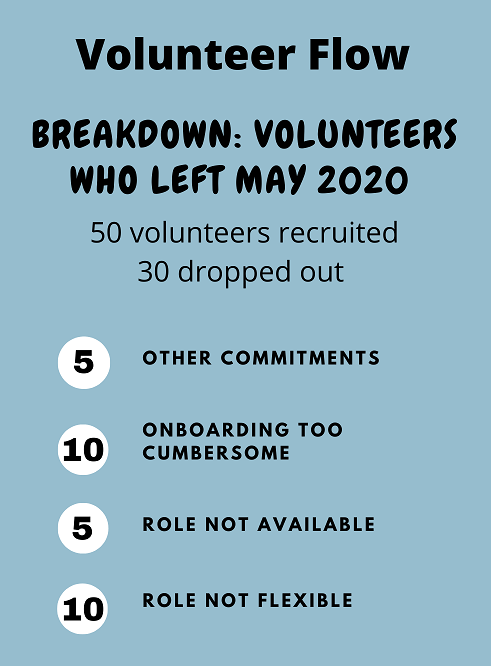
    Example: Month of May: We recruited 50 volunteers who signed up. Of those, 20 volunteers followed through and are now officially volunteering.  The other 30 volunteers did not follow through. The volunteer base has now increased by 20 volunteers. Sounds great if you simply say, “we gained 20 volunteers this month. 

    But let’s go further. What about the 30 volunteers who left after recruitment? Here’s where you can explain the reasons volunteers leave and predict that more volunteers will leave due to these same reasons. Not so great, after all, is it?

    Percentages are calculated from stats gathered – for example, exit surveys or interviews.

    Percentages break down this way:

    • 16% of volunteers who left in May had other commitments
    • 33% of volunteers who left in May found on-boarding too cumbersome
    • 16% of volunteers who left in May did not find a role that suited them
    • 33% of volunteers who left in May needed more flexibility

    When projecting volunteer recruitment in the future, we can now predict:

    For every 10 volunteers we recruit, only 4 (or 40%) will stay. ( based on the above stats, 50 volunteers recruited – 30 volunteers that left = 60% of new volunteers will leave before they even start. Now, 20 new volunteers doesn’t sound so great when the number could have been 45, right? (not 50 because you can’t control the 5 who had other commitments)

    Explain why volunteers leave by showing causation:

    Of the volunteers who left:

    • only 16% left due to unavoidable reasons
    • over 80% left due to factors we can modify or change

    We need to change…

    We can now infer from the statistics that changes will likely increase the number of recruited volunteers who follow through. Changes include:

    • on-boarding needs to be less cumbersome
    • roles need to be more flexible
    • roles need to be expanded

    A strategic Volunteer Flow sheet shows the reasons volunteers leave or stay. (causation). These “causes” are the reasons you have experienced all along and have been advocating for. Volunteer flow is a way to form your knowledge into a measurable report and more importantly, predict the future with statistical information.

    Instead of the notion that a volunteer manager should “work harder” to “get volunteers,” we need to place the reasons volunteers leave or never get started squarely on the outdated systems that no longer work.

    By predicting the same results in the future, you are illustrating that without the changes you are advocating for, volunteers will continue to leave before they even get started. You can use this method to show volunteer retention and causation as well.

    show what you know

    Volunteers flow in and out of our organizations for hundreds of reasons. The reasons we can control must work for the volunteer and by showing causation, we can more effectively advocate for the changes that will increase volunteer engagement.

    Modern volunteers need modern programs that meet their needs. Our communities are ecosystems and volunteers flow in and around looking for the right opportunity to offer their skills and passions.

    Let’s strategically advocate so that when volunteers flow our way, they find a place to stay.

    -Meridian

  • Predicting Volunteer Flow

    Predicting Volunteer Flow

    What freezes the flow of volunteers?

    What is a volunteer flow? It is the movement of volunteers in and out of an organization, much like a cash flow in business. Like any resource, volunteers are a people-resource that is rich in skills, passions, marketing reach, knowledge, experience, dedication, and in ability to procure donations and other desired resources. As such, our volunteers must be viewed as just as valuable a resource as a donation flow.

    Can we, volunteer managers predict our volunteer flow, especially in uncertain times such as we face today? Before we say no way, (mainly because we have all experienced surprises when it comes to who actually will volunteer), let’s ask this question: Would it benefit us, Leaders of Volunteers, to create a volunteer flow statement?

    As a fan of mathematical equations (even when I mangle them), our aim is: UPV (under promise volunteer resources) < OPV (over produce volunteer resources).

    We know that there are thousands of factors that influence volunteer recruitment and sustainability and we know that challenges have increased exponentially due to the pandemic. So, how can we possibly predict how many volunteers we will gain, retain or lose in the next few months?

    We can’t predict with certainty, but we can estimate with causation. And this is actually a good time to introduce the idea that volunteers ebb and flow not only with changing times, but with any negative or positive experiences within our organizational structure. Volunteers aren’t something we “order up” or people who magically appear when needed and never question their assignments. This is the time to introduce the factors that freeze or free up a volunteer flow.

    What is our objective?

    Our aim is to create a consistent flow of highly engaged and productive volunteers who positively impact our organization’s goals, objectives and mission. Our job is to recruit these volunteers, and to develop them into contributing members of our teams. For more on development, see:

    #LoVols, This Needs to Change Now

    What do #LoVols do all day?

    Download Volunteerplaintalk Tools

    Will volunteers return after being furloughed? Will more virtual volunteers sign-up and then we are caught without enough meaningful roles for them? Will corporate and other groups want to continue their philanthropy? How will virtual training affect volunteer sustainability? These are questions we don’t have all the answers for, but based on what we are experiencing, we can create a volunteer flow strategy statement.

    Next time: What goes into this strategy?

    -Meridian

  • VPT Podcast Episode 9: Interview with Jaylen Christie, Super Volunteer and PR Director

    A Preview of Jaylen’s Interview

    https://www.buzzsprout.com/605416/episodes/3832022

    https://podcasts.apple.com/us/podcast/volunteer-plain-talk/id1481197705

    (Apple may take a full day to list a new episode)

    https://www.stitcher.com/podcast/meridian-swift/volunteerplaintalk

    Thank you Jaylen, for your infectious positivity, your wisdom and advice and for your commitment to making our community a better place. And a special thanks to your grandmother, mom and dad for instilling the volunteer spirit in you.

    -Meridian

    Coming soon: Volunteer Plain Talk podcast on Pandora and iHeart Radio.

  • #LoVols, Passing the Time Constructively Like We Always Do

    One thing I realized in all these years, is that leaders of volunteers are never, ever idle. We are always recruiting, talking up volunteering, hatching new ideas, and working a crowd (even if it’s only 1 person in line for a 99 cent taco on Tuesday). We never stop, even during chaotic times. Some of the things we’re doing are:

    We can’t get rusty so we practice training volunteers wherever and whenever we can. It helps to target the audience in practice, just like we do for real. You never know what civic group or club might invite you to give orientation.

    We want to be super-prepared for the time when volunteer fairs are running again, so we pass the time by making give-a-ways – it doesn’t hurt to have something people really want.

    We don’t stop talking about our volunteer initiatives to anyone that might listen. I figured heck, we go to the store anyway, may as well use this opportunity to recruit volunteers. (in theory, but all I experienced was customers making a wide arc around me)

    Leaders of volunteers are creative, innovative people. I’m thinking, we will look back on this time as the most innovative in the history of volunteer management.

    Seriously.

    -Meridian

  • Advocacy: Join the Webinar Today at 2pm ET

    Join me today (Wednesday, May 6th) for the ALIVE webinar: Elevating Leaders of Volunteers: It’s time to strategize advocacy.

    I’m a big, big believer in strategy because hey, I spent the first 10 years of my #LoVols career without strategy, and that pretty much meant running around putting out fires, often without a hose, sometimes without water and sometimes seeing two fires merge and burn the place down. I got tired of smoke in my lungs.

    Chaos can be an opportunity for becoming a change-maker as new a normal arises.

    So, be well, be safe, be strategizing.

    -Meridian

  • Volunteer Past, Meet Volunteer Present and Volunteer Future:

    Volunteer Past, Meet Volunteer Present and Volunteer Future:

    We are at a junction. Volunteer past is meeting volunteer present and volunteer future. How will we treat each one going forward?

    It’s too soon to know what changes will occur, but it is not too soon to start strategizing for a better present and future. Will we recruit new volunteers saying, “It’s a new day folks,” and by sweeping away the past, piss off all the volunteers who have stuck with us? Will we try to force all the new volunteers into old roles and methods and appear to not have gained any innovative insight from this crisis?

    Volunteer past is an organization’s foundation. Honoring volunteer stories and accomplishments from the past means your organization has created a solid base and has laid an infrastructure on which to continue building.

    I discovered long ago, that when seasoned volunteers spoke at volunteer orientation, new volunteers were impressed, but also thought, “Am I supposed to be like this volunteer or will I have my own volunteering path? Is there anything new to be done?”

    Moving forward, modern volunteers need to get excited about their volunteering journey. Volunteers are looking at the future instead of being content with the present. It’s a subtle, but significant shift.

    What does that mean for us then, when it comes to recruiting, sustaining and on-boarding new volunteers? It means balancing past volunteer methods, awards and accomplishments with present goals and visions for the future. It means setting the foundation and then inspiring new volunteers to put up the walls, or decorate the interior or construct another floor. It means focusing on moving forward.

    What if you’re not an exciting start-up organization with endless possibilities? Introduce expansion, new programs and future visions to volunteers who may be wondering, “why do you need me?”

    Nothing is more infectious than an inspiring vision that has movement. It gives volunteers an identity. It means that they won’t have to mimic volunteer past to make their unique mark.

    Volunteer Past infused with Volunteer Future looks something like this:

    “Our volunteers have won numerous awards for their work. But, we want to build on that and we need your unique passion.”

    “Our volunteers gave 70,000 hours in the past 5 years. That’s why we can expand our innovative programs. That’s where you come in.”

    “We’ve used this method for many years because it worked. Now, we are moving forward and you are part of the journey.”

    A well-rounded volunteer understands volunteer past and looks to make their mark on volunteer present and volunteer future.

    Our volunteers want to celebrate and understand the past, but own the future. Let’s give them both.

    -Meridian

    This is a more timely version of a past post: https://volunteerplaintalk.com/2018/10/03/volunteer-motivation-past-present-and-future/