Category: volunteer management

  • The Shift Towards Communit-eers

    Although I like new descriptive words, I don’t think a word like ‘communit-eer’ should replace volunteer. It makes me think of other “teers” like the swashbuckling three musketeers, a puppeteer, or more recently, the mouse-ears wearing folks over at Disney. However, the definition of a communiteer, someone involved in their community, works because new paths to volunteering are emerging. Social media, new generational thinking, the embracing of global issues, disaster response, and a pandemic have all contributed to seismic shifts in volunteering’s structure. Communities mobilizing when a critical need strikes has become an efficient and effective answer to our current model of relying solely on traditionally recruited, vetted, trained and deployed volunteers. Does this mean the end of formal volunteering? Or can we embrace community partners, learn how to harness their enthusiasm and make it work for everyone?

    The signs are everywhere

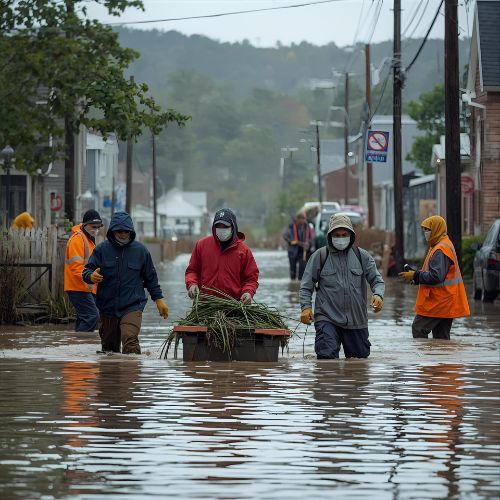
    This article, “Volunteers flock to help search efforts after Texas floods even as officials warn them away,” says it all. The systems we have in place require formalized volunteering, including background checks, adherence to policies and procedures, the ability to record volunteer hours, and let’s not kid ourselves, the ability to solicit said volunteers for donations. Systems don’t want the ‘show up and wing it, then retreat to something else’ kind of volunteer. Systems want loyal, fill your slot every week, donate to the cause, keep within your lane volunteers. Systems hoard. Systems perpetuate systems. But what do today’s community-minded citizens want, and what happens in a disaster when time is critical to success?

    I am not, nor ever was, opposed to rules and background checks and gathering vital data and statistics that support all the impact our volunteers have on our missions. But I see how volunteering is changing, and how a stranglehold on the systems we have in place can alienate communities, kill creativity, drive innovation away and dry up our pool of volunteers.

    Is self-mobilization the new volunteering?

    In the aftermath of the devastating flood in Texas, citizens found ways to help. This article, “The Texas floods washed away their possessions. Volunteers are helping reunite them,” chronicles a Facebook group that posted pictures of items recovered, many of which the finder lovingly cleaned and returned to the owners. These community-rich citizens did not contact an organization for instruction; they did not wait for interviews nor background checks. They saw a need and created a solution.

    Or, consider this recent article, “No one claimed his body when he died. These strangers came together to help bury him.” Citizens showed up, answered the call, and formed a “chosen family” for this gentleman.

    What are modern socially minded people looking for?

    What if we harnessed the social goodwill of the people who responded after the Texas flood or became surrogate pallbearers? What drove them to act? Was it the immediate need? The camaraderie that comes from a united front? The instant impact they experienced? Can we provide the same urgency and results-based satisfaction? Can we give them a semblance of the freedom to find solutions rather than just telling them what to do?

    How can we embrace the community partner?

    What if, in a perfect world, we imagine a community of partners ready to help when the need arises? Let’s take it to the extreme first, (and by extreme, I mean mostly unattainable at this point) then pare it down and chop it into pieces that we might manage.

    • In the extreme, everyone in our communities receives an invitation to basic volunteer training, and those who complete training have willingly completed background checks.
    • Volunteer training and opportunities are front and center in schools.
    • Communities, whether municipalities or villages, each track volunteer hours and projects and, with gamification in mind, vie for the title, “Most Community Spirited.”
    • Nonprofits share, not hoard, community help.
    • Nonprofits collaborate with one another to share resources, ideas and solutions. Instead of operating in silos, we recognize challenges are complex, and working together benefits the community. Instead of competing for donations, grants, government help, and volunteers, we band together in more efficient ways.
    • Community truly means community as nonprofits operate under an organic concept versus an emphasis on the prevailing system.
    • When help is time-sensitive, such as in a disaster, mobile notifications, akin to the ones emergency warning systems use, would kick in. Messages inform individuals how they can help, while also warning them about dangerous conditions. (For example, stay away from downed wires on main street-emergency personnel are on scene).
    • Community partners have an opportunity to sample a wide variety of roles, giving them a broader connection to their neighbors through multiple and varied interactions, thus leading to a more cohesive community.

    Many studies have shown that people have not stopped wanting to help; they are simply looking for better ways to do it. They’re finding solutions that are immediate, impactful and unburdened. Informal volunteering is alive and well.

    So, how can we pivot and harness the shifts we are seeing in volunteerism so that they work for our missions and work for volunteers? How can we keep up with mobilization and a rapidly changing culture of helping?

    Training-a tiered approach

    In this perfect world, training comes in tiers. In 2018, I wrote an article for the Engage Journal, “Effective Volunteer Training is a Three-Tier Investment,” in which I talked about volunteer training as tiers. With a tiered training program, volunteers can quickly get started. Then, as they seek deeper involvement, we provide the in-depth and specific training for more complex roles.

    Can we generalize basic volunteer training? I believe so because organizations share similar concepts, such as “do no harm.” All participating organizations would agree on the basics covered in a general volunteer training video, thus giving organizations a pool of volunteers for events, simple assignments and even fill-in positions. Instead of waiting for an assignment from one organization, volunteers could choose from a variety of roles, times and places to volunteer. And our benefits would come from:

    • Drawing from a larger partner pool.
    • Directly tapping into the urge to serve when needed-think disaster relief and even events or special projects.
    • Using the sense of urgency that begets action.
    • Keeping the people who are not being engaged from giving up. Instead of waiting for a notification from one organization, every volunteer would experience a vibrant world of volunteering that offers them choices in roles, locations, times and durations, giving them a greater sense of how our communities are interwoven and complex, which confirms how much their involvement matters to their neighbors and fellow citizens.
    • Exposing more people to our work. After sampling a role, people might like what they find and want to become more involved. We may actually see an uptick in the number of people who want a recurring role (thank goodness). As community partners sample various volunteer opportunities, not only would they feel their interests are being taken seriously, they might find a fit.
    • Putting our communities first as opposed to competing for volunteers, resources, donations, media play and grants.
    • Fostering a sense of humble inclusion, and of wanting to fully engage the citizens who live in our communities.
    • Positioning our organizations as community partners versus the perception that “we’re the experts here, so come and do what we tell you to.”
    • Making diversity the norm, not a goal for the future.
    • Embracing innovative ideas.
    • Exposing volunteers to more missions, multiple needs, and a more diverse representation of fellow citizens, all of which would lead to a more cohesive community.
    • Capitalizing on the “helper’s high” volunteers experience when they see what their work has accomplished. As each volunteer experiences a role that impacts a mission, we could offer them something “next,” something more, by giving them a variety of options, instead of letting those feelings cool.

    If organizations banded together and created a solid, basic orientation that touched on missions, responsibilities as community partners, rights of the participants, and treatment of people within our programs, we’d have a solid base for our community partners to get started.

    What about notifications?

    Fortunately, we have technology and the ability to communicate immediately. In the case of the Texas flood or the need for a pallbearer, a communications center could mobilize already vetted citizens, while informing them how, why, and where dangers to themselves and others exist.

    While we don’t yet have a central communication system for partnering non-profits, we can still collaborate. How?

    • Inform volunteers of opportunities other organizations offer.
    • Conduct some volunteer meetings together. Let volunteers meet each other and share tips and stories.
    • Pool resources and pay for a speaker to inspire all community volunteers.
    • Celebrate Volunteer Week as a group.
    • Band together and share trends and challenges.
    • Review policies and procedures with other volunteer managers.
    • Forge a united front to advocate for the resources everyone needs.
    • Make impact, not number of volunteers, as your organization’s goal in your reports and when speaking about your volunteers. Change the narrative from retention to engagement and point to the untapped potential your community offers.

    Of course, there are drawbacks

    Change is never easy nor perfect, and change is difficult even if it is inevitable. But the possibilities are worth it. We’d foster a community of helpers. Cooperative training can streamline the onboarding process. After basic volunteer training, each organization would then offer ongoing and specialized training. Time-strapped volunteer managers could share in providing refresher courses, celebrations, and meetings.

    Silos aren’t helping us. What if, instead of making retention one of our primary goals, we band together and orient our citizens to be communiteers, or community partners? What if we put the community and our volunteers first?

    I know I’m throwing out broad concepts that are easy to voice from my laptop lofty goals, but I think we can move towards a space where volunteering is not only better for the volunteer and for our community, it is more organic, and more in keeping with the trends we are seeing instead of remaining constrained behind aging systems that still value these outdated measurements of success above more important concepts;

    • Number of volunteers
    • Number of volunteer hours
    • Volunteer retention
    • Volunteers who fill regular slots

    Change doesn’t happen overnight, so if I’m throwing concepts out there like tossing bread at pigeons, how do I expect to get there?

    • First: We can start by sharing or continue sharing and recommending volunteers with/to other volunteer organizations in our areas.
    • Second: Finding, joining or creating local volunteer engagement professional clubs or associations in our communities in which to share, discuss and find solutions to volunteer issues and needs. There’s more leverage in becoming a one-voice force that can speak to volunteering’s challenges by using collective knowledge and experience.
    • Third: Flexibility. Let’s create more flexible roles and increase programs that can accommodate students and groups of volunteers. Corporate social responsibility is on the rise. Students are more socially conscious. One way might be to partner with other volunteer organizations to create rotating schedules for students during summer break so they can experience a variety of opportunities. (Full disclosure-I tried to do this many years ago and it flopped, but that was then and I didn’t do a good job of structuring it.)
    • Fourth: Communication is the key to mobilizing volunteers, and tech is the answer. Would a system such as a local municipality warning system work to communicate with volunteers? Would it be treason to collaborate with other volunteer organizations to send out combined messages? Volunteers could opt-in to be contacted by multiple organizations through text messaging, giving them a range of opportunities.
    • Fifth: Costs. Will local governments help, or will a consortium of non-profits decide to share the background checks and training costs?

    This “perfect world” concept is daunting, but we leaders of volunteers know how critical it is to engage volunteers, not by dictating to them, but by offering them experiences that will light up their desire to help. So, what’s better? A volunteer joins an organization, doesn’t find the experience they are looking for and quits volunteering altogether. Or, that same volunteer joins a pool of community helpers, tries out an organization, doesn’t find a fit, but finds one at another organization. In both instances, the first organization loses a volunteer. But in the second scenario, another organization gains a volunteer, thus growing our pool. Is this concept so far out of our reach?

    But wait, it’s already being done

    In Maia Portugal, the seeds are in place. From this article, “Volunteering as the Invisible Engine of Social Cohesion in Europe,” the following paragraph sums it up:

    “Maia’s recognition as both the Portuguese Capital of Volunteering and the forthcoming European Volunteering Capital 2026 is far more than a symbolic  honour; it reflects a long-standing commitment to civic engagement,  innovation, and community solidarity. These titles represent not only what Maia has achieved, but also what it aspires to become: a municipality where volunteering is central to public life and social transformation.”

    So, that “perfect world” is attainable. Volunteering is a social activity, one in which everyone benefits. We’ve all witnessed how barriers, fears and hesitations fade as people offer and receive the best of themselves and each other during deep human connections. We, all of us in the volunteer engagement profession, have always championed volunteering as something bigger than hours given.

    Why can’t we begin moving volunteering towards a community partnership, one more inclusive, and geared towards engaging volunteers versus using volunteers? I think the world just might embrace it.

    -Meridian
  • Lies and well, more lies

    I think we, leaders of volunteers hold ourselves to this inner higher standard. Not that we think we’re better or more noble, but because we believe the volunteers and our missions deserve a steward who believes in higher purposes. But sometimes, well…

    So, there’s senior managers and then there’s favored senior managers, right? Maybe they’re legacy managers because they’ve been around so long and they’re like pets now, or maybe they tell the CEO exactly what needs to be heard, like “no one gets how brilliant you are, but me.”

    I recall one favored senior manager (FSM) had some questionable taste in decorating. (not my words, but pretty much everyone else’s). She loved to decorate our main care center. (Actually everyone did, can you say teal and mauve explosion?) One day, some pretty influential donors were coming for a tour and my boss asked if the volunteers (which was me, really) to tidy up the front lobby. I went the extra mile and did the communal bathroom too. Someone had placed this hideous arrangement of faded silk flowers on the sink, so I took them out and tossed them in the dumpster.

    Not more than 20 minutes later, the FSM burst into my office asking where the flower arrangement in the bathroom went. “Did the volunteers disturb it?” Uh oh. Turns out these pale flowers were given to her by her dear, late mother and they meant the world to her. (why she didn’t keep them at home, but rather, subjected the rest of us to them, who knewwait, they had a teal container, oh, now I get it ). Mouth hanging open, I stuttered, “I’ll take a look, maybe the volunteers are washing them, you know to make a good impression on the donors.”

    That seemed to satisfy her. So, I bolted out the back door and crawled into the dumpster while staff went by, watching me throwing garbage around, but I managed to find the arrangement under a load of lunch leftovers. I went back inside and washed the flowers, loaded with spaghetti sauce in the sink, scrubbing the sauce away. (yeah, white flowers were now pinkishwas that mauve I was seeing?) I put the arrangement back into the bathroom and hurried off to find the FSM. “That’s what happened,” I said, breathless, as she got up to go meet the arriving donors. “The volunteers wanted everything to look wonderful, so they washed the arrangement.”

    Satisfied, she waved me off. I went back to work, breathing a sigh of relief. However, an hour later, the FSM was in my office again. “While I appreciate the volunteers washing my arrangement, one flower is missing. Do you know where it is?”

    Yes, I knew. It was in the dumpster. “Ahhh, I think they said it broke when they washed it.” I lied. “They said they were really, really sorry because it is just so beautiful.”

    “Well, next time, have them ask before they touch the decorations.” She turned. “The volunteers are well meaning, but sometimes they think they know better than the actual people who work here.”

    I stared at her for a long moment, a tick on my eyelid pulsing. “You know, you are so right. I just hate it when they think they know more than us.”

    So, this is my formal apology. Uh, sorry volunteers, I threw you all under the bus.

    -Meridian

  • Collaborative Volunteering or Why I Started Enjoying the Kids

    Be honest. If a group of 10 year olds wanted to volunteer, would you:

    • scurry to find some crayons?
    • make sure it was on a Saturday when the office was empty cause you don’t want the tykes to bother the staff? (although in reality, you’d love to dump a couple of sticky-handed kids on Gwen in marketing)
    • make up some labor law that prevents children under 26 from entering your organization due to the excessive use of whiteout?
    • fake an allergy to glitter?

    Yeah, I used to do all four, and even “touched up” some messy artwork so that when it was tacked up, Malcolm in IT wouldn’t sniff, “what a waste of time.” (it’s a sickness, right?)

    In the last VPT podcast, Summer Neiss, coordinator for a K Kids program in Oregon, told us what we already know and tend to just sweep under the rug: There are countless people, including kids, who want to help, but have little luck in finding a place to volunteer.

    Collaborative vs. Set Roles

    How is this still a thing? I believe it’s because we don’t collaborate with volunteers.

    Nope, we dictate to them, we mold them, we fit them into boxes, we cling to a “standard” (what the Holy H is a standard, anyway?) and yet, when no volunteers want what we are offering, we keep searching for more bodies. (and I’m talking about organizations, not volunteer managers. Volunteer managers get it) Hmm, not so efficient, is it?

    So, what does collaborative volunteering look like?

    Ok, sorry, but I gotta tell you a story.

    I was asked to “get volunteers” to restock an activity cart at a nursing home in which there were hospice patients on our program. Problem was, our volunteers weren’t that interested in stocking a cart; silly volunteers wanted to interact with human beings, go figure.

    Anyway, I stewed about it, muttering to myself, “why can’t anyone see what absolute garbage (might have used other words) this request is,” and then I stopped my little temper tantrum and decided to go talk to the nursing home myself.

    Together, with the activities director, who BTW didn’t want volunteers stocking carts, but asked for real, meaningful help, we collaborated on several programs. The activities director took me on a tour of the nursing home. This was a facility where 98% of the residents were under 60 years old. By no means was this a wealthy place. That tour alone, made me want to work with that director.

    Together, with our volunteers’ input, we created several programs, including recording life stories. And oh, the stories those residents had to tell.

    But here’s the point. Collaborative volunteering takes away the sizing up of a potential volunteer to see if they would fit into our little mold.

    Collaboration is a path to engagement on all sides

    Collaborative volunteering is a three way venture. Volunteer, organization and recipient of volunteer time. There’s the sweet spot-> where the three intersect:

    Collaboration increases engagement, solves actual challenges in more efficient ways, and moves us forward.

    In this time of chaos and change, we can make volunteering better. Like kids volunteering? Why not? Once I quit looking at volunteers fitting into slots, I found myself at a kindergarten, standing there, those 5 and 6 year-old eyes on me, waiting. (Soooooo, I found myself thinking, maybe my speech about terminal illness and dying, the one that gets right to the heartstrings isn’t the right approach here. Huh.) And boom, I had to wiggle out of my box and see things differently.

    When we work with, not at volunteers and recipients of volunteer involvement, we create something organic that is structured to work for everyone. And honestly, when collaboration is encouraged, the burden on our overworked brains eases because we don’t have to think of everything. (you can put that super human cloak aside)

    Change is upon us right now and it’s challenging, but it can open up a whole new way of seeing things.

    Collaborative volunteering can ease us into a new age where, because everyone participates in the system, the system doesn’t become the dictator.

    -Meridian

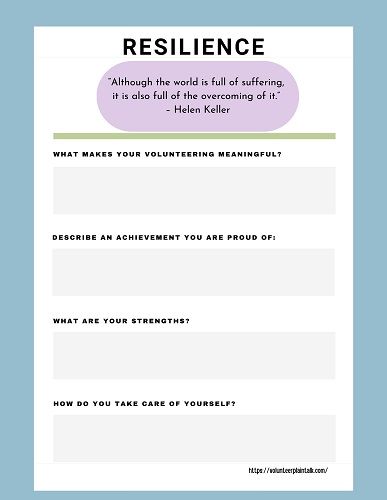
  • A Resilience Worksheet: Free Download

    Dare we ask volunteers, “how resilient are you?” Does nurturing a resilient mindset belong in volunteer meetings or in orientation? Is resilience in the face of change as crucial as policies, ethics, and the most valuable, urgent, significant, important phrase to throw at new volunteers; “by the way, we welcome donations too! And, here’s an envelope to take with you!”

    Discussing resilience and utilizing change scenarios when orienting or constructing workshops lays the groundwork for smooth change management down the road. It’s like a gift to your future self. It doesn’t matter if change is upheaval or small. Change upsets the status quo and we can nurture a “change is not the end of the world” mindset, so that when changes occur, volunteers are prepared to work through them.

    This free worksheet explores resilience and reframes this debilitating response to change: “Nothing will ever be the same.”

    page 1

    Hopefully, it will get your creative juices flowing and you will consider adding Resilience Nurturing to your volunteer mentoring.

    -Meridian

  • Volunteer Resilience

    In the last VPT podcast, Laura Rundell wisely chats about resilience, a subject we have been forced to examine in the past year. Laura asks: What is resilience? What masquerades as resilience? How do our volunteers show resilience?

    What can we learn from this year?

    We were unprepared for the magnitude of the pandemic and how it disrupted volunteerism. But, you know what? We, LoVols, deal with disruption all the time. Changes in volunteer assignments, policy tweaks, staff shuffling, new projects implemented, tasks taking precedent over other tasks, organizational restructuring, and then there’s the personal changes in volunteers’ lives that create disruption. We live in the Upheaval Hotel. (Too many volunteers answering that old add you forgot to remove in your room? I’ve got one on the 10th floor with explaining the new policy changes you might like better)

    Because volunteer resilience is key to not only surviving major disruptions, but key to surviving and thriving during more minor disruptions, we are knee-deep in encouraging resilience. Nurturing volunteer resilience is necessary, regardless of a pandemic or a change in policy. So, going forward, what can we learn from this experience?

    I recall a few years back, we had a near volunteer mutiny when a beloved staff member left in a hasty manner. It was not pretty. I was unprepared for the upheaval that followed. But through a series of dialogues, adjustments and extensive follow-ups that centered on resilience, the volunteers stayed. It proved to me that resilience is a mind-set we can help foster.

    How can we help volunteers be resilient?

    • Make change normal: Use change language and lay a foundation that says change is natural and an evolving strategy to move forward. Make the distinction from the need to adapt and pivot (change) on operational issues from the solid core values of your mission that remain foundational and say, for example, “we are adapting and learning to navigate the changes we must make to grow, but we never lose sight of our mission which is the foundation on which we operate.” Make sure volunteers know that the mission is their anchor.
    • Present change as an opportunity: Present change in a positive light by encouraging volunteers to think about opportunities such as, “now that we have to re-think our in-person services, let’s look at the opportunities to utilize different skills, find new talents.” Get volunteers to brainstorm, be part of the process. Change is received more readily when volunteers are part of the change process.
    • Connect to purpose: Offer stories of how the volunteers’ can-do attitude helps those being served. Tell volunteers how they inspire staff and clients to keep going. Use humor and inspiration as stress relief.
    • Debrief and reflect: Always elicit feedback. In change management, feedback is key to navigating change. Not once, but repeatedly, so when you hear the volunteers say, “We get it, you’re always asking how are we doing with these changes,” you’re on the right track. Reflection is a way to embrace the difficulties, to acknowledge the loss of status quo. Reflection is nonjudgmental and healing and allows for the volunteers to express their frustrations and loss. When I experienced the volunteer near mutiny, reflection gave the volunteers a space to grieve over losses without feeling judged. I learned so much by just listening to them.
    • Survivor attitude: Make surviving a badge of honor. We tell volunteers how special they are, so add surviving into that mix.
    • Introduce scenarios into training: I love scenarios because they apply knowledge to real situations. Adding a change scenario is a great way for volunteers to think about how they might act when change is inevitable and a great way to encourage resilience.
    • Admit the struggle: As a volunteer manager, you are good at being honest. Admit the “work in progress” because it’s easier to be resilient when you know everyone else is struggling to be resilient too. It’s the team mentality. We will get through this together.

    Resilience is not…

    Resilience is not forcing volunteers to accept the unreasonable without question. That’s being a door-mat. And it’s good to let volunteers know that you understand the difference between resilience and being taken advantage of and will work to make sure they are treated with respect. That way, when proper changes occur, they will likely be more resilient.

    Oh, and what about you? How’s your resilience holding up? Do you, as Laura says in the podcast, practice self-care and find joy in our profession? Do you seek out other volunteer professionals to vent to? Laura and I chat often, and I have to say, I get so much out of our chats. We’re not alone. We are strong and resilient. Finding another volunteer engagement professional to chat with, laugh with, cry with, or vent with is one of the greatest ways to steady a wobbling boat, to adjust your sails and take a moment to enjoy the journey.

    And feed your resilience.

    -Meridian

  • Hey #LoVols Reputation, Meet Our Self-Identity

    Photo by Pixabay on Pexels.com

    So, what’s next for leaders of volunteers? #WeGetToRevampEveryVolunteerRoleSoVolunteersActuallyWantToVolunteerWithUsWhatAConcept!

    Ok, maybe we should take it one step at a time. To reframe volunteer engagement and impact, we first need listeners who become supporters who then become advocates for our vision.

    Tall order, right? It’s hard enough to get anyone to listen, much less champion the ideas we are advocating for. This is where reputation comes in.

    And who will listen to us if our reputation paints us as:

    • meek and mild
    • having fun
    • doing easy stuff
    • always apologizing
    • always running around putting out fires
    • reactive versus proactive
    • unable to fill requests
    • babbling on and on about how wonderful the volunteers are
    • in charge of the fluff
    • not involved in the nitty gritty planning work
    • going along to get along

    Being known as proactive vs. reactive

    Taking control of the conversation surrounding your volunteer program begins by taking control of your reputation as the leader of volunteers. Look at it like this: Let’s say you go to a bank to open an account. Two bankers are working that day and as you wait, you listen to them talk to clients.

    A tale of two bankers, or who the heck would you trust with your money?

    One banker is animated, showing her client the various accounts available. She points to stats, but doesn’t rattle off numbers. She explains how each statistic impacts the client’s vision for financial success. She offers multiple paths to success so the client can grow their investments. She explains in detail how each account functions, their positives and their challenges and yet assures the client that with her expert guidance, financial success will come.

    Photo by Frans Van Heerden on Pexels.com

    The other banker looks harried. He fumbles through a stack of papers, dropping them on the floor and apologizes for the lack of available options. He grabs a board he obviously made himself that displays the various colors the client can choose for a checkbook cover and points to the blue one, saying “this color is really pretty, don’t you think? “

    Who would you pick? (and if you picked the banker who spent his time showing checkbook cover colors, you’re most definitely a volunteer manager who has spent a lot of time “rescuing people,” am I right?)

    Perceptions are created in the first few minutes.

    And to make matters worse, once a perception is established, people then look for signs that reinforce the perception. (We all do it BTW, which is why I always gave this one pompous marketing executive the incomplete copy of a report-cause I figured he’d never read it and I always waited for him to ask where the rest of the report was, but he never did) So, if you’re perceived as being in charge of fluff, people will notice anything that reinforces that perception. Boom, you now have a reputation because people talk.

    Establish the reputation you deserve

    Start by doing small things that produce big reputation results.

    • Speak up in meetings in an advocating way-most of us get caught off guard in situations so create a few well-crafted opening statements and memorize them. For example, “Volunteers have contributed a lot to that program and here’s how,” or “This is a great opportunity for our volunteers to contribute, let me show you how,” or “Just a reminder that our volunteers are involved in that initiative and so far, they’ve…” Opening statements make it soooooo much easier to quell any jitters about speaking up. And you know what? Pretty soon, when you open your mouth to speak, others will chime in, “yeah, we know, volunteers are contributing because….” But that’s great, because the phrases will cement themselves and your professional reputation improves.
    • explain how volunteers are having fun because you are working at making a welcoming environment for volunteers. Say, “because we don’t pay our volunteers, their reward for a job well done includes having an enjoyable atmosphere in which to work. That’s why I work hard to create fun around them.”
    • explain the work involved in engaging volunteers (see Not So Fast, Captain Obvious for more on explaining volunteer engagement)
    • NEVER, EVER apologize because a volunteer can’t fulfill an assignment (see Volunteer Managers are better than These 3 Phrases for more about re-framing apologies)
    • flip the perception which means emphasize the positive versus reacting to the negative. When staff say, “I have a last minute request, so not sure if you can get someone,” instead of saying, “I’ll try,” say “Most volunteers are willing to do last minute requests because they want to help us reach our goals.”
    • offer solutions with this caveat: we can do more with me at the planning table
    • stop going along to get along to be liked. Instead aim to be respected as a professional. Being respected has little similarity to being liked. Liked is for your friends, family, dog, hamster, hairdresser, maybe the guy who rotates your tires cause he’ll throw an oil change in for free. Respected is the professional’s goal. Respected means you accomplish stuff and do the hard things without complaint. It means you are fair, mission focused and strong.

    Know it or not, YOU are the face of your volunteer program and the perceptions of how your program is run, lies with you. It can feel overwhelming, but once you take control of the perceptions, you emerge with the reputation as… a leader of volunteers.

    I’m not saying it’s easy and I’m not saying it’s instantaneous. But it is doable.

    And besides, when have you, volunteer professionals ever backed down from a challenge? (Uh huh, thought so)

    -Meridian

  • International Volunteer Managers Day November 5: What’s Next?

    Photo by Pressmaster on Pexels.com

    International Volunteer Managers Day is tomorrow and the theme for 2020 is: What’s next?

    I’ll tell you what’s next. Change-big, big, gargantuan change, that’s what’s next. Sweeping changes, whether we initiate them by adjusting volunteer programs, or they occur naturally in spite of what we do. But changes in volunteerism have been drip, dripping in for years and the pandemic has merely loosened the change valve and allowed a wave of changes to gush in.

    Shall we get red in the face and shout?

    So, do we simply amplify our change voices?

    Should we yell in the next meeting that “volunteers need respect and true recognition, you fools, not balloons and cute sayings?” Scream over the intercom that “volunteers need meaningful roles, people” and hope that sticks? Put up posters with sayings like “volunteers are human beings, not tools,” or “the volunteer exodus is real?”

    Starting where change must first begin: with our approach to enacting change

    “If you do not change direction, you may end up where you are heading.”
    – Lao Tzu

    What is your perception of yourself? Well, that’s easy, right? Let’s see, I’m

    • hardworking
    • dedicated
    • kind
    • creative
    • forward thinking
    • humble
    • a team player
    • a believer in possibilities

    But what is your reputation (not self-identity) within your organization?

    Your self-identity may not be the same as your reputation. You know you possess all those wonderful traits, but how do you exhibit them at work? Or, could it be that (as I’ve experienced more times than I care to admit) what seems obvious is not obvious at all?

    Maybe your humility is viewed as weakness. Maybe your kindness is viewed as a lack of gumption. Maybe all of your hard work behind the scenes is not seen at all. Maybe your dedication is viewed as having fun with volunteers. Maybe your forward thinking is perceived as complaining.

    Shouting won’t change the perception of who we are and the importance of our volunteer programs

    Think about a person you respect and/or admire. When they say something you listen, right? Now think about a person you’re ambivalent about. What happens when they say something? Do you listen with the same intent? Probably not.

    Change will never happen until people want to hear what we have to say

    We can argue and advocate all we want, but if our reputation hinders us, people won’t listen deeply to understand what we are saying. And we must get through to our organizations. Why? Because volunteers are rapidly changing, irrespective of Covid’s impact, and we know that organizations must adapt to sustain volunteering.

    For years, volunteers have been changing because:

    • they look for flexibility
    • they need meaningful roles
    • they want instant access
    • they want to have say in what they do
    • they crave being told how they’ve impacted missions
    • they hate red tape
    • they demand transparency
    • they want to know more about organizational inner workings
    • they don’t feel bad about leaving for better opportunities
    • they want to be educated and more involved
    • they want to feel totally integrated
    • they want to use their skills, not be slotted into tedious roles
    • they want to create an identity within the organization
    • they want more control over their volunteering
    • they want to be on an even par with donors
    • they want to be recognized for their additional support outside of their recorded volunteer hours

    That’s a butt-load of changes, isn’t it? These changes are not new; they’ve been coming for years and now, they’re here in our laps. So, we can shout all we want, but we need listeners.

    Who are we in the nonprofit world?

    Take a moment and think about perceptions. Look at the behaviors that might create the wrong perception. Do you ever…

    • stay quiet in meetings
    • phrase your advocacy in terms such as “but, volunteers don’t want to do that.”
    • hang back so volunteers are in the spotlight
    • assume everyone sees how hard you work
    • look harried at times
    • get down or mad because no one seems to get it
    • react defensively when staff doesn’t respect volunteers
    • use phrases like, “I’m putting out fires”
    • talk about “having fun with the volunteers”
    • avoid confrontations with challenging volunteers
    • just sit back and hope for the best

    Now, remove yourself and picture a random person (let’s call her Matilda) exhibiting any of the above behaviors. What would your perception of Matilda be? What would Matilda’s reputation at work be like? Would she be thought of as a visionary, a leader, a go-getter, an innovator, a solutions gal?

    So, for International Volunteer Managers Day, the “what’s next” question for me means this: Forget for a minute all that needs to change when engaging volunteers and think about how we can make change happen.

    What needs to change is our self-identities as innovative, mission-supporting, forward thinking, visionary people must match our reputations within our organizations.

    Once we are viewed in the way we self-identify, we can successfully advocate for the changes we seek because people will listen.

    Next time: An action plan

    -Meridian

  • Do donors wear different socks than volunteers?

    Photo by The Lazy Artist Gallery on Pexels.com

    In times of chaos, the flaws in our systems become starkly visible. One such flaw is the antiquated nonprofit notion separating donors and volunteers.

    The stark Covid reality is this:

    • There aren’t enough in-person or virtual volunteer roles for people who flock to help in times of crisis
    • Volunteers who are furloughed may not all return
    • Volunteer roles may forever change
    • Increasingly, people are finding ways to help informally and are bypassing formal volunteering
    • Donations remain a nonprofit’s top priority
    • Nonprofits operate in outdated systems

    If businesses ran like nonprofits, they’d go under

    In business, it’s all about acquiring and keeping customers. In nonprofits, it’s all about acquiring and keeping donors while using volunteers.

    Imagine if a business that made wool socks (the Wooly sock company) looked at customers this way. Customers who buy yellow wool socks get the red-carpet treatment while customers who buy red wool socks are expected to work unpaid for the company. Oh, and they’re also asked to help get the yellow wool sock customers to buy more yellow wool socks.

    An acquisition team at the Wooly sock company has a huge budget devoted to enticing yellow wool sock customers to purchase more yellow wool socks. For red wool sock buyers, eh, maybe one employee (the red wool sock coordinator) is handed the role of managing those orders. Oh, and when red wool sock orders are down, the red wool sock coordinator is blamed.

    The yellow wool sock acquisition team is given the latest trainings and attends the yearly “Get More Yellow Wool Sock Customers in 10 Easy Steps” conference. Meanwhile, the red wool sock coordinator answers the phones while they are gone.

    Volunteers vs. donors

    Nonprofits hold volunteers and donors in separate and unequal groups. Sure, nonprofits hit up volunteers for money and seek ways to “engage” volunteers in opening up their wallets. But the fact that nonprofits look at volunteers as a different, magically potential source of money proves their short-sightedness in separating donors from volunteers. And why are donors treated as breakable? Why are they shielded from participating in the nitty gritty work?

    The fallacy of silos

    One day, the Wooly sock company realized that customers who bought yellow socks and customers who bought red socks were all actually customers, because someone asked for orange socks. After that day, the company successfully treated all customers alike and offered socks in a wide variety of colors.

    Because our volunteers and donors all work towards furthering nonprofit missions, they are all advocates for our organizations and causes. They may differ in varying activities at any given time, but they aren’t starkly separated or unwilling to step outside their primary role. As advocates, they accomplish much more than giving a few bucks or a few hours a week.

    What do advocates do?

    • donate money
    • recruit other advocates
    • volunteer time and skills
    • engage new advocates
    • procure in-kind donations
    • market to their circles of influence
    • care about mission success
    • support mission staff
    • share knowledge
    • bring outside opinions and trends in
    • are a pipeline to community leaders
    • bring in potential people who could benefit from services
    • raise awareness in every community corner

    Dividing mission support into siloed “donating” versus “volunteering” misses all the overlap going on. Why don’t donors receive an invite to volunteer? Why don’t volunteers get invited to the gala? Why doesn’t the marketing team collaborate with volunteer services?

    Covid has given us an opportunity to make systemic changes.

    Sock companies realize customers buy socks in all colors and so they market to all customers, not just the ones who buy one color.

    It’s time for nonprofits to realize that advocates are all people (donors, volunteers, corporate partners, community voices etc.) who step forward to help in more ways than their siloed category. It’s time to treat them equally.

    -Meridian

  • 3 Tips for Change Mgmt and Volunteer Ownership

    Like it or not, Covid means changes affecting our volunteers are inevitable. How do we manage the upheaval change brings?

    There are multitudes of theories on change management, and wading through them can be exhausting. For our purposes, here are 3 tips to help you navigate your changing landscape.

    Why are volunteers averse to change?

    Change represents uncertainty and loss. Change threatens our status quo and destroys our comfort zones. Even if the status quo is not ideal, humans cling to the known verses embracing change for a better unknown. Managing change is tough, even if the change is for the better.

    Let’s begin by assessing the volunteers. As we introduce change, what are the volunteers thinking/feeling/imagining? They may verbalize or worse, internalize:

    • “Where does this change leave me?”
    • “Does this change mean more change (upheaval) is coming?”
    • “Will my role disappear?” or “What if I’m no longer needed?”
    • “What if change is an excuse to get rid of the volunteering I love so much?”
    • “What if I can’t adapt to this change? Then what?”

    Tip 1: Involve the Volunteers

    Easier said than done, right? Especially if Covid has changed policies to reflect social distancing. There’s little to no room for volunteer input on mandatory changes. However, HOW you go about implementing change can involve your volunteers. Volunteers can set goals and brainstorm the path to achieving these goals once they understand the need to implement change.

    A large portion of change management deals with the why. Why are these changes happening? Failed change management strategies don’t adequately explain the why, which leads to push-back and ultimately mutiny. We don’t have to worry excessively about explaining the why, because a global pandemic speaks for itself which differs vastly from an organization internally revamping policies. We still must explain the why, but at least they don’t view Covid as some mean CEO who hates volunteers and just wants to get rid of them. (yeah, been down that pot-holed road a few times)

    Create focus groups or panels of volunteers to flesh out how to best implement the change. Controlling some changes helps create volunteer commitment, especially when you connect the changes to delivering mission goals.

    For example: Volunteers can no longer make in-person house visits (temporarily or permanently). You’ve already decided that in-person volunteers can substitute phone calls for the in-person visits, but don’t suggest that. Instead, ask the focus group to re-imagine ways to continue a personal touch. They may suggest Zoom or phone calls, or emailing, etc. The point is, give them the control and let them come up with the solutions instead of just telling them the alternative.

    Tip 2: We’re in this Together

    Make Covid the enemy, which means we are all in this together. Adopt verbiage that reinforces a team approach and commitment to flexible thinking (flexible thinking says, “this is not written in stone, your input is valuable to making this work”). Ditch the “I, they, them” words and use “we” verbiage such as:

    • “Together, we’ll figure this out and beat this.”
    • “The organization is on board with..”
    • “We’re all invested in our mission goals despite having this setback.”
    • “Everyone has a valuable role in achieving our goals.”
    • “We are all contributing to success.”
    • “We can’t do it without everyone’s contribution.”
    • “We’re stronger than this pandemic.”

    Change management often fails due to something as innocent as two people in authority delivering conflicting messages. Conflicting messages reinforces the “they don’t know what they’re doing” push-back and undermines volunteers’ confidence and commitment.

    Can we control messaging from other staff, volunteers and senior management? Probably not, but we can routinely ask our volunteers, “what have you heard about this change from others?” We can’t control everyone’s word choices, but we can clear up misinformation, discrepancies and bring messaging anomalies to the attention of staff and senior management.

    Make messaging clear. Ask senior management to create short, easily digested statements on any changes. For example:

    “Because of social distancing rules and guidelines, we have to consider the legal implications of letting volunteers go into homes, even with masks on, so to be on the safe side, we are putting a temporary moratorium on in home visits,” becomes “Temporarily, we are suspending in home visits.”

    Too much verbiage is not only confusing, it opens itself up to wide interpretation. Often, long explanations contain apologetic language that implies, “we’re not committed to what we’re saying, so go ahead and challenge us.” Simple, to the point sentencing ensures everyone will repeat the same message.

    Tip 3: Repeat, Check-in, Repeat

    Repeat your change message often, way more often than you think is necessary. Sounds childish, right? But studies have shown that in order for a message to stick, it needs to be repeated anywhere from 7-66 times. Work messaging into chats, meetings, phone calls and emails. Be consistent. You’re not being patronizing, you are being clear. When you hear a volunteer laughingly repeat, “I know, we’re all valuable in making this change work,” you’re on the right track.

    A change management strategy includes change duration (how long will it take to implement change). But here’s the interesting finding. In successful change management, duration of change is less of a factor than the frequency of reviews (the process of consistently reviewing change implementation). For us, that means don’t worry so much about how long it will take to implement a change, concentrate on frequent reviews for maximum success.

    And formal reviews are superior to informal reviews. What do I mean by that? The casual, “hey how’s it going with the new virtual mentoring program” as you chat on the phone with your volunteer holds no weight against a scheduled, formal review in which you go over changes by taking notes, asking questions, and reinforcing the volunteer’s importance and value in achieving change goals. Formal reviews show you’re serious about successful change implementation and you care about the volunteers’ contributions.

    Change is never easy, but we can manage it with strategies. And who is the best person to navigate a changing landscape that volunteers will get behind? You got this.

    -Meridian

    For more information on managing change, see the Harvard Business Review: The Hard Side of Change Management.

  • Becoming Volunteer to Organization (V2O)

    Let’s pretend volunteers are a type of consumer. They search for a volunteer experience that fits for them, kinda like looking for that certain shirt for the next Zoom meeting. Organizations advertise volunteer jobs in an O2V (organization to volunteer) model. Orgs basically say, “Here’s what we have to offer, take it or leave it. Go ahead, shop around, there’s nothing better out there.”

    But, social media has changed everything. Customers now can buy direct from one another in a C2C (customer to customer) model. We are seeing this shift in our sector as volunteers bypass formal volunteering and mobilize directly through social media. They’ve cut out the cumbersome organizational middle man in an new, V2V (volunteer to volunteer) model.

    But now, businesses are seeing an additional shift to a C2B (customer to business) model. In this model, customers’ value increases. Customers offer businesses talent for hire through numerous websites such as Upwork. Customers with a social media following advertise products. Customers review products online and participate in surveys and by doing so, add value by helping design the next product.

    But how would a V2O (volunteer to organization) model look? Can we adopt this growing trend or are nonprofits stuck in an archaic model that sells their volunteering experiences in a take it or leave it fashion while the world moves on?

    The point of V2O: Recognizing and embracing volunteer value.

    Demonstrating volunteer impact is one way of showing volunteer value. Embracing the additional ways volunteers add value takes us into a V2O model.

    For more on volunteer value also see:

    Older posts such as the volunteer investor or the value of a volunteer is $#.@S

    So, how do we adopt a V2O model without breaking the system?

    Soliciting Feedback:

    Encourage volunteers to review their experience. But wait, what about negative comments? Here’s the interesting thing about negative reviews. Businesses have found that negative comments do not deter customers, it’s the way businesses respond to negative comments that turn people off.

    So, that volunteer comment that states, “I didn’t like my assigned job,” becomes an opportunity for the organization to respond, “thank you for your comment and we are committed to improving volunteer roles. Let us show you other roles that may be a better fit for you.” The negative comment becomes a vehicle for the organization to advertise their dedication to working with volunteers. It’s a powerful opportunity.

    Focus Groups, Surveys and the like

    Volunteers offer diverse opinions. Many volunteered because they also benefited from mission resources and are a wealth of information on the mission experience. (see more in The Disruptive Volunteer Manager) Volunteers have a wide circle of influence and bring in breaths of fresh air from the communities we serve.

    Volunteer In-demand Talent

    Freelancing is here to stay and volunteers are moving from committed volunteering to freelancing. It’s time we sought out volunteer candidates on sites such as Linkedin. Remember the old, but true survey result that the number 1 reason people didn’t volunteer was because no one asked? Well, it’s time we paid attention by searching out the people we feel would add value and ask them to volunteer.

    Volunteer-generated content

    Volunteers are an untapped, rich source of content. In a study by TurnTo, USG (user generated content) bests traditional marketing by influencing 90% of consumer purchasing decisions. Whuh-what?

    Organizations shy away from “letting” volunteers speak on behalf of the organization. “But, we can’t control what they will say.” This iron fist clinging to the message is short-sighted. As with negative comments, organizations can quickly correct any misinformation given by a volunteer (or staff BTW-let’s not pretend staff give out correct information all the time, am I right?) on sites. By holding tight to messaging, organizations are missing the marketing content volunteers provide.

    And think about this for a minute. If a volunteer says their organization is doing good work, it’s more convincing, considering the volunteer is unpaid and not afraid of losing a job (whereas a staff member is perceived as having to be biased).

    V2O is simply embracing volunteer value in ways that sustain volunteering. As leaders of volunteers, we can move towards V2O by:

    • recording and analyzing volunteer impact
    • seeking out volunteer candidates who add value
    • soliciting volunteer opinions, testimonials, quotes, etc.
    • advocating for volunteer voices
    • streamlining volunteer onboarding
    • using volunteer focus groups to create new volunteering opportunities
    • reaching out to volunteer grassroots groups
    • partnering with fellow volunteer leaders in our communities to form coalitions that speak with one, strong voice and share volunteers, volunteer resources etc. (more in the Disruptive Volunteer Manager)

    Leaders of volunteers are tuned in to the ever-changing volunteer mindset and are adapting practices based on what today’s volunteers want. As volunteers leave the organization to volunteer (O2V) model, we can create a volunteer to organization (V2O) environment that engages modern volunteers.

    Or, we can just continue to be a V-Mart. (“go ahead, shop around, we may not have the volunteer experience you’re looking for, but nobody else does either.”)

    -Meridian