Tag: volunteer retention

  • Huggable Book of Volunteering Stats or Why a Kiddie Pool Can’t Explain the Ocean

    kiddie pool

    “Stats, reports, time management sheets, I’m sick of all of them,” Clara lamented. “None of these truly depicts my day. When I include activities for volunteer retention on my day book, the entries look so superfluous. Unless I write paragraphs as to why spending time with a volunteer is necessary to retain them, it just sounds like I’m having a coffee break all day.” Clara laughs, “sometimes I think I’m just viewed as a caffeine junkie.”

    Yes, stats,  the way we justify our actions. If you, like I, have struggled with showcasing the complex work involved with attaining, training and retaining volunteers, you feel Clara’s pain. Volunteer managers everywhere keep stats on all sorts of activities-impact, volunteer retention, volunteers trained, return on investment (ROI), clients served, events staffed, recruitment efforts, etc. We include anecdotal stories, quotes, pictures and anything else to illustrate the impact of our volunteers on organizational missions and the efforts required to support that work. (Sometimes it feels like bringing a kiddie pool filled with water to describe the ocean.)

    In a recurring fantasy, my Day book  is covered with glittery gold stars and smiley faces and called, “The Doing the Right Thing Day Book.” It is frayed and loved and cherished by the CEO because she believes in doing the right thing above immediate numbers and simplistic reports . Of course in this fantasy I’m also 30 years younger and I actually know how to catch a Pikachu, but I’m off topic here.

    So what if we could report stats that revolved around doing the right thing, even if that meant traditional reporting occasionally fell short? How would that huggable soft leather day keeper look? (Sorry, in my fantasy, the day book is paper based, ’cause you can’t hug excel)

    Here is an excerpt from Week 26 in the “Do the Right Thing” Day book:

    DAY 1 at 9AM:     Trusted my instincts to spend extra time with a 5 year volunteer whose partner has just been diagnosed with cancer. I can see he needs to take some time off and I have placed him on the inactive list thus reducing the number of active volunteers. He may or may not resume volunteering, but, due to his positive experiences volunteering so far, will remain a friend to our organization forever. I will be spending some time to check in on him periodically because I truly hope he returns to volunteering, but also, because I care about him as a person.

    Day 2 at 2PM:  Realized that a situation requiring a volunteer was overwhelming for just one volunteer so took the extra time (three days) to find and enlist the right two volunteers who could support one another while dealing with a very difficult and challenging assignment. Did not meet goal of finding a volunteer in 24 hours, but instead, created a workable solution that avoided one of our excellent volunteers becoming embroiled in a difficult situation, thus retaining two good volunteers for the future and ensuring our client received excellent care.

    Day 3 at 11AM: Temporarily removed a marketing volunteer from staffing events because of recent health challenges. Although volunteer insists that he is physically able to carry boxes, his wife informed me that his doctor has prescribed no lifting or standing for three months. As a result, I reduced the number of available marketing volunteers but salvaged this volunteer’s future potential and eliminated the substantial risk for a workman’s comp situation should this volunteer injure himself while under his doctor’s orders. More importantly, we sent a message to all volunteers that their health and well-being is important to us and we view them as valuable assets. 

    Day 4 at 3:15pm: Spent 45 minutes with a prospective volunteer who admittedly can’t volunteer until sometime next year. This prospective volunteer’s father was helped by our organization and she is interested in giving back, although current commitments are preventing her from taking training. I have set reminders in my calendar for scheduled contact with her throughout the year as I perceived her as an excellent future volunteer. Rushing her at this time will only increase her overload of responsibilities and will cause her to quickly quit. As a result, no new volunteer stat has increased but time spent will pay off in future because this potential volunteer also belongs to several key civic groups that I have been recruiting.

    Day 5 at 6pmAttended funeral of long-term volunteer who retired due to health reasons more than two years ago. No stat will be affected, but please folks, this is the right thing to do.

    When you think about it, this fantasy Day Book is really a book about trust-trust that volunteer managers everywhere know how to spend their time wisely. VM’s know what to do and how to do it in order to ensure a volunteer program built on excellence, not just for the present, but for the future as well.

    If Executive Directors and CEO’s would just trust their volunteer managers to do the right thing, then stats will fluctuate at times, but will also naturally increase due to the good and hard work put into a volunteer program.

    It’s a huggable fantasy, isn’t it?

    -Meridian


  • Volunteering Ointment While the Wound Heals


    eagle

    I was reading this article on how volunteering helped a volunteer through her grief and it gave me this warm, familiar feeling, like the cracked and stained coffee cup I reach for every morning. It makes me think of all the volunteers with a story similar to this young woman’s who have applied volunteering as an ointment of sorts on their wounds while they heal.

    I think of Paul, whose beloved wife died so young. His gaping open grief was covered by a thin bandage of keeping busy. Helping others, focusing on someone else’s pain and being surrounded by kind people allowed him a chance to slather on the soothing volunteering ointment each time he came. And he stayed for almost ten years as the  ointment became less necessary, but more of a routine that he was used to and so so good at.

    I think of Judy, whose loss was long ago, but unresolved and ever fresh, who talked about the death of her son as though it had happened twenty minutes before. I think of how she instinctively avoided working with any clients, as though she knew her rawness would just get in the way. But while volunteering behind the scenes, she smeared herself in the listening ears of ever patient staff and volunteers who heard her pain and with encouragement, Judy sought out grief counseling.

    I think of Claire, who had been let go from a long-term and secure job. Her wound was to her psyche, and her face showed the lines of deep self-doubt. Every skill she possessed was slashed open, and each job rejection opened her wound again and again. Claire sought out volunteering like a lost pet who puts its nose against a stranger’s patio door in desperation. Her feelings of worth grew very slowly, but steadily until she shook the mantle of worthlessness and viewed each job rejection as a sign of the times. Eventually she gained employment and was more prepared to walk into her new place with confidence on the mend.

    It’s ironic, because each one of these volunteers was not “retained.” Each one of these “wounded healers” used volunteering as salve while delivering extraordinary work to the organizations they served.

    But they did not stay forever. Their retention lasted as long as the ointment helped them to heal enough that they did not need us anymore. Yes, they left not because we did not need them anymore but because they did not need us anymore.

    And just as we celebrate the release of a rehabilitated injured bird back into the wild, we can celebrate the fact that these volunteers were ready to fly. And we can take some solace in the fact that volunteering helped these wonderful hurting people begin to heal.

    So, should we continue to say that volunteer retention is our end game?  I don’t think so, because personally, I’ll take a soul on the mend over retention any day.

    -Meridian

  • The Conversation We Dread: Pain or Opportunity?

    The_Scream
    Or, in reality, “The Horrible, No-Good, Very Bad, Completely Upsetting, “Don’t Make Me Do It,” “I Think I’m Going to Be Sick” Day. Yes, that should pretty much cover it.

    Having that conversation with a volunteer-you know the one, the one where you have to discuss a complaint during that mean chat that will forever label you a terrible, cold person for hurting the helpless volunteer. You may as well burn the volunteer’s house down too while you’re at it-that’s how soul-less you are.

    So, how do we start a difficult conversation with a volunteer after a complaint has been made? And how do we prepare ourselves to have the confidence to do the right thing without melting down into mush? For what it’s worth, here are a few suggestions that I hope help you.

    Remember that you are the best person for this challenge: You have recruited and cultivated this volunteer. You care about them and will do what is necessary to see them succeed. And leaving them to fail is ultimately more cruel than helping them remain on track. Tip: Keep reminding yourself that clearing the air and guiding a volunteer is a growing experience for all of you and you will get through this.

    Practice your opening line: “I wanted to sit down with you today and chat about how things are going,” is fine, but volunteers really need us to get to the point. The more you dance around the topic, the more uncomfortable it becomes for you and the volunteer. It’s better if you nicely state the complaint up front. “Emma, I wanted to meet with you today, because one of the visitors to our museum called us to say that last Friday you were too busy to show their disabled son where the bathroom was located. You are one of our finest docents and have been for over five years now and I want to hear your side of the story. Do you recall this particular incident?” Tip: Tell yourself to use the exact words of the complaint-don’t water them down because the volunteer deserves the opportunity to respond to the exact charges that were brought.

    Don’t apologize for the conversation: Starting out with “I’m so sorry to call you in for this,” or “I hate that we have to talk about this” creates the impression that your organization’s ethical standards are meaningless. Tip: Tell yourself that being neutral, not apologetic helps the volunteer think and respond more clearly.

    Assure the volunteer that you are open-minded and fair but don’t put words in their mouth: “Emma, we want to hear your side of the story,” or, “Emma, let’s talk about what happened,” is better than saying, “I’m sure the complaint is unfounded,” or “this must be a misunderstanding.” Tip: Tell yourself that if the complaint is indeed a misunderstanding, then it will surely become obvious and not to worry. If the complaint is well founded, then you have an amazing opportunity to help this volunteer regain their footing.

    Don’t diminish the person(s) who made the complaint: Saying, “don’t worry, this person complains about everyone,” or “they probably just had a bad day,” negates the actual complaint. Tip: Tell yourself that bridging relationships is one of your strong skill sets and seeing both sides validated is a chance to bring both sides together.

    Allow ample time for discussion: Here is the area in which you will excel at nice-guy volunteer management. These conversations ebb and flow-but the savvy volunteer manager rides the spoken waves with the recurring message that the volunteer’s time and effort is invaluable and their concerns are worth hearing and discussing, even if their actions are in the wrong. Tip: Trust your instincts to tell you when you know the volunteer is satisfied that their feelings, opinions and aspirations are validated. That is when you can move forward with a resolution.

    Follow up with diligence: This step takes you from a manager to a leader. Speak with both parties after your initial conversation to ensure that the resolution works for both and that there are no lingering issues. Tip: Use your best mediation skills to assure both parties that your goal is to provide the finest volunteer involvement possible and that you believe in each person. Keep following up periodically until you see the resolution has been met.

    We can view difficult conversations in the same way we view traveling to a new place. We can tell ourselves that we will hate the new place by thinking things like “It’s going to be too hot,” “I will hate the food,” “the people are too strange,” etc. That usually becomes a self fulfilling prophecy. Or, like the person who welcomes traveling somewhere out of the comfort zone,  we can entertain the idea that this new experience will help us grow, both as a manager and leader.

    Choosing to grow and embrace challenging conversations will strengthen not only your program, but yourself as well. So, while it is perfectly normal to dread a difficult conversation, don’t let the opportunity to excel go to waste.

    You’re not the bad guy, you’re the leader.

    -Meridian


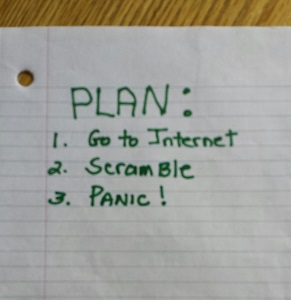
  • May I “Trouble” You For a Plan?

    plan
    “There was something about Jules,” Jake recalled, “something just off. She didn’t seem to connect with the program nor with other staff and volunteers. She never looked me in the eye. She made off the wall comments to other volunteers.She even started to call me after hours with odd requests about volunteering; for example, she called me one Sunday night to see if it would be okay to bake doggie cookies to bring to any staff that owned dogs . Frankly, I had an uncomfortable feeling about her but had no idea what to do about it because she passed our background check.”

    Oh boy. We deal with all types of people who are potential volunteers. And unless we are conducting clinical psychological testing sessions with each one, we have to pretty much trust our instincts and judgement when working with volunteers who set off that gnawing gut feeling that something is just “off.”

    But. on the flip side, we also walk alongside some pretty amazing people who might be going through common personal issues that render them sensitive such as:

    Loneliness/Socially ostracized

    Grief/Loss of job/Loss of home/Loss of identity

    Illness/Caregiving

    So, if the overwhelming majority of volunteers are wonderful, then isn’t it overkill to treat every volunteer as potentially snapping? On the other hand, do we blissfully think we can fix everyone’s challenges by our cheery encouragement? Or is there a professional medium?

    I recall a brand new volunteer, Kristof, who had a very strong, almost in your face personality. He passed all background checks. He said the right things in training. But a long-term volunteer, Jim, who was a fellow member of a club Kristof belonged to, told me in confidence that Kristof had threatened to hit a fellow club member.

    Now what do we do with second-hand knowledge? Could I hold that against Kristof? Was he a violent man? I hadn’t witnessed violent behavior, but proactively,  I assigned Kristof to a seasoned, mentoring volunteer. Also, in the agreement that Kristof and all other new volunteers signed, it stated that he was under a six month probationary period during which he would be evaluated and could be terminated at any time for rule violation, including threatening or inappropriate behavior.

    Sure enough, after about three weeks, one of the mentoring volunteers came to me and said that Kristof had made a threatening gesture towards him. It seems that Kristof did not appreciate being told that he could not go and do whatever he wanted.

    So, I called the head of security, Charles and asked him to accompany me and a senior manager in a meeting with Kristof. Thank goodness for Charles. He stood like a statue in the closed doorway, saying nothing, but speaking volumes about our seriousness. I talked with Kristof about the presumed threat. He got angry and said to me, “I see what this is about. I know what you are doing.” I reiterated our policy and he looked at Charles. “I don’t want to be here anyway,” he said. “I quit.”

    We walk a fine line here. Being proactive with volunteers prevents surprises and even tragedy down the line. Here are a few things to keep in mind when those little red flags start to flutter before your eyes:

    1. Be aware and monitor-enlist trusted volunteer mentors to help monitor all new volunteers
    2. Have expectations and rules written out and signed by each volunteer
    3. Put probationary periods in place for all new volunteers
    4. Never counsel volunteers alone
    5. Involve security if necessary
    6. Document all “red flag” behavior
    7. Create a step by step procedure to address situations before one arises
    8. Script a conversation that is neutral, professional yet firm
    9. Involve appropriate staff members within the organization
    10. Know risk management assessments, volunteer rights and legal pitfalls

    While volunteer managers excel at coaching, inspiring, mentoring and cultivating volunteers, we cannot stick our heads in the sand. Nice people and nice organizations can sadly sometimes be a place that feels right for folks with less than honorable intentions.

    Was Jake wise to be concerned about Jules? Yes, because he trusted his instinctive ability to lead. With his heightened awareness, he could then proceed to monitor and/or cultivate Jules’ volunteering. Having a plan in place to act quickly and professionally does not mean that you are suspicious of everyone and everything. It just means that you are prepared to handle difficult situations should they arise. And you are prepared to be a leader.

    -Meridian


  • But What Are The Values?

    light switch
    When Amar answered the ad for a volunteer coordinator, he was certain that he could fulfill the stated requirements. “It was pretty straightforward,” he said, “and although I had not managed volunteers previously, I did have experience in non-profit work. So, I applied and was hired. I worked there for four years, and now, when looking back at that recruitment ad, I wonder why they included along with all the skills required, the phrase, ‘and uphold the values of the organization’. In retrospect, I left that job because I came to really wonder what their values were.”

    Amar continued, “our mission was very clear. Our service delivery was excellent. Recruiting and training volunteers was going well and I felt that their contributions were generally regarded as meaningful. But internally, our organization was a mess. People routinely stabbed one another in the back. The CEO practiced rampant favoritism, set exclusionary rules and so morale was pitifully low, even though everyone worked hard at their jobs. It was as if our organization had a community face for our recipients, donors and general public and then behind closed doors, this dark side emerged. I began to wonder which face was actually the real face of the organization and what really were the values. Fairness? Not that I saw. Inspiration? No, staff was pretty much left to find inspiration where they could. It became a place where you took pride in your work, although you hated coming to work.”

    Can those of us who work in the non-profit world turn our kindness off and on? Can our volunteers also turn it off and on? If we treat clients with tenderness while treating other staff or volunteers with disdain, is it truly genuine? I often wondered that when working with a few volunteers who had a nasty side. I wondered, “how can honest kindness be selective?”

    Amar left his job and found another one. “I walked into a new place that did not speak openly about their values, but instead, showed them daily. Staff was genuinely kind and supportive of each other. Volunteers responded in that atmosphere and accomplished so many amazing things. I took a pay cut, but could not be happier. A value based organization that lives their values is far more rewarding than a larger paycheck accompanied by the stress of working with mean-spirited people.”

    Mahatma Gandhi once said,  “The greatness of a nation can be judged by the way its animals are treated.” That makes me wonder if  the greatness of an organization can be judged by the way everyone within and without is treated, including its staff, volunteers, the delivery people, visitors, the repairmen or even someone who wanders in off the street.

    Is a culture of kindness so thin that it is able to be turned on and off? If so, then it’s a veil and not really a culture, isn’t it?

    -Meridian

  • See, Hear, Then Feel

    fingertips
    “I walked into this position without any experience,” says Miriam, a tiny freckled redhead with sea blue glasses. “I had no idea what to expect since I had never worked with volunteers before. My supervisor told me to come in with a purpose, to take charge. They gave me a volunteer manual so that I could train new volunteers and a list of rules.” Miriam sighed. “No one encouraged me to listen to the existing volunteers, to hear their stories, to get their history. Actually, a couple of long-term volunteers wanted me to shadow them, to see what it is they do but I felt like my manager wanted me to establish the program without too much volunteer input. For whatever reason, I didn’t shadow those volunteers and now I think I regret that.”

    Oh boy. Walking into an established program is tough. How do you meet the expectations of the organization yet give power to the volunteers? How much weight do you give to how things were done before? How much immediate control do you need to establish? Is there a happy medium?

    I remember the day I walked into an established program. I was scared because I had no idea how the volunteers did what they did. How can someone who knows nothing, tell them how to volunteer? How could I train new volunteers with no idea of what it was like?

    Fortunately, a lifesaver named Mary took pity on me. Mary had been volunteering for some time and she saw how lost I was and because, luckily she wanted me and the program to succeed, she burst into the office one day and took my arm. “C’mon,” she said, “I want to take you with me to meet my hospice patient.”

    She drove me to this nondescript house. Mary explained, “the caregiver is a neighbor who took the patient into her home after the patient’s husband died. They had no children.” We knocked and entered the modest home which to me, felt like a labyrinth of secrets and unknown societies. The patient, Emma, a child’s smile touching the corners of her lips, watched as Mary greeted her caregiver and neighbor, Francine. I was introduced to both and I folded myself inconspicuously into a corner to observe. Francine, who was going out on errands while we sat with Emma, whirled around the living room, searching for keys, lists of groceries, and gathering papers to drop at the bank. Mary’s visit was her once a week chance to get her errands done. With a manic intensity, Francine showed Mary where everything she could possibly need was located, all the while assuring us that she would return as quickly as possible. There was this wild energy in the room. I couldn’t look away from the enormous responsibility of Francine.

    But then I watched calm Mary, who had been gently stroking Emma’s hand while steadily gazing into her eyes. “Just a moment,” Mary said to her as she got up from Emma’s side. She walked over to Francine who had just checked her purse again and was opening the door to leave, still mumbling over and over that she wouldn’t be gone long. Mary gently wrapped her arm around Francine’s shoulders and said, “you are doing a remarkable job. We can all see how difficult this is and you are doing it with grace. You need to know what a blessing you are to Emma.”

    And then it happened. I heard the catch in Francine’s voice. I saw her shoulders rise and her expression change. I felt the waves of encouragement wash over her. I experienced the renewal she felt.
    And in that brief moment, in that tiny living room, Mary opened up the world of volunteering to me.

    Being able to connect with our volunteers as they change the lives of those we serve is a precious gift. The moments we are privileged to witness inspire us, teach us and equip us to enlist others in important work.

    Our volunteers are teachers too. From them we learn to see, to hear and to feel. And then, armed with those gifts in our fingertips, we can put our rules and expectations in place.

    -Meridian

  • when a question is not a question

    Photo by Pixabay on Pexels.com

    “So, are we supposed to come back tomorrow for more in-depth training?” Doris asked Mikki, the volunteer coordinator.

    “Um, no,” Mikki returned, puzzled at the question. “I’m sorry if I gave that impression. Today is the only day of training, at least in the beginning. We will be interviewing each one of you for your assignment next week. Is that ok?”

    “Hmmm,” Doris said and paused. “I suppose so.”

    Down the road, volunteer manager Don stopped in the hallway to chat with Jeremy, a volunteer. “I have five of our best volunteers lined up for the event next week,” he said, proudly, “including you. I am just awaiting instructions as to start time and assignments. Jeremy shifted and asked Don, “is your volunteer Chad one of the ones who will be there?”

    “Yes, actually he is,” Don answered. “Is that a problem?”

    “Just wondering,” Jeremy said after a moment and then he shrugged his shoulders.

    Occasionally we are faced with statements concealed within questions and often these statements are thinly veiled criticisms. And since it is difficult to respond to a question with anything but an answer, you end up defending something you didn’t know you needed to defend in the first place.

    I remember a volunteer Gladys, who threw these “critiquestions” like a pitcher striking out a string of batters. “Are you planning on giving that assignment to Hershel?” she’d ask, one eyebrow arching skywards in lofty judgment. “Is that the wording in the letter you are sending to all the volunteers?”

    Being on the defensive is not the best position for volunteer managers. It is not ideal, defending every decision made, whether it is yours or your organizations’. Volunteers do have a right to know why decisions are made, but a barrage of constant critiques is counter productive. We want to keep our volunteers from becoming embroiled in organizational politics so we don’t share any political reasons for our actions. We also want them to experience the mission in its purest form, so explaining the nuances of policy is an art form in itself.

    Dismissive phrases such as “I don’t make the rules, it’s just the way it is,” or “I agree, that policy is stupid but we are stuck with it,” doesn’t help the volunteer and actually encourages them to ramp up their criticisms. We can certainly hear their concerns while encouraging them to work within the system . “I understand your criticism, but here is the reasoning behind this policy or decision.”

    Not every volunteer will agree with your style of managing volunteers, or your system for reporting hours or your training methods or your assignments. Heck, there will be volunteers who dislike you personally from the start. This hurts, I know.

    But we’re not here to be liked by every volunteer who crosses paths with us. It would be nice, but it is unrealistic. Instead, we are creating an atmosphere in which volunteers feel connected to the work. So, for those volunteers who are overly nit picky and critical, the question becomes: How are they connected to their work? Are they deriving meaning out of helping, or are they deriving meaning out of the feeling they get when criticizing?

    And, if hyper critical volunteers, like Gladys are hard-working, efficient, reliable folks, you may find yourself overlooking their prickly questions. You may just turn a blind eye to their not so subtle barbs and tell yourself, “oh, it’s ok, I’ll put up with it because frankly, I need the help.”

    There’s a few ways to deflect these critiquestions so that it does not become the permanent way a volunteer interacts with you. Here are three I’ve used:

    Sincere honesty: “I’m noticing a tone of disapproval in your question. Can you tell me what you mean by that?”

    Reverse the power: “Hmm, why would you ask me that?”

    Humor: “C’mon, you know that everything we do makes no sense. That’s why I love working here!” Granted, this is flippant and doesn’t address the underlying behavior, but sometimes, I just needed to laugh.

    The point is, negative patterns often become established. Volunteer managers, being savvy leaders, can discourage a nit-picking pattern from forming by managing negativity head-on, having those difficult conversations and redirecting volunteers to the joy in mission work.

    And, the next time you get a question that isn’t really a question, acknowledge the criticism buried just below the surface. Dig it out and keep it from growing too big.

    -Meridian

  • Above and Beyond or Off the Rails?

    derailed train

    While attending a recent staff meeting, Beth, the volunteer coordinator for a mid-sized hospital, took note of the meeting tone. “It was really interesting to watch,” she said, “because there was this staff member who was singled out for going above and beyond. He’s a social worker who bought food for a patient’s family and delivered it to their home. The CEO spoke glowingly of the social worker’s commitment to helping our patients. And while I applaud him for his creative way to do his job, I mentally compared his actions to our code of conduct. According to the code, he broke the rules. It made me wonder what or who the rules are for and for those of us who follow the rules, are we just mediocre employees? And how do I set rules for our volunteers when we applaud behavior that oversteps boundaries?”

    Hmm, that is a paradox and begs the question: How do we encourage volunteers to be creative, innovative, flexible, imaginative, out of the box thinkers without simultaneously giving them the go ahead to break all rules?

    “I had that experience,” said Craig, a volunteer manager at a museum. “We had this volunteer, Bethany, who put in a lot of hours behind the scenes. She was a dynamo with lots of ideas who was encouraged to create new programs by the staff that worked with her. So one day, we all were shocked to learn that she had her own social media account that she presented as an official arm of our museum. Bethany was dispensing all types of misinformation and asking for donations on her own. It was a horrible mess and I was blamed for not over seeing her more closely. She was dismissed and I became kind of “gun-shy” with the rest of our volunteers.” Craig paused. “While I still want to see our volunteers take initiative, I don’t want another Bethany. I don’t want them to think that the sky’s the limit. I mean, none of us has that kind of carte blanche.”

    There’s a teeny tiny thin line between volunteers taking initiative and being called up before the executive director because a volunteer started their own slush fund. Ultimately, we are often blamed for any volunteer who goes off our rails. So what are the ways that volunteers might bend the rules?  I’m betting you’ve experienced these scenarios:

    A volunteer argues with you because he finds a rule inhibiting and wants you to look the other way. He argues that the rule is stupid and gives you examples as to how it was never meant to be followed.

    A volunteer creates programs or initiatives on her own, utilizing your organization’s name. She is convinced that your organization is just being stubborn by refusing to incorporate her “Walk Across America” fundraiser.

    A long term volunteer seldom checks in, and is very cagey about his duties. Staff doesn’t really know what he is doing in client’s homes either. He waves off any inquiries by asking, “Don’t you trust me?”

    On the other hand though, you’ve probably experienced these scenarios as well:

    A volunteer brings in a fabulous idea and would like to implement it. This volunteer is one of your best, on time, committed, transparent and reasonable.

    A new volunteer has an unusual skill that triggers creative thoughts in your head.

    A volunteer has experience in an area that you know would enhance your mission and you’ve read about other similar organizations successfully utilizing these types of volunteers.

    This conundrum has been referred to in the Human Resources world as the “Initiative Paradox”.  We too, often are faced with the paradox of encouraging inventiveness while trying to remain rule bound. So, how can we reasonably advance creativity? It all boils down to communication and due diligence on our part. In other words, a big heap of extra work for us.

    Volunteers who are not willing to properly report on their creative endeavors should send up a huge red flag. Any volunteer who dismisses your need to know or tries to make you feel like a busy body is not a volunteer who plays by the rules. You are after all, the volunteer’s supervisor and you must keep abreast of their actions, provide direction and feedback while doing all your other tasks.

    Communication goes two ways. When we honestly communicate with our volunteers and tell them why they can’t move a client into their home, we are not only considerate of their feelings, we reinforce their importance as a team member. We can then guide them to remaining a meaningful help to their client while keeping boundaries and everyone’s sanity intact.

    Our volunteers bring a wealth of talent, skills and ingenuity to our organizations. With two-way communication,  due diligence, and a heap load of old fashioned extra work, our volunteers’ creative  initiatives will flourish.

    -Meridian


    Francesca Gino, coauthor with Dan Ariely of Duke University, describes part of the study in Psychology Today: Inducing a “casual” mindset, with cues that encouraged flexibitlity—with words like original, novel, and imaginative—increased the odds of cheating at a game.

  • Happy Volunteer Appreciation Week!

    gears

    Well, it’s hump day for volunteer appreciation week and as everyone who manages volunteers knows, it is a wonderful, hopeful, stressful, physically and mentally exhausting, go without much sleep week.

    Behind the scenes, volunteer leaders everywhere are working long hours so that every volunteer receives the recognition they deserve. If you wear a wristwatch, take a good look at it. This is you: On the outside, the good old watch reliably tells you whether it’s exactly the time to phone Virginia, the volunteer who left you a voicemail to call her this morning at preciously 10am, because after that, she is unavailable. (And she means it, you’ve discovered from having called her five minutes after her specified time on another occasion).

    But back to the clock. On the inside, all these gears and wheels are spinning their little metal hearts out, interlocking with one another in a never sleep mode that makes the reliable watch look so simple on the outside. That is you, the volunteer manager.

    So, this week, think about these outward results created by your inner spinning gears:

    When your volunteers are pleased with all the glittery stars hung everywhere, it’s due to you enlisting your family in a “family craft day” of cutting and glueing glitter on one hundred stars. (Note to self, glitter will never come out of tweed furniture and the statement “I’ll make it up to you” will cost you dearly one day).

    When the volunteers are swooning over the delicious home-made cupcakes, it’s due to you staying up until 2am to learn through YouTube how to make each cupcake look like a trophy. (Note to self, pick a round object next year).

    When the volunteers see the huge cardboard card signed by all the staff, it’s due to you chasing everyone down for weeks in advance. You even went so far as to show up at staff member Fred’s door because he was home recuperating from a bout of H1N1 flu. (Note to self, keep masks in the car, just in case).

    When the volunteers are snapping pictures by the “Tree of Thank Yous” in the common room, complete with a variety of leaves sprouting sayings of gratitude, it’s due to you gathering leaves of all types from local forests and parks on your weekends when you should have been helping your daughter do her homework or your significant other clean the gutters. (Note to self, poison oak is itchy as heck and the offending oils need to be scrubbed out from under the skin).

    When the volunteers are all abuzz about that mention on the local radio program, it’s due to you stalking the morning drive radio host all over town trying to get just a moment of his time. When you finally accosted him outside the gym he attends, you mumbled something about “volunteer power”, but somehow he agreed to give a shout out to your volunteers, and even though he mispronounced your organization’s name, it was a win-win. (Note to self, inform marketing of any publicity requests you make because they are not happy that the morning drive guy said “The Sleeze Organization” instead of “The Seize Organization.”).

    When volunteer Joyce feels special because she got a hand delivered invitation that somehow the post office lost (wink wink), it’s due to you finding the unfinished address labels in the desk drawer. You called everyone on that list just to be sure and made up some lame story about the invites being lost but you couldn’t get through to Joyce’s voicemail so you drove 30 miles out there because just last week, Joyce was gently reprimanded by a staff member and Joyce is very sensitive and somehow you just knew that if she didn’t get this invite, she would feel completely unwanted and so you went after work when you had this great dinner date set up and instead you ate a cold burger on the way and dropped mustard on your brand new cream colored shirt.                                                                                       (Note to self, uhhhhhhhhhhhhhhhhhhhhhhhhhhhhhhhhhhhhhhhhhhhhhhhhh, nope I have nothing).

    There you have it-you are the watches of the world of volunteering, the reliable, always working, always the main spring of motion that makes a volunteer feel connected and appreciated.

    Happy Volunteer Appreciation Week to all the wonderful volunteers!

    And to all the volunteer managers out there who work their gears off to make sure the volunteers are appreciated?

    It’s 5 o’clock somewhere. A nice Chardonnay or a good pint of Lager or cup of tea is waiting for you on Friday!

    -Meridian