Category: recruitment

  • Director of First Impressions Volunteer

    director-of-first-impressions

    Director of First Impressions Volunteer: Wow. What a concise, succinct way to advertise for a front desk or receptionist volunteer. The ad then goes on to talk about how important it is for clients to experience a first impression that is compassionate and helpful. Gosh, I want to be that volunteer.

    So, what verbiage appeals to prospective volunteers? Is it silly, eye-catching titles or serious, touching the heart ads that bring volunteers in? And does the same ad appeal to millennials and baby boomers, working adults and students, community service needing and weekend warrior potential volunteers alike? And anyway, are there foolproof ads that once you’ve created them, you can then just magically sit back and answer the ringing phone?”

    Clearly, marketing has a tremendous impact on companies that sell goods and services. If we think of ourselves as selling goods (enhanced life experiences) and services (ways to help the community), then we can think of our potential volunteers as consumers who can pick and choose where they will spend their valuable time. So, how do we market to them?

    Here are just three creative ways to frame a volunteer ad:
    1. Describe the benefit to the organization.
    2. Describe the benefit to the client served.
    3. Describe the benefit for the volunteer.

    So, let’s take a simple job title such as “volunteer receptionist” and re-imagine it in the above three ways:

    “Director of First Impressions:” The word ‘director’ exudes importance, and ‘first impressions’ neatly describes how this organization genuinely cares for their clients and is striving for excellence with every paid and/or volunteer position.

    “Imagine How Hard It Is To Need Our Help:” This immediately frames the position in the eyes of the client and elicits an empathetic feeling for those who are being served.

    “Where Else Can You Feel Like You Have Thrown Out a Lifeline:” This ad goes right to the heart of volunteerism-making a difference.

    And what law says we can’t use all three ads for one position at the same time? Who knows which approach will attract the kind of person you are looking for because ads exist to quickly capture attention. All three ring true; they are just different ways of framing meaningful volunteer roles in punchy descriptions. If you can combine all three ways without becoming too verbose, then by all means, give it a go.
    But can we even go further and be even more creative?  Why can’t we inject some playfulness? How about an ad that asks, “What Intergallactic Volunteer Character Are You?” (Or another current and popular theme). Create a description for a few popular characters, such as:
    The Scavenger Captain: You’re roguish and free wheeling, this job is flexible. We won’t tie you down!
    The Robot Sidekick: You’re diplomatic and precise, this job needs your attention to detail.
    The Galaxy Princess: You’re strong and smart and destined to lead our rebellion against hunger.

    Want to advertise for a thrift store volunteer? How about “Are You the First One at Garage Sales? Come, Help Sort Through Our Treasures Where It’s A Garage Sale Everyday.”

    Do you need something very specific? Celebrate it! Web help might become, “If You Know What This Is, Call Us: 01101000 01100101 01101100 01110000.”

    There are catchy volunteer ads out there that say, “show off your basketball skills,” “do you love cats and acting,” “do you walk by homeless people not knowing what to do,” “be the role model she’ll remember always,” “50% of school age children in our town go to bed hungry.” A few great ads tell a personal story: “Meet Ed. He will sit alone in his room today unless a volunteer comes to visit. Will you be that volunteer?” “Sarah received a scholarship in part because she volunteered. If you can you use a scholarship, call us!”

    Do you have multiple locations? Tack the location onto the ad so that potential volunteers know they can stay close to home or work or school. You can say, “Be the Role Model She’ll Always Remember in Springfield” or “Calling All You Bristolians Who Dress Up Their Dogs.”

    And if your program has won an award or has been feted in any way, use that to your advantage: “Join our award-winning volunteer program!”

    Refresh your ads frequently. Keep statistics on the more successful ads so that you can start to track what is working and for whom it is working.

    You can also put together a focus group of volunteers to come up with creative ads that they believe will appeal to their peers. Marketing students are also an excellent resource for help in crafting creative and appealing ads.

    Well, then, how can we jazz up that soul-sucking Data Entry Volunteer ad? (and you know what always surprised me, there are people who want to do this kind of volunteering because it’s sort of like washing dishes by hand, it gives them a chance to just quiet the mind).

    “Monotonous, Repetitious Data Entry Volunteer Job For That Amazing Person Who Knows This Work is Critical.  Help Our Clients While Decompressing in a Calm Environment. We’ll Play Some New Age Music.”

    -Meridian
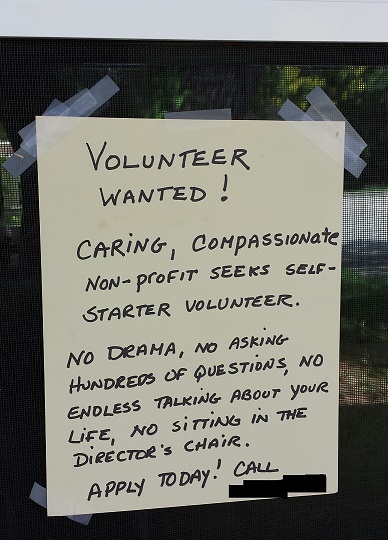
  • Caring Volunteer Wanted: Well, Duh!


    caring-volunteer-wanted

    Every day, potential volunteers peruse volunteer want ads. What do they find? Are they intrigued? Do they dial us up immediately, hoping to not miss the wonderful opportunity we offer? Or do they thumb through ad after ad that says basically the same tired thing?

    According to research, the science of naming brands is so much more than just descriptive words. Research and real thought goes into names that resonate with consumers. Clever word coinage, rhymes that fall off your tongue and words that sound like the actual word (think fizz) all play into the careful selection of names. Maybe it’s time we borrowed some of that science and applied it to volunteer recruitment ads.

    So what if we rename some common volunteer wanted ad titles, using techniques from this science, such as rhyming words, onomatopoeia, alliteration, and coining words. Here are just a few straight forward volunteer job titles reimagined.

    Office volunteer:  Shredding Goddess; Tasktastic Volunteer; Phone Joan; Receptionista; File Jockey; Scanning Scientist; Gossip Ignoring Go-Getter.

    Volunteer Driver: Go-fer Chauffeur; Transporter Supporter;  Joyager; Food Trucker; The Dean of Clean Driving Records.

    Marketing/Fundraising Volunteer: Money-Honey; Goods Grabber; Shake-Down Shirley; Bucks Buckaroo.

    Events Volunteer: Darling of Developement; A Party Hardy; Our Gala Girl; Work Till You Drop Wonk; Jamboreally Need You.

    Volunteer Recruiter: Captain of Coercion; Rope ‘Em In Randy; Soul-Snagger; Goodie Two Shoes Gatherer; Codger-Finder; Tenderfoot Tender.

    Thumbing through volunteer recruitment ads pretending to be a prospective volunteer looking for potential opportunities can give us a sense of what is and is not appealing. What ad stands out and is at least worth exploring further?

    While ad titles such as Program Volunteer, Marketing Assistant, Resource Specialist and the soul-sucking Dracula of all ad titles, Data Entry Volunteer may accurately describe the positions, they lack the enthusiasm and meaning that volunteers wish to experience by spending their precious time with us.

    Other outdated, but somewhat descriptive ad titles such as “Caring Volunteer;” “Hold a Hand;” “Make a Difference; “Become a Mentor;” “Friendly Visitor;” can feel like they were written with a chisel on stone and a potential volunteer may just pass them up because they are so “yesterday.” Recruitment ads written once and left up on social media sites gather more dust than my speech written in case I am employee of the year.

    Or how about these dusty goodies: “Buddy;” Bring Your Smile; “Inspire Youth.” Picture paging through volunteer ad after volunteer ad that basically heralds the same vague thing no matter what or where the volunteering position.

    Writing volunteer ads is passive recruitment and sadly quite often overlooked. Passive recruitment means that the ads we post keep working for us while we are out talking to civic groups or sitting at community fairs or having lunch. That is why spending time and energy on writing these ads and regularly refreshing them is one of the smartest things we can do.

    Picture a student, late at night, smart phone in hand, swiping through ads that will enforce their desire to be a change maker. Or picture a retired senior, recently widowed, searching in the still morning for something that will add meaning to a bruised soul. Or a working parent, sneaking a peek at ads while helping with homework, looking to spend some me time helping others. What will speak to each one of them?

    Volunteer recruitment ads should be working every bit as hard as you do.

    -Meridian

    Next time:  A volunteer ad that says it all and 3 ways to re-imagine volunteer ads.


  • Oh BTW, Get 42 Permanent Volunteers By Next Month-Part 2 Looking Back

    Oh BTW, Get 42 Permanent Volunteers By Next Month-Part 2 Looking Back

    We have to be prepared for it. One day you’re working hard placing volunteers when bam, you’re now in charge of a new program. Your focused energy now has to be refocused. Your carefully managed time has to be completely reworked. Your priorities which you have so meticulously set have to be reset. It happened to me and I survived and here is a quick perspective regarding the project that was handed to me a long time ago.
    First off, the Good:
    Ok, I learned that I was fairly capable after I waded through all the self-defeating voices and just got on with it. I’ve found over the years that equating my work with my worth just held me back. Once I realized that no one concocted this project in order to make me fail, I could logically begin to actually put a plan in place. Tip: Personalizing thoughts can sabotage efforts, so focus on the task at hand in a logical, non-emotional way.

    Now, the Bad: So I have to admit, I fantasized about all the accolades I would receive when I accomplished this gargantuan feat. But, I wasn’t exactly crowned prom queen. Results were ongoing, fluid and expected, therefore in organizational speak, I did not go above and beyond, even though I felt that I did. Tip: Be careful as to your expectations, but don’t go all “aw shucks” and downplay the results. Frame them in terms of volunteer accomplishments and benefits to organization and clients. Then ask for a raise.

    And then, here are just a few Useables:
    Cross-training volunteers is the same as having extra volunteers. When assessing a volunteer request, I learned to look to all volunteers and not just those on a particular list. I’d ask kitchen volunteers to go into homes of patients in their neighborhood (stop by on the way home? Please?) (Mind you, all volunteers got the full patient training). Nursing home volunteers who I knew did not attend a worship service would be asked to come in once in a while on a Sunday or Saturday. Everyone was cross trained so that they could fill in when necessary.
    Volunteer staying power sometimes is really about finding each other. I learned to make sure that the members of groups working together as a team were compatible with each other instead of simply filling time slots. It took more effort and sometimes a time slot would remain open longer, but after losing volunteers due to mismatched teams, I realized the effort was crucial. Members of cohesive groups encourage each other, fill in for each other, and create that camaraderie that keeps them coming back.
    When you have a big ongoing project, you at least have something to offer volunteers who are interested in volunteering with you instead of putting them on hold. In volunteer training, I used to tell the story of two new volunteers, Della and Debbie who told me that absolutely under no circumstance would they ever work in a kitchen. Well, you guessed it, they tried it temporarily, loved it and not only gave 12 years to the kitchen project, they did fundraising, trained new volunteers and filled in for other jobs.
    Don’t pigeonhole a job: So, sure, kitchen work didn’t sound like meaningful stuff for many volunteers who wanted to work with patients, but we were able to expand the kitchen role by having volunteers take trays into rooms, and chat with families about menu choices which led to some real meaningful conversations. Some volunteers started in the kitchen and moved “up” to working exclusively with patients.
    You have to honestly believe that every job matters and not just try to “sell it”. Why did it matter that volunteers were cooking for patients? Well, heck, the meal the volunteers prepared may have been the patient’s last real meal and shouldn’t it have been made with care? Besides, the patient’s family would see the pretty garnishes on the plate, see the homey touches in the food, and see the hand written signatures on the place mat. But do those tiny actions by volunteers really matter? Oh, wow, did I learn that it’s the smallest things that matter the most. Once I began to experience the project in terms of how it impacted real people, my recruitment pitch changed drastically for the better.

    Somehow, in some way, make it your own. When you initiate a project, you already have ownership and buy-in. When you are handed a project, you need to find a way to make it your own so that your enthusiasm and commitment is akin to a project you created. Since I was handed no real guidelines to follow, I quickly made it my own by giving my project a title and mission statement, thereby taking it from the cold ‘Volunteer Dietary Project’ to ‘Homelike Meals Made by Caring Volunteers.’ It was a simple but very powerful transition from an antiseptic concept to a vibrant and purposeful one that I could get behind.

    Big results come from big work. The effort may take a great deal of time and energy, may go forward then backward, may sometimes look impossible, but with the skills already honed from managing volunteers, a project can succeed. We, volunteer managers are stronger and much more capable than we might think.

    -Meridian

  • Thank You, Thank You For That Silly Answer, Any Answer!

    painting

    Recently I went on a tour of a historical site with some friends and family. From start to finish, I made sure to ask questions of the tour leader and I frequently poked my group members in their sides so they would answer the questions he threw out. Why was that so important to me? Well, I was actually thinking of volunteer manager Jonas.

    “And then the silence was so awkward,” Jonas said one day, recalling the time he took a large, prospective group of volunteers on a tour of his organization’s headquarters. “I really, really pitched the benefits of volunteering with us. I showed them all the great opportunities to volunteer, I stopped staff in the hallway to say hi, I mean, I was passionate and threw out lots of anecdotal stories to get them thinking. But, then, when we stopped back at the lobby, I asked them what they thought and crickets! No one said anything, they just nodded and looked like they were ready to get their things and leave. I felt like a big balloon had popped.”

    Ahhhhhhhhhh, the silent group. We’ve all had them. Now, it’s not that they’re evil, or mean, or out to make us look bad, these are just groups that have a quiet dynamic. It makes it harder to connect with them, and in my humble experiences, I have found the groups that engage in honest give and take will bond with each other, with you and with the mission. But it takes skill to facilitate a group and real effort to create an atmosphere conducive to meaningful conversation.

    So, what can we do to encourage participation by the groups we train, or speak in front of, or tour with? Here are just a few methods I’ve toyed with over the years:

    Begin by establishing your expectations: Tell your group that you are not a lecturer, you are the group facilitator and that you are extremely interested in their comments and questions.

    Don’t wait until the end to ask questions: Ask several immediately and establish the give and take.

    Make it about them: Do research on their group if you can and speak to that or…
    Be an ignoramus: Ask questions about the group itself and let them school you on their interests, reason to be, etc. But keep in mind, it only works if you show genuine interest in them.

    Never start with hard questions: No one wants to be the first to be wrong. And then, when someone answers the simple questions, you can say, “see, you know more about us than you think!”

    Try a simple yes or no polling question and go around the room, capturing everyone: (thereby making everyone verbalize an answer but without having to be put on the spot) Then you can mentally calculate the stats and ask another question about the results. “Are you surprised at the results?” You can compare your group’s results to other groups or national stats to pique curiosity.

    Look for people who speak to each other and ask a question for the two of them to answer.

    Offer “This is one of the questions other groups have asked” and throw out your own question: Follow up with “what do you think?”

    Use humor and be self-effacing: Let them know you are approachable and not authoritarian.

    Break them into smaller groups: Have them discuss a topic then present to the others if you have time.

    I remember one training group I had. No matter what I did, they would not talk. It was just the wrong roll of the group dynamic roulette wheel. These were the hardest hours (over the course of six sessions) of my training life-my voice went hoarse, I started to babble and finally when I was just about to dismiss them ridiculously early, one of the group members raised their hand. “Thank you, thank you,” I silently breathed, not caring if the question was silly or redundant or even, “do you know that you have a piece of spinach in your teeth?”

    From that day forward, I made a promise to myself to never let a facilitator suffer through the silent treatment. Engaging with groups is an art form. You paint a picture and hope they can find something worth admiring or critiquing or just plain talking about. Sometimes you paint in silence, but that doesn’t mean the connection is not there.

    It just may take your best skills to bring that connection out.

    -Meridian


  • Volunteering Ointment While the Wound Heals


    eagle

    I was reading this article on how volunteering helped a volunteer through her grief and it gave me this warm, familiar feeling, like the cracked and stained coffee cup I reach for every morning. It makes me think of all the volunteers with a story similar to this young woman’s who have applied volunteering as an ointment of sorts on their wounds while they heal.

    I think of Paul, whose beloved wife died so young. His gaping open grief was covered by a thin bandage of keeping busy. Helping others, focusing on someone else’s pain and being surrounded by kind people allowed him a chance to slather on the soothing volunteering ointment each time he came. And he stayed for almost ten years as the  ointment became less necessary, but more of a routine that he was used to and so so good at.

    I think of Judy, whose loss was long ago, but unresolved and ever fresh, who talked about the death of her son as though it had happened twenty minutes before. I think of how she instinctively avoided working with any clients, as though she knew her rawness would just get in the way. But while volunteering behind the scenes, she smeared herself in the listening ears of ever patient staff and volunteers who heard her pain and with encouragement, Judy sought out grief counseling.

    I think of Claire, who had been let go from a long-term and secure job. Her wound was to her psyche, and her face showed the lines of deep self-doubt. Every skill she possessed was slashed open, and each job rejection opened her wound again and again. Claire sought out volunteering like a lost pet who puts its nose against a stranger’s patio door in desperation. Her feelings of worth grew very slowly, but steadily until she shook the mantle of worthlessness and viewed each job rejection as a sign of the times. Eventually she gained employment and was more prepared to walk into her new place with confidence on the mend.

    It’s ironic, because each one of these volunteers was not “retained.” Each one of these “wounded healers” used volunteering as salve while delivering extraordinary work to the organizations they served.

    But they did not stay forever. Their retention lasted as long as the ointment helped them to heal enough that they did not need us anymore. Yes, they left not because we did not need them anymore but because they did not need us anymore.

    And just as we celebrate the release of a rehabilitated injured bird back into the wild, we can celebrate the fact that these volunteers were ready to fly. And we can take some solace in the fact that volunteering helped these wonderful hurting people begin to heal.

    So, should we continue to say that volunteer retention is our end game?  I don’t think so, because personally, I’ll take a soul on the mend over retention any day.

    -Meridian

  • May I “Trouble” You For a Plan?

    plan
    “There was something about Jules,” Jake recalled, “something just off. She didn’t seem to connect with the program nor with other staff and volunteers. She never looked me in the eye. She made off the wall comments to other volunteers.She even started to call me after hours with odd requests about volunteering; for example, she called me one Sunday night to see if it would be okay to bake doggie cookies to bring to any staff that owned dogs . Frankly, I had an uncomfortable feeling about her but had no idea what to do about it because she passed our background check.”

    Oh boy. We deal with all types of people who are potential volunteers. And unless we are conducting clinical psychological testing sessions with each one, we have to pretty much trust our instincts and judgement when working with volunteers who set off that gnawing gut feeling that something is just “off.”

    But. on the flip side, we also walk alongside some pretty amazing people who might be going through common personal issues that render them sensitive such as:

    Loneliness/Socially ostracized

    Grief/Loss of job/Loss of home/Loss of identity

    Illness/Caregiving

    So, if the overwhelming majority of volunteers are wonderful, then isn’t it overkill to treat every volunteer as potentially snapping? On the other hand, do we blissfully think we can fix everyone’s challenges by our cheery encouragement? Or is there a professional medium?

    I recall a brand new volunteer, Kristof, who had a very strong, almost in your face personality. He passed all background checks. He said the right things in training. But a long-term volunteer, Jim, who was a fellow member of a club Kristof belonged to, told me in confidence that Kristof had threatened to hit a fellow club member.

    Now what do we do with second-hand knowledge? Could I hold that against Kristof? Was he a violent man? I hadn’t witnessed violent behavior, but proactively,  I assigned Kristof to a seasoned, mentoring volunteer. Also, in the agreement that Kristof and all other new volunteers signed, it stated that he was under a six month probationary period during which he would be evaluated and could be terminated at any time for rule violation, including threatening or inappropriate behavior.

    Sure enough, after about three weeks, one of the mentoring volunteers came to me and said that Kristof had made a threatening gesture towards him. It seems that Kristof did not appreciate being told that he could not go and do whatever he wanted.

    So, I called the head of security, Charles and asked him to accompany me and a senior manager in a meeting with Kristof. Thank goodness for Charles. He stood like a statue in the closed doorway, saying nothing, but speaking volumes about our seriousness. I talked with Kristof about the presumed threat. He got angry and said to me, “I see what this is about. I know what you are doing.” I reiterated our policy and he looked at Charles. “I don’t want to be here anyway,” he said. “I quit.”

    We walk a fine line here. Being proactive with volunteers prevents surprises and even tragedy down the line. Here are a few things to keep in mind when those little red flags start to flutter before your eyes:

    1. Be aware and monitor-enlist trusted volunteer mentors to help monitor all new volunteers
    2. Have expectations and rules written out and signed by each volunteer
    3. Put probationary periods in place for all new volunteers
    4. Never counsel volunteers alone
    5. Involve security if necessary
    6. Document all “red flag” behavior
    7. Create a step by step procedure to address situations before one arises
    8. Script a conversation that is neutral, professional yet firm
    9. Involve appropriate staff members within the organization
    10. Know risk management assessments, volunteer rights and legal pitfalls

    While volunteer managers excel at coaching, inspiring, mentoring and cultivating volunteers, we cannot stick our heads in the sand. Nice people and nice organizations can sadly sometimes be a place that feels right for folks with less than honorable intentions.

    Was Jake wise to be concerned about Jules? Yes, because he trusted his instinctive ability to lead. With his heightened awareness, he could then proceed to monitor and/or cultivate Jules’ volunteering. Having a plan in place to act quickly and professionally does not mean that you are suspicious of everyone and everything. It just means that you are prepared to handle difficult situations should they arise. And you are prepared to be a leader.

    -Meridian


  • Awards: The Bridge to Inspire


    PeaceBridge
    Peace Bridge from e-architect.co.uk

    “Integrity is doing the right thing, even when no one is watching.”   …C.S.Lewis

    When John approached Emma about nominating her for a volunteer award, she adamantly shook her head. “No way, no. I don’t want the recognition. I don’t do this for any praise, I do it because it’s the right thing to do.”

    “I know, Emma,” John replied. “But you are perfect for the award. I know you can win.”

    Nominating a volunteer for a local, regional or national award is a big deal. We all know volunteers who deserve recognition and ironically, the ones who embody the spirit of the awards are the ones who don’t want the “fuss.”

    So, how do we convince deserving volunteers to let us nominate them and should we bother with it anyway? Is winning an award something we should boycott on principal or does it have a place?

    You know the volunteer who immediately comes to mind when thinking about nominations. You happen to peek in on them and they are quietly doing the most amazing work. As you watch them, you envision the entire room as a bridge, constructed by an unassuming volunteer who is changing the life of the person they are helping, one plank, one suspension wire at a time. You wish you could capture that perfect scene in a bottle or at least on film, so that you could show it worldwide. “Here!” you would shout, holding up the moment. “Here is the perfect piece of volunteering. This is what it is all about!”

    Perhaps awards are not exactly what we are aiming for, but if they are an avenue to tell a volunteer’s story, to shed light on our volunteers’ accomplishments, and to galvanize others, then awards can serve a purpose. And explaining that to a reluctant volunteer just might convince them to allow you to tell their story.

    “Emma,” John continued, “I know that you are not an attention seeker. Your work speaks for itself. “But if telling your story can inspire others to step forward and volunteer, wouldn’t that be a worthwhile thing?”

    “I just don’t want to do this for the wrong reason,” Emma returned skeptically.

    “I agree wholeheartedly,” John agreed. “We’re not going to make a big fuss. We just want to show others that volunteering impacts our clients in the most profound way. I know that telling your story will do just that.”

    And so, with the assurance that a nomination was for reasons that would never include self-promotion, Emma agreed to allow her exceptional story to be told. She not only won, she caused others to get involved.

    A very wise person once told me that the secret to nominating volunteers for awards is to find the “angle.” What sets the volunteer apart? What obstacles has the volunteer overcome by volunteering? What has the volunteer done to initiate change, improve a program, or solve a problem? What about this volunteer’s story must be shared with others?

    But nominations can also be written to influence people. By hearing amazing volunteer stories, potential volunteers can seek an opportunity to be part of that incredible bridge building. And many folks just might want to join a group of “award-winning volunteers.”

    Nominating volunteers can:

    1. Elevate volunteers within the organization
    2. Demonstrate the importance of volunteer involvement
    3. Show the volunteers that they are valued
    4. Inspire potential volunteers to join
    5. Gather stories highlighting the impact of volunteers

    Although most volunteers shy away from the spotlight, their compelling work can often motivate others to step forward.

    And if awards can work for us,  then let the nominations begin!

    -Meridian


  • The Why? Parade

    Huntington-Beach-Parade-009
    http://www.huntingtonbeachparade.com/archives/huntington-beach-parade-huntington-beach-high-school-marching-band-4/

    report on the Giving in Hard Times Project that attempted to increase volunteering levels in the UK showed that none of the employed approaches increased volunteering, according to Peter John, professor of political science and public policy at the School of Public Policy, University College London. The conclusion of this report in Professor John’s words was “finding out that something did not work means more research can discover something that does.”

    Ok, that’s an honest conclusion and implies that recruiting volunteers is not as easy as some might think. You know, for some odd reason, this makes me think of comedian Louis C.K.’s hilarious riff on children who continually ask “why” to every answer given until a parent incoherently rattles off meaningless garbage or just yells at the child. Sometimes organizations repeatedly ask volunteer managers “why are there no volunteers” without hearing or understanding our answers, much like four-year old tykes. It goes something like this:

    Senior Manager Gwen: Esther told me there were not enough volunteers at the Golf Tournament on Saturday. Can you tell me why?

    Volunteer Manager Toby: Well, there were 10 really capable volunteers in attendance, as per the original request, just three short of the last-minute requested number.

    SM Gwen: Well, why weren’t there 13 volunteers there?

    VM Toby: There were several reasons, the biggest one being that we had ten volunteers lined up and Esther asked for three more on Friday at 4pm. We made numerous calls, but were not able to procure extra volunteers.

    SM Gwen: Why couldn’t you reach more volunteers? You say we have a hundred volunteers on our list, why couldn’t you get three more if you actually called everyone?

    VM Toby: Mainly because not every volunteer is available last-minute and our volunteers are very busy people with jobs and families and other commitments. Most volunteers are not home at 4pm. I know this because I have had multiple requests for last-minute volunteers.

    SM Gwen: Why are they unavailable? Didn’t they sign up to help us?

    VM Toby: Of course they did and they do; if I might show you last month’s volunteer hours, you will see that we increased volunteer participation 20% over the month before.

    SM Gwen: I’m not interested in stats right now. Why then do I have a golf tournament coordinator who had to stay an extra hour to collect and tally all the score sheets?

    VM Toby: Yes, I was told that by our lead volunteer, Ben who by the way was a professional events coordinator for over ten years. However Ben said that volunteer staffing was more than adequate and that some volunteers did not have enough to do. He also mentioned that the scores were not tallied on time because the system for collecting them was chaotic. He offered to help, but was rebuffed.

    SM Gwen: Huh. Be that as it may, 13 volunteers were requested. So why can’t you recruit people who are available to us, like people who aren’t doing anything like the ones who have no jobs and no commitments?

    VM Toby: Well, because typically, people who don’t do anything don’t do anything for a reason. Mostly, they don’t wish to volunteer. We try, but they don’t follow through.

    SM Gwen: C’mon. It can’t be that hard.Why can’t you just convince them? Do you need one of our marketing people to come talk to recruits?

    VM Toby: Thank you, no. From my extensive experience, volunteers need to hear a message directed at their wants and needs, not a general marketing message meant mainly for donations..

    SM Gwen: Why are you taking that attitude with me?

    VM Toby: Because I feel like you are calling me incompetent and incapable, of which I am neither. Recruiting volunteers takes skill and I have recruited and retained forty productive volunteers in the past two years. Besides, I also weed out inappropriate people as well, It’s not about numbers here, it’s about great, professional people volunteering for our organization. I’m proud of our volunteer force .Last minute requests will always be hard to fill, but I willingly do my best every time.

    SM Gwen: Then why can’t Esther get 3 volunteers when she needs them? Three, just three?

    VM Toby: Ok, because I’m stupid and lazy and I just want to collect a paycheck! I come in late, leave early and spend hours at lunch. I could care less about this mission and just want to find another job! Recruiting is easy, managing volunteers is a breeze, any idiot can do it, all right?


    Yeah, kind of like answering a four-year old’s why parade. Even a well-thought out attempt by highly qualified people to increase volunteer rates proved that volunteer recruitment is a complicated and nuanced task.

    So my why question to organizations is: Why aren’t volunteer managers judged on the number of competent and productive volunteers professionally recruited and managed, instead of on the perceived handful of phantom always available mind-less volunteers who are unavailable last-minute?

    -Meridian


  • The Two Forks and Timing

    forks3
    Icebreakers: I could never really get the hang of using them at the first meeting when training hospice volunteers. I usually got eye rolls and polite “oh here we go” smiles so I opted for a more conversational start to training new volunteers who had real expectations for a serious mission.

    I did however, develop a few exercises of my own that I introduced into the middle of volunteer training. Admittedly, these were often self entertaining and helped keep me engaged and I tried to deliver them with a twinkle so that the volunteers understood that the subject at hand was not just about doom and gloom. Hopefully they saw a lighter, quirkier side that prepared them to view patients and families with appreciation for the diverse and sometimes absurd situations that might arise.
    forks2

    One exercise for a small group was “two forks.” I asked the volunteers to arrange two identical forks in any setting they wanted. I told them to just arrange them on the table however they envisioned them at the moment. After the volunteers arranged the two forks, I would “interpret” their arrangement with phrases such as, “you are very open minded” or “you are extremely creative.” Teens especially liked this exercise. They would smile wryly and mentally call me out on my “game” but they would play anyway and seemed to enjoy the spoof of psychological testing. (I always did “fess up” and tell the volunteers that it was all made up) But then we would seriously discuss volunteering with various personalities and how to best connect with folks.
    forks

    Another exercise that I used in group training was the personality test. I downloaded a simple quick personality test with broad results and tweaked the questions to represent volunteering scenarios. I asked the volunteers to record their answers on their paper and then tally up their score. I then read the “results” according to the score ranges. For instance, those with a score within 10-20 were introspective while 90-100 were very outgoing.

    But I added my own twist to the test results. I made up silly outcomes for each personality type based on volunteering with a patient or family member such as, “it is said that this personality type because of their bubbly personality ends up talking so much about their recent family cruise that the family member actually experiences seasickness.”

    About halfway through the result reading, the shocked looks turned to laughter and relief. “Oh you got us,” the volunteers would say. But it wasn’t just for comedy relief. We then went on to discuss the different ways a well meaning volunteer could over step their boundaries and reiterated how to keep active listening in mind. Those were productive conversations.

    One thing I did learn in years of training was that timing is everything. Acting wacky or introducing quirky subjects too soon destroys the trainer’s credibility. Once trust and sincerity is established, then comedy relief and diverse teaching methods will be much more readily accepted. The same goes for introducing deep subjects. Volunteers have to be ready in order to really digest profound information.

    My barometer of a class’ comfort level was always predicated on the day the class got up and freely helped themselves to coffee and snacks while chatting warmly with one another. It usually took two sessions to establish that level of comfort and trust. (I always taught six 3 1/2 hour sessions for initial orientation).

    But once that comfort level was achieved, then I could introduce really fun activities, and on the flip side, speakers with really deep and profound experiences to share. Classes laughed and cried, but only after we all felt really safe with each other. Honestly, those intimate moments with new volunteers are memories so precious to me, I can’t even begin to describe them. How fortunate I am to have them.

    Yes, timing is everything. Volunteers look to us to illuminate the way and we should be honored to own that responsibility. Providing volunteers with deep meaning enhanced with light and laughter takes some sense of timing. But when you get it just about right, it fills your soul with the most amazing moments.
    forks4

    Training volunteers creates a bond with them from the very beginning. We neither have to be just ultra serious nor just silly and entertaining. We only need to make them comfortable and care that they learn and feel a part of our team. This sincerity paves the way for the information you want to present.

    So, don’t be afraid to have some fun.(When the timing is right of course) Arrange your own two forks, create a personality test, make up an icebreaker and watch the magic happen!

    -Meridian