Tag: volunteer management

  • Lies and well, more lies

    I think we, leaders of volunteers hold ourselves to this inner higher standard. Not that we think we’re better or more noble, but because we believe the volunteers and our missions deserve a steward who believes in higher purposes. But sometimes, well…

    So, there’s senior managers and then there’s favored senior managers, right? Maybe they’re legacy managers because they’ve been around so long and they’re like pets now, or maybe they tell the CEO exactly what needs to be heard, like “no one gets how brilliant you are, but me.”

    I recall one favored senior manager (FSM) had some questionable taste in decorating. (not my words, but pretty much everyone else’s). She loved to decorate our main care center. (Actually everyone did, can you say teal and mauve explosion?) One day, some pretty influential donors were coming for a tour and my boss asked if the volunteers (which was me, really) to tidy up the front lobby. I went the extra mile and did the communal bathroom too. Someone had placed this hideous arrangement of faded silk flowers on the sink, so I took them out and tossed them in the dumpster.

    Not more than 20 minutes later, the FSM burst into my office asking where the flower arrangement in the bathroom went. “Did the volunteers disturb it?” Uh oh. Turns out these pale flowers were given to her by her dear, late mother and they meant the world to her. (why she didn’t keep them at home, but rather, subjected the rest of us to them, who knewwait, they had a teal container, oh, now I get it ). Mouth hanging open, I stuttered, “I’ll take a look, maybe the volunteers are washing them, you know to make a good impression on the donors.”

    That seemed to satisfy her. So, I bolted out the back door and crawled into the dumpster while staff went by, watching me throwing garbage around, but I managed to find the arrangement under a load of lunch leftovers. I went back inside and washed the flowers, loaded with spaghetti sauce in the sink, scrubbing the sauce away. (yeah, white flowers were now pinkishwas that mauve I was seeing?) I put the arrangement back into the bathroom and hurried off to find the FSM. “That’s what happened,” I said, breathless, as she got up to go meet the arriving donors. “The volunteers wanted everything to look wonderful, so they washed the arrangement.”

    Satisfied, she waved me off. I went back to work, breathing a sigh of relief. However, an hour later, the FSM was in my office again. “While I appreciate the volunteers washing my arrangement, one flower is missing. Do you know where it is?”

    Yes, I knew. It was in the dumpster. “Ahhh, I think they said it broke when they washed it.” I lied. “They said they were really, really sorry because it is just so beautiful.”

    “Well, next time, have them ask before they touch the decorations.” She turned. “The volunteers are well meaning, but sometimes they think they know better than the actual people who work here.”

    I stared at her for a long moment, a tick on my eyelid pulsing. “You know, you are so right. I just hate it when they think they know more than us.”

    So, this is my formal apology. Uh, sorry volunteers, I threw you all under the bus.

    -Meridian

  • Are You a Steel Trap, A Sieve or A Spigot?

    Working for a nonprofit, I quickly learned that unless stuff was written in a memo, information was pretty much filtered through the staff person or volunteer sharing it. I also learned the hard way, whom I could trust and who blabbed upon leaving my office. I actually identified 734 different types of info spreaders, which I compiled into a book entitled “The Industrial Psychology of Spreading Information:” but since I am not a clinical psychologist, the book was widely rejected. Anyway, we’ll only look at the top 5. Which ones do you recognize?

    The Sieve

    The Sieve leaks information in a nice way, to share good news, etc. but they are often misguided. The Sieve is a good person and when the sieve hears someone being maligned, they will step in with any information entrusted to them to “help that person out.”

    Sieve Example:

    Staff person: “Volunteer Doris was 30 minutes late again. Is she really reliable?”

    Sieve: “Well, did you know that Doris is late sometimes because she takes in stray cats. She has like 136 cats in her home that she has to take care of, so she’s kinda busy with fighting the city, because they’ve condemned her home, so let’s give Doris a break, OK? Oh, and you might want to take some allergy medication with you when you work with Doris.”

    The Spigot

    The tap is always on with the spigot. They broadcast everything to everyone because they….wait, honestly, I don’t know why they do it. But they are always lurking, ready to share, so never, ever tell them in a moment of weakness that you wear Groot jammies to bed.

    Spigot Example:

    Volunteer Manager (noticing a staff member still at their desk): “Hey, c’mon, there’s a fire in the microwave in the breakroom, so let’s go, we gotta exit the building.”

    Spigot: (getting up) “I’ll bet it was Betta; she’s burned 4 microwave popcorn packs this month. Did you know she has this weird idea that eating popcorn makes you concentrate more?” (Volunteer manager grabs spigot’s arms, yanks them to the door) “Speaking of fire, did you know that Monty in accounting’s son is serving time for arson?”

    The Mold Maker

    With the mold maker, information goes in raw, comes out according to how the mold maker perceived it. Remember the old kids’ game telephone where you would whisper a message in the ear of the kid next to you and by the time it got to the end it was mangled? The mold maker perceives everything according to their world view or whether they’re constipated, I’m not sure which.

    Mold Maker Example:

    Volunteer Manager: “I’ll set up a meeting with our finance director to discuss that new program. Right now I believe he’s in a meeting.”

    Mold Maker Volunteer: “Oh, yes, the poor finance director; he’s probably talking to his divorce lawyer. I heard from Janey in records that he was going through a nasty divorce. You know,(Mold Maker Volunteer whispering) his wife left him because he works too much, stays here so late. Let that be a lesson to you. You shouldn’t work so much, tsk, tsk.”

    The Shredder

    The Shredder massacres the message because the shredder does not listen well, or at all, so you can never, ever expect the message to arrive in the same condition you sent it.

    Shredder Example:

    Volunteer Manager: “Look, this is extremely important. Please tell the CEO that the volunteers are willing to dress up as wait staff and serve at that black-tie donor event, but they would need gas money reimbursement to drive the 87 miles to the country club at Lake Hilda.”

    Shredder to CEO: “Yeah, Madame CEO, the volunteer manager said something about the volunteers wanting you to serve them Thai food at the banquet. Oh, and they’re afraid of falling into an 80 foot deep lake and for some reason, they think your name is Hilda.” (shrugs). “Volunteers, jeesh, they’re a funny bunch, right?”

    The Steel Trap

    For a Steel trap, everything in, nothing out. I tried to be a steel trap at work. I always viewed information shared in confidence as akin to a possession. That info is not mine. It’s belongs to the person sharing. If I spread it, I’ve stolen it.

    And here’s the thing about being a steel trap-you get to hear all kinds of helpful stuff. When you’re a trusted source, people will seek you out, because sometimes, they just gotta share, right? So, you hear things like “there’s going to be a huge change to policy, no one knows it yet.” Or you might hear something that is a key to someone’s motivation. Or that there’s a backlog in finance or marketing is fighting with one another. Since we, LoVols are typically info junkies, there’s quite the upside to being a steel trap.

    Steel Trap Example

    Staff Member: “Hey, Lazo talks to you all the time. What’s going on with him leaving for an hour at lunch?”

    Steel Trap: “That’s Lazo’s business. Go ask him.”

    Or:

    Volunteer: “What’s going on with volunteer Jemma? I heard she’s sick.”

    Steel Trap: “Thanks for your concern. What Jemma shared with me is confidential. I’m sure if you shared confidential information with me, you would expect me to respect your wishes.”

    Information is a valuable commodity. For us, volunteer engagement professionals, knowing the filter in which you hear information can save a lot of time and trouble. And being a trusted steel trap can just be your ticket to hearing all the stuff that gives you a leadership edge.

    Happy Listening!

    -Meridian

  • If You Love What You Do, It’s Not Work…Wait, Really?

    Photo courtesy of Gratisography

    There’s a quote out there I hear all the time, attributed to different sources that basically says, “if you love what you do, it’s not work.”

    Sigh. I’ve always detested that saying/quote.

    Clearly, whoever said this, never followed a leader of volunteers around for a day.

    What we do, what YOU do, is hard, hard work. It’s not easy. It’s not fun a lot of the time, like when a haughty senior manager sniffs at the notion that volunteers are capable of running a program. It’s not predictable, or easily explained or rote. It’s a constant “all hands on deck” mental and often physical challenge. It’s WORK.

    And heck, it never stops, because when you’re not “there,” you are thinking about it, planning, worrying about a volunteer, or creating new engagement strategies in your head. It occupies the spaces in our brains, nagging at us to “work harder.” Especially now, since we’re in a pivotal time of change, so more work is required to navigate the shifting landscape.

    And when well-meaning staff or friends giggle about how we get to plan parties and chat all day, we stoically smile and politely try to explain all the various skills it takes to engage volunteers, determine impact, create a sustainable volunteer team, mitigate conflict and everything else while they look off into the distance, their eyes glazing over. And frustrated again, we go on.

    Steve Jobs once said, “You’ve got to find what you love.”

    For us, Love is backwards

    Most of us didn’t seek out volunteer management because we loved it, but stumbled into volunteer management and fell in love with the work. Like a slow-burning romance, we discovered how much it filled us with joy, how much we thought about our new passion, late at night; how much we enjoyed the challenges and envisioned ourselves, holding hands with volunteer engagement as we aged.

    For us, Leadership is seldom a title

    “Leadership is not a title,” according to Vijay Eswaran. You can read his inspiring post here .

    Leading volunteers will probably not become the most coveted job in the world in my lifetime. I’m ok with that. But much progress is being made and that’s where true leadership comes in, because Volunteer Engagement is probably not going to “go viral” anytime soon. True leadership is the day-to-day hard work you do. It’s the passion you feel, the challenges you accept, the example you set, and the belief you have in yourself and your peers that what you love is essential in making our world a better place.

    Leadership is going beyond, by educating yourself, attending conferences, helping your peers, sharing best practices, crafting reports that show volunteer value, demonstrating volunteer value and impact whenever and wherever you are. It’s furthering our profession by caring about it, with all its warts and stinky body odor.

    So, do I agree with the saying, “It’s not work if you love it?” Nope, nope, never. Maybe try this: “It’s a lot of work, because you love it.”

    -Meridian

  • Until the Family Member Said, “No.”

    My organization developed a solid volunteer strategy. One volunteer even referred to it as a rescue team of angels who would swoop in and take care of all the patient and family members’ needs. Wow, how can you say no to that?

    As a new believer, I trained volunteers to operate in the tried and true methods my organization had set. Our leadership had learned so much and were the experts, after all.

    What we offer might not be what someone wants

    That is, until the day a family member pushed back. One of our experienced volunteers, a volunteer who helped train new volunteers had arrived at the patient’s home. “I’m here to sit while you go shopping,” Essie told the patient’s husband.

    “I don’t want to leave her.” He was holding his wife’s hand. “Thank you, though. I’ll make do.”

    “It’s ok,” Essie assured him. “I’ll take good care of her and you’ll be back soon. You need to get supplies and may not get a chance until I return.” She then added, because the experts always said this, “you can get out for a bit, come back refreshed, be a better caregiver.”

    His eyes were on his wife’s face. “No,” he said, “I’m not leaving her, but thank you.”

    And so, Essie used her intuition, thought about what he needed versus what she was trained to offer and asked for the shopping list. She went to the store for him, apologizing if she got the wrong brands or the wrong size. He didn’t care. He was where he needed to be. Essie didn’t care either and we worked out a way for her to be reimbursed. She said as she left for the store, she watched him tenderly stroke his wife’s face and knew that her instincts, not official training nor volunteer job description told her she was doing the right thing.

    Roles may be the problem

    See, our training didn’t include “sit down with the people adapting to your presence and work out with them what they need.” No, our training relied on the volunteer roles pre-determined to be the best option for the people served.

    The point is, our volunteers understand that programs are only effective if the participants/recipients are part of the process. They’re only effective if the participant is in control and not made to feel that “this is what you need.” Volunteer after volunteer operated outside the norm because they listened to and respected what people wanted from them. I changed training after accompanying volunteers to homes where I learned what collaborative volunteering looked like.

    As we experience upheaval in the volunteer world due to circumstances we could not control, we can view this as an opportunity to change everything for the better. We can introduce collaborative volunteering and show how volunteers can work with, not for a recipient of our services.

    We could ditch titles that speak to roles, such as “visiting volunteer,” or “companion volunteer” and instead, offer collaborative volunteering by letting volunteers forge a partnership with the folks we serve.

    For more information, check out this study, “Putting Participants at the Center of Managing and Leading Nonprofits” here

    Collaborative volunteering: It’s time.

    -Meridian

  • When a Volunteer Has Your Back

    Photo by Kelly Lacy on Pexels.com

    Nineteen year-old Dominick worked at the pizza joint a block away from the thrift store I was managing and needed court ordered community service .

    Dom was angry, impatient, and didn’t really care about our cause, but he needed his job, so he sucked it up and came to my door.

    I was des-per-ate for any able-bodied human to help me on the box truck I would borrow to pick up donated furniture, our highest ticketed items in the store. (I had a non-existent budget, but you knew that already, didn’t you?)

    Dom agreed to spend a day or two on a ride along and help me haul the furniture. I always made a route to save gas and the day Dom went with me, we talked, or really, he talked and I listened. He told me about growing up in the area, his brothers, some in trouble, his sisters, his mom, his deceased father, his struggles in school. He told me about making pizzas, how he wanted to own a business and gave me some tips on fishing in local retention ponds.

    One of our stops was at a woman’s home. She had donated a few knick-knacks before, and called me to say she had some nice furniture to donate. (I only picked up furniture; I asked that all other donations be dropped off)

    We arrived at her upscale house and she handed me a plastic bag containing some clothes. “I don’t have furniture for you, but,” she said, “I bought a new mattress set and I’m giving my old one to a friend who lives down the street. Would you mind taking it there?”

    I held my tongue, rolled my eyes, said, “fine,” and Dom and I put the pristine mattress and box springs into the truck and headed down the road. When back in the cab, the door shut, I let loose, fuming, literally running at the mouth at the arrogance of this woman who was using a charity to deliver her goods.

    Dom just sat there, watching me, my hands flying off the wheel as I vented my anger. He said nothing.

    The friend was waiting for us, all smiles, and I kept my mouth shut, gritting my teeth against the hail of words that threatened to burst forth. We retrieved the box spring and she directed us to a bedroom where we deposited it on the empty bedframe.

    We went back for the mattress. I could feel Dom’s eyes watching my clenched jaw as we picked it up and brought it inside, laying it atop the box spring, the friend gazing contentedly at her new treasure.

    I stepped away, muttered “we’ll be off now,” to the woman and turned to see Dom walk over the mattress, his dirty boot leaving the most perfect outline on the white cover. The woman’s eyes went wide and I pretended I didn’t see it, while scurrying away. (kinda like when I’d notice the marketing director coming down the hall.) Dom, chin high, sauntered along, without a care in the world.

    We got back in the cab and I started the engine. Dom stared straight ahead, an imperceptible smile flickering over his lips. I drove in silence for a few streets, processing in my head what to say to him and then I bust out laughing.

    Although I sweated for days, expecting a call from the CEO, none came. The lady never donated again. Dom finished his community service and I signed off on it.

    But I did start ordering pizza from Dom’s pizza shop.

    -Meridian

  • How about these Recent Volunteering Headlines?

    While binge researching, I thought I’d share a few recent volunteering headlines I found with you. They were deep in my feed…really deep, like buried deep.

    Disclaimer: These “headlines” are made up.

    In blatant effort to increase respect for volunteers, volunteer manger renames them “Fluffy Donors” and requires each Fluffy Donor to pledge $1 to the general fund for “you know, the fluffy work we do.” In other news, charity heralds “new era of respect for donors.”

    In bid to save money, nonprofit CEO cuts volunteer department budget by 50% before being told there is no volunteer department budget and laments, “What, now I have to cut the senior retreat?”

    In a shocking nonprofit study, organizations learn that 78% of mistreated volunteers quit. “The remaining 22% will get a nice thank you luncheon,” says one CEO.

    Upon hearing there is an uptick in people wanting to volunteer, nonprofit consulting agency unveils “Fees to Volunteer” as next big source of revenue for struggling organizations, using “They should pay for the privilege of volunteering” as their tagline.

    .

    After learning the 850 packets they assembled for the annual walk/run were thrown away because of typos, volunteers stage walkout the same day the marketing manager is promoted.

    After reading study that shows volunteering is good for health and well-being, nonprofit ED scraps wellness plan, asks staff to volunteer and replace “those pesky unpaid people.”

    It’s nice to know volunteering makes the news. 🙂

    -Meridian

  • Collaborative Volunteering or Why I Started Enjoying the Kids

    Be honest. If a group of 10 year olds wanted to volunteer, would you:

    • scurry to find some crayons?
    • make sure it was on a Saturday when the office was empty cause you don’t want the tykes to bother the staff? (although in reality, you’d love to dump a couple of sticky-handed kids on Gwen in marketing)
    • make up some labor law that prevents children under 26 from entering your organization due to the excessive use of whiteout?
    • fake an allergy to glitter?

    Yeah, I used to do all four, and even “touched up” some messy artwork so that when it was tacked up, Malcolm in IT wouldn’t sniff, “what a waste of time.” (it’s a sickness, right?)

    In the last VPT podcast, Summer Neiss, coordinator for a K Kids program in Oregon, told us what we already know and tend to just sweep under the rug: There are countless people, including kids, who want to help, but have little luck in finding a place to volunteer.

    Collaborative vs. Set Roles

    How is this still a thing? I believe it’s because we don’t collaborate with volunteers.

    Nope, we dictate to them, we mold them, we fit them into boxes, we cling to a “standard” (what the Holy H is a standard, anyway?) and yet, when no volunteers want what we are offering, we keep searching for more bodies. (and I’m talking about organizations, not volunteer managers. Volunteer managers get it) Hmm, not so efficient, is it?

    So, what does collaborative volunteering look like?

    Ok, sorry, but I gotta tell you a story.

    I was asked to “get volunteers” to restock an activity cart at a nursing home in which there were hospice patients on our program. Problem was, our volunteers weren’t that interested in stocking a cart; silly volunteers wanted to interact with human beings, go figure.

    Anyway, I stewed about it, muttering to myself, “why can’t anyone see what absolute garbage (might have used other words) this request is,” and then I stopped my little temper tantrum and decided to go talk to the nursing home myself.

    Together, with the activities director, who BTW didn’t want volunteers stocking carts, but asked for real, meaningful help, we collaborated on several programs. The activities director took me on a tour of the nursing home. This was a facility where 98% of the residents were under 60 years old. By no means was this a wealthy place. That tour alone, made me want to work with that director.

    Together, with our volunteers’ input, we created several programs, including recording life stories. And oh, the stories those residents had to tell.

    But here’s the point. Collaborative volunteering takes away the sizing up of a potential volunteer to see if they would fit into our little mold.

    Collaboration is a path to engagement on all sides

    Collaborative volunteering is a three way venture. Volunteer, organization and recipient of volunteer time. There’s the sweet spot-> where the three intersect:

    Collaboration increases engagement, solves actual challenges in more efficient ways, and moves us forward.

    In this time of chaos and change, we can make volunteering better. Like kids volunteering? Why not? Once I quit looking at volunteers fitting into slots, I found myself at a kindergarten, standing there, those 5 and 6 year-old eyes on me, waiting. (Soooooo, I found myself thinking, maybe my speech about terminal illness and dying, the one that gets right to the heartstrings isn’t the right approach here. Huh.) And boom, I had to wiggle out of my box and see things differently.

    When we work with, not at volunteers and recipients of volunteer involvement, we create something organic that is structured to work for everyone. And honestly, when collaboration is encouraged, the burden on our overworked brains eases because we don’t have to think of everything. (you can put that super human cloak aside)

    Change is upon us right now and it’s challenging, but it can open up a whole new way of seeing things.

    Collaborative volunteering can ease us into a new age where, because everyone participates in the system, the system doesn’t become the dictator.

    -Meridian

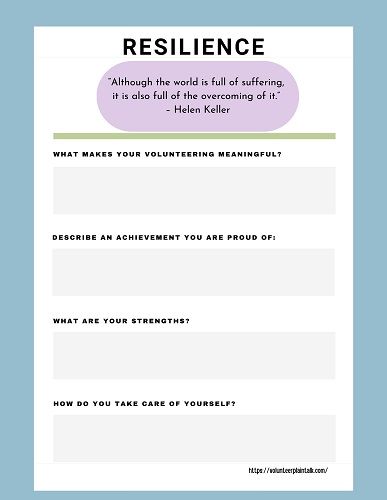
  • A Resilience Worksheet: Free Download

    Dare we ask volunteers, “how resilient are you?” Does nurturing a resilient mindset belong in volunteer meetings or in orientation? Is resilience in the face of change as crucial as policies, ethics, and the most valuable, urgent, significant, important phrase to throw at new volunteers; “by the way, we welcome donations too! And, here’s an envelope to take with you!”

    Discussing resilience and utilizing change scenarios when orienting or constructing workshops lays the groundwork for smooth change management down the road. It’s like a gift to your future self. It doesn’t matter if change is upheaval or small. Change upsets the status quo and we can nurture a “change is not the end of the world” mindset, so that when changes occur, volunteers are prepared to work through them.

    This free worksheet explores resilience and reframes this debilitating response to change: “Nothing will ever be the same.”

    page 1

    Hopefully, it will get your creative juices flowing and you will consider adding Resilience Nurturing to your volunteer mentoring.

    -Meridian

  • Volunteer Resilience

    In the last VPT podcast, Laura Rundell wisely chats about resilience, a subject we have been forced to examine in the past year. Laura asks: What is resilience? What masquerades as resilience? How do our volunteers show resilience?

    What can we learn from this year?

    We were unprepared for the magnitude of the pandemic and how it disrupted volunteerism. But, you know what? We, LoVols, deal with disruption all the time. Changes in volunteer assignments, policy tweaks, staff shuffling, new projects implemented, tasks taking precedent over other tasks, organizational restructuring, and then there’s the personal changes in volunteers’ lives that create disruption. We live in the Upheaval Hotel. (Too many volunteers answering that old add you forgot to remove in your room? I’ve got one on the 10th floor with explaining the new policy changes you might like better)

    Because volunteer resilience is key to not only surviving major disruptions, but key to surviving and thriving during more minor disruptions, we are knee-deep in encouraging resilience. Nurturing volunteer resilience is necessary, regardless of a pandemic or a change in policy. So, going forward, what can we learn from this experience?

    I recall a few years back, we had a near volunteer mutiny when a beloved staff member left in a hasty manner. It was not pretty. I was unprepared for the upheaval that followed. But through a series of dialogues, adjustments and extensive follow-ups that centered on resilience, the volunteers stayed. It proved to me that resilience is a mind-set we can help foster.

    How can we help volunteers be resilient?

    • Make change normal: Use change language and lay a foundation that says change is natural and an evolving strategy to move forward. Make the distinction from the need to adapt and pivot (change) on operational issues from the solid core values of your mission that remain foundational and say, for example, “we are adapting and learning to navigate the changes we must make to grow, but we never lose sight of our mission which is the foundation on which we operate.” Make sure volunteers know that the mission is their anchor.
    • Present change as an opportunity: Present change in a positive light by encouraging volunteers to think about opportunities such as, “now that we have to re-think our in-person services, let’s look at the opportunities to utilize different skills, find new talents.” Get volunteers to brainstorm, be part of the process. Change is received more readily when volunteers are part of the change process.
    • Connect to purpose: Offer stories of how the volunteers’ can-do attitude helps those being served. Tell volunteers how they inspire staff and clients to keep going. Use humor and inspiration as stress relief.
    • Debrief and reflect: Always elicit feedback. In change management, feedback is key to navigating change. Not once, but repeatedly, so when you hear the volunteers say, “We get it, you’re always asking how are we doing with these changes,” you’re on the right track. Reflection is a way to embrace the difficulties, to acknowledge the loss of status quo. Reflection is nonjudgmental and healing and allows for the volunteers to express their frustrations and loss. When I experienced the volunteer near mutiny, reflection gave the volunteers a space to grieve over losses without feeling judged. I learned so much by just listening to them.
    • Survivor attitude: Make surviving a badge of honor. We tell volunteers how special they are, so add surviving into that mix.
    • Introduce scenarios into training: I love scenarios because they apply knowledge to real situations. Adding a change scenario is a great way for volunteers to think about how they might act when change is inevitable and a great way to encourage resilience.
    • Admit the struggle: As a volunteer manager, you are good at being honest. Admit the “work in progress” because it’s easier to be resilient when you know everyone else is struggling to be resilient too. It’s the team mentality. We will get through this together.

    Resilience is not…

    Resilience is not forcing volunteers to accept the unreasonable without question. That’s being a door-mat. And it’s good to let volunteers know that you understand the difference between resilience and being taken advantage of and will work to make sure they are treated with respect. That way, when proper changes occur, they will likely be more resilient.

    Oh, and what about you? How’s your resilience holding up? Do you, as Laura says in the podcast, practice self-care and find joy in our profession? Do you seek out other volunteer professionals to vent to? Laura and I chat often, and I have to say, I get so much out of our chats. We’re not alone. We are strong and resilient. Finding another volunteer engagement professional to chat with, laugh with, cry with, or vent with is one of the greatest ways to steady a wobbling boat, to adjust your sails and take a moment to enjoy the journey.

    And feed your resilience.

    -Meridian

  • Never Forget, You Have a Hand in This

    Photo by Jacob Kelvin.J on Pexels.com

    Do you matter? Does the work you do matter? Are you feeling (mainly because there’s this pandemic going on) like “what difference does all this make?” Sometimes there are days like that, even weeks. That’s why I have stories that I clutch to my heart for times like these. Here’s one of mine in brief:

    There was something so familiar about her. Her eyes crinkled as she spoke. I’d seen that chin before, but it was her mannerisms that gave me deja vu. She was like reuniting with a good friend after a long absence.
    “I’m Bree,” she said, holding out her hand and we shook, a familiar warmth cursing through my arm. We walked back to my office and she sat down, her eyes taking in everything as though she had seen it before in another life.

    “My name is Bree Phillips and I want to volunteer here.” I didn’t recognize her name, but she continued. “I just moved here to be near my mother. Mom is getting older, and I need to take care of her. But I have some free time to give, and really, I’m here because of my father. He volunteered here many years ago.”
    “No kidding,” I said, still puzzled over the name Phillips, “who is your father?”
    “George Keenon,” she said.
    My mouth dropped open. “Your dad is George Keenon?”
    “Yes,” she answered, “do you remember him?”

    I knew him so well

    It suddenly dawned on me, those eyes, her chin, the mannerisms, I was looking at a clone of George. In that instant, I felt like I was sitting with him again, enjoying his stories of growing up on a farm, his love for family and helping others. George roamed the halls of the hospice care center, complementing the nurses and stopping to acknowledge a broken heart. I remember one day, when a patient asked to see Frank Sinatra, George agreed to “be Frank” and when he entered the room, she looked at him with a smirk and said, “whoa, you really let yourself go!” After that, our little inside joke was, “whoa, you let yourself go.” George was light and air and life itself all in one.


    Bree told me that before her father died, he told her to go volunteer at a hospice. “He was always talking about his experiences here,” she said. ” I swear, he had this long, great career in business, but he spoke more fondly about his connections to the patients.” Bree’s eyes brimmed with so much emotion. “I want to honor my father by following in his footsteps. I want to do something that lights me up the way it lit up my dad.”

    Do we ever really know?

    We, Leaders of Volunteers, operate in the intangible world: Goodness, Hope, Love, Charity, Personal Growth, Awareness, Connection, Discovery. Trying to measure these intangibles is like explaining why your dog loves you. He just does.

    We invest in people. But we don’t often measure our investment’s growth. We’re too overwhelmed with daily work to stop and take stock of our positive influence on volunteers and our missions. So, when these incidents like the Bree story occur, we stop spinning and realize that all of our work has far-reaching effects.

    You will never hear all the positive influence you’ve had. You’ll hear about some, but not all. That’s why I cling to my stories and quotes and even the look a volunteer gives me when they know, I mean really know that they have touched another person’s heart. I cling to the tears, the restarts, and the joyous celebrations. I fiercely hold the deep ache of volunteers’ souls when they share why they volunteer or their fears of inadequacy, or a pain from their youth.

    What we do know

    Maybe filling out a report doesn’t change the world. So, ok, making a quick phone call doesn’t alter the history of mankind. And sure, conducting a zoom meeting doesn’t solve societal ills. But look at all the good you produce. Look at your sphere and see what you radiate: Kindness, understanding, encouragement, belief in the goodness of others, acceptance, hope, inspiration, a willingness to listen and learn.

    You matter. Big time. And, do me a favor, ok? Forget for a moment the idea that you have to have earth-shattering successes to matter. Instead, feel contentment at how much you matter to so many people who may not say so. Feel satisfied that so much of your life is spent doing something meaningful. Feel fulfillment in how you engage and encourage people to be better. Embrace the satisfaction of knowing you’ve changed lives for the better. Feel privileged to have found something that fills your soul with meaning. Feel gratified that you are strong enough to go on.

    You matter to all of us

    We, volunteer managers are fighting for professional recognition, for more meaningful volunteer involvement, for seats at the planning table, and for volunteerism to be recognized as a society-changing force for good.

    Yes, we fight. But even the fighter has a moment alone, when the enormity of the fight presses down on wearied shoulders. Contentment comes, not from being complacent, but from understanding you matter.

    Let your “Bree” stories fill your heart to fight another day.

    -Meridian