Category: Uncategorized

  • Until the Family Member Said, “No.”

    My organization developed a solid volunteer strategy. One volunteer even referred to it as a rescue team of angels who would swoop in and take care of all the patient and family members’ needs. Wow, how can you say no to that?

    As a new believer, I trained volunteers to operate in the tried and true methods my organization had set. Our leadership had learned so much and were the experts, after all.

    What we offer might not be what someone wants

    That is, until the day a family member pushed back. One of our experienced volunteers, a volunteer who helped train new volunteers had arrived at the patient’s home. “I’m here to sit while you go shopping,” Essie told the patient’s husband.

    “I don’t want to leave her.” He was holding his wife’s hand. “Thank you, though. I’ll make do.”

    “It’s ok,” Essie assured him. “I’ll take good care of her and you’ll be back soon. You need to get supplies and may not get a chance until I return.” She then added, because the experts always said this, “you can get out for a bit, come back refreshed, be a better caregiver.”

    His eyes were on his wife’s face. “No,” he said, “I’m not leaving her, but thank you.”

    And so, Essie used her intuition, thought about what he needed versus what she was trained to offer and asked for the shopping list. She went to the store for him, apologizing if she got the wrong brands or the wrong size. He didn’t care. He was where he needed to be. Essie didn’t care either and we worked out a way for her to be reimbursed. She said as she left for the store, she watched him tenderly stroke his wife’s face and knew that her instincts, not official training nor volunteer job description told her she was doing the right thing.

    Roles may be the problem

    See, our training didn’t include “sit down with the people adapting to your presence and work out with them what they need.” No, our training relied on the volunteer roles pre-determined to be the best option for the people served.

    The point is, our volunteers understand that programs are only effective if the participants/recipients are part of the process. They’re only effective if the participant is in control and not made to feel that “this is what you need.” Volunteer after volunteer operated outside the norm because they listened to and respected what people wanted from them. I changed training after accompanying volunteers to homes where I learned what collaborative volunteering looked like.

    As we experience upheaval in the volunteer world due to circumstances we could not control, we can view this as an opportunity to change everything for the better. We can introduce collaborative volunteering and show how volunteers can work with, not for a recipient of our services.

    We could ditch titles that speak to roles, such as “visiting volunteer,” or “companion volunteer” and instead, offer collaborative volunteering by letting volunteers forge a partnership with the folks we serve.

    For more information, check out this study, “Putting Participants at the Center of Managing and Leading Nonprofits” here

    Collaborative volunteering: It’s time.

    -Meridian

  • When a Volunteer Has Your Back

    Photo by Kelly Lacy on Pexels.com

    Nineteen year-old Dominick worked at the pizza joint a block away from the thrift store I was managing and needed court ordered community service .

    Dom was angry, impatient, and didn’t really care about our cause, but he needed his job, so he sucked it up and came to my door.

    I was des-per-ate for any able-bodied human to help me on the box truck I would borrow to pick up donated furniture, our highest ticketed items in the store. (I had a non-existent budget, but you knew that already, didn’t you?)

    Dom agreed to spend a day or two on a ride along and help me haul the furniture. I always made a route to save gas and the day Dom went with me, we talked, or really, he talked and I listened. He told me about growing up in the area, his brothers, some in trouble, his sisters, his mom, his deceased father, his struggles in school. He told me about making pizzas, how he wanted to own a business and gave me some tips on fishing in local retention ponds.

    One of our stops was at a woman’s home. She had donated a few knick-knacks before, and called me to say she had some nice furniture to donate. (I only picked up furniture; I asked that all other donations be dropped off)

    We arrived at her upscale house and she handed me a plastic bag containing some clothes. “I don’t have furniture for you, but,” she said, “I bought a new mattress set and I’m giving my old one to a friend who lives down the street. Would you mind taking it there?”

    I held my tongue, rolled my eyes, said, “fine,” and Dom and I put the pristine mattress and box springs into the truck and headed down the road. When back in the cab, the door shut, I let loose, fuming, literally running at the mouth at the arrogance of this woman who was using a charity to deliver her goods.

    Dom just sat there, watching me, my hands flying off the wheel as I vented my anger. He said nothing.

    The friend was waiting for us, all smiles, and I kept my mouth shut, gritting my teeth against the hail of words that threatened to burst forth. We retrieved the box spring and she directed us to a bedroom where we deposited it on the empty bedframe.

    We went back for the mattress. I could feel Dom’s eyes watching my clenched jaw as we picked it up and brought it inside, laying it atop the box spring, the friend gazing contentedly at her new treasure.

    I stepped away, muttered “we’ll be off now,” to the woman and turned to see Dom walk over the mattress, his dirty boot leaving the most perfect outline on the white cover. The woman’s eyes went wide and I pretended I didn’t see it, while scurrying away. (kinda like when I’d notice the marketing director coming down the hall.) Dom, chin high, sauntered along, without a care in the world.

    We got back in the cab and I started the engine. Dom stared straight ahead, an imperceptible smile flickering over his lips. I drove in silence for a few streets, processing in my head what to say to him and then I bust out laughing.

    Although I sweated for days, expecting a call from the CEO, none came. The lady never donated again. Dom finished his community service and I signed off on it.

    But I did start ordering pizza from Dom’s pizza shop.

    -Meridian

  • VPT podcast: Volunteers as Essential Workers, Part 2, an Interview with Dr. Paul Falkowski, PHD

    Volunteers as essential workers? Dr. Paul Falkowski, PHD lays out his vision for designating volunteers as essential workers. Think about this-volunteer firefighters run into burning buildings, save lives, yet we place risk above benefits when thinking about adults who are suffering from the effects of social isolation.

    In part 2, Paul Falkowski, PHD touches on:

    • The workloads of nursing home activity directors
    • How family members are pushing to be designated essential
    • The toll isolation takes on nursing home residents and the surprising statistics 
    • Risk vs. gain
    • Training for essential volunteers
    • Volunteer creativity
    • Quirky interview questions that reveal character
    • Is reimbursement an answer?
    • How creating individualized volunteer help can increase quality of life
    • Universal volunteer training
    • The need for volunteer managers to mobilize

    To connect with Paul and his efforts, please reach him at:

    Website: https://voluncheerleader.com/
    Emailpaul@voluncheerleader.com
    Podcast: https://soundcloud.com/voluncheerleader
    Twitter: 
    @paulfalkowski1
    Facebook: https://www.facebook.com/voluncheerleader
    Linkedin: https://www.linkedin.com/in/paul-p-falkowski-ph-d-2b15512/

    Listen on Buzzsprout here

    Listen on Spotify

    Listen on iHeart Radio

    Listen on Apple Podcasts

    Listen on Stitcher

    Listen on Google Podcasts

    Thank you Paul, for sharing your vision with us, and for your efforts to elevate volunteers and volunteer impact. And remember, “a Klingon does not run away from his battles.”

    -Meridian

  • VPT podcast espisode 17: Volunteers as Essential Workers, Part 1, the Beginning, an Interview with Dr. Paul Falkowski, PHD

    Volunteers as essential workers? In part one of a two part interview, Dr. Paul Falkowski discusses how he began his journey to designate volunteers as essential workers. Paul shares how he became a champion for volunteers in nursing homes through a nonprofit he built from the ground up. Paul discusses the importance of team, volunteer education and training, skin in the game, and navigating volunteer management challenges. In the next episode, he discusses his ambitious plan to designate volunteers as essential workers

    Listen on Buzzsprout here

    Listen on Spotify

    Listen on iHeart Radio

    Listen on Apple Podcasts

    Listen on Stitcher

    Listen on Google Podcasts

    Dr. Paul Falkowski is dedicated to serving the people who live and work in long-term care communities. Paul has a bachelor’s degree from Duquesne University, Pittsburgh, Pennsylvania, in Music and a Master’s degree in Gerontology from the University of Nebraska at Omaha and went on to earn a doctorate in Gerontology also from the University of Nebraska.  He was first attracted to the field of aging through his volunteering in nursing homes providing musical entertainment. In 1993, he formed a nonprofit that recruited and trained some 700 volunteers for Omaha and Lincoln nursing homes over 26 years. In 2003, he contacted the Department of Gerontology at the UNO and was encouraged to pursue a Gerontology graduate certificate.  Eighteen years later, he teaches online courses for the Department of Gerontology, conducting research and consulting with nursing homes. He recently developed the course “Volunteer Management and Aging Services” and is working on publishing a study in which he connects volunteerism in long-term care and the nursing home’s quality of care measures. Also, he authored “Creating the Volun-Cheer Force: Rethinking the way we use volunteers in nursing homes” and formed VolunCheerLeader LLC to provide support to nursing home managers of volunteers. His passion for volunteerism and improving the care of older adults is unwavering.

    VolunCheerLeader website

    Thank you, Paul for sharing your inspirational journey and vision for the future with us. And for imagining, no, working tirelessly towards a world in which volunteers are essential workers.

    Be sure to catch episode 2, in which Paul lays out his vision for elevating volunteers.

    -Meridian

  • How about these Recent Volunteering Headlines?

    While binge researching, I thought I’d share a few recent volunteering headlines I found with you. They were deep in my feed…really deep, like buried deep.

    Disclaimer: These “headlines” are made up.

    In blatant effort to increase respect for volunteers, volunteer manger renames them “Fluffy Donors” and requires each Fluffy Donor to pledge $1 to the general fund for “you know, the fluffy work we do.” In other news, charity heralds “new era of respect for donors.”

    In bid to save money, nonprofit CEO cuts volunteer department budget by 50% before being told there is no volunteer department budget and laments, “What, now I have to cut the senior retreat?”

    In a shocking nonprofit study, organizations learn that 78% of mistreated volunteers quit. “The remaining 22% will get a nice thank you luncheon,” says one CEO.

    Upon hearing there is an uptick in people wanting to volunteer, nonprofit consulting agency unveils “Fees to Volunteer” as next big source of revenue for struggling organizations, using “They should pay for the privilege of volunteering” as their tagline.

    .

    After learning the 850 packets they assembled for the annual walk/run were thrown away because of typos, volunteers stage walkout the same day the marketing manager is promoted.

    After reading study that shows volunteering is good for health and well-being, nonprofit ED scraps wellness plan, asks staff to volunteer and replace “those pesky unpaid people.”

    It’s nice to know volunteering makes the news. 🙂

    -Meridian

  • Collaborative Volunteering or Why I Started Enjoying the Kids

    Be honest. If a group of 10 year olds wanted to volunteer, would you:

    • scurry to find some crayons?
    • make sure it was on a Saturday when the office was empty cause you don’t want the tykes to bother the staff? (although in reality, you’d love to dump a couple of sticky-handed kids on Gwen in marketing)
    • make up some labor law that prevents children under 26 from entering your organization due to the excessive use of whiteout?
    • fake an allergy to glitter?

    Yeah, I used to do all four, and even “touched up” some messy artwork so that when it was tacked up, Malcolm in IT wouldn’t sniff, “what a waste of time.” (it’s a sickness, right?)

    In the last VPT podcast, Summer Neiss, coordinator for a K Kids program in Oregon, told us what we already know and tend to just sweep under the rug: There are countless people, including kids, who want to help, but have little luck in finding a place to volunteer.

    Collaborative vs. Set Roles

    How is this still a thing? I believe it’s because we don’t collaborate with volunteers.

    Nope, we dictate to them, we mold them, we fit them into boxes, we cling to a “standard” (what the Holy H is a standard, anyway?) and yet, when no volunteers want what we are offering, we keep searching for more bodies. (and I’m talking about organizations, not volunteer managers. Volunteer managers get it) Hmm, not so efficient, is it?

    So, what does collaborative volunteering look like?

    Ok, sorry, but I gotta tell you a story.

    I was asked to “get volunteers” to restock an activity cart at a nursing home in which there were hospice patients on our program. Problem was, our volunteers weren’t that interested in stocking a cart; silly volunteers wanted to interact with human beings, go figure.

    Anyway, I stewed about it, muttering to myself, “why can’t anyone see what absolute garbage (might have used other words) this request is,” and then I stopped my little temper tantrum and decided to go talk to the nursing home myself.

    Together, with the activities director, who BTW didn’t want volunteers stocking carts, but asked for real, meaningful help, we collaborated on several programs. The activities director took me on a tour of the nursing home. This was a facility where 98% of the residents were under 60 years old. By no means was this a wealthy place. That tour alone, made me want to work with that director.

    Together, with our volunteers’ input, we created several programs, including recording life stories. And oh, the stories those residents had to tell.

    But here’s the point. Collaborative volunteering takes away the sizing up of a potential volunteer to see if they would fit into our little mold.

    Collaboration is a path to engagement on all sides

    Collaborative volunteering is a three way venture. Volunteer, organization and recipient of volunteer time. There’s the sweet spot-> where the three intersect:

    Collaboration increases engagement, solves actual challenges in more efficient ways, and moves us forward.

    In this time of chaos and change, we can make volunteering better. Like kids volunteering? Why not? Once I quit looking at volunteers fitting into slots, I found myself at a kindergarten, standing there, those 5 and 6 year-old eyes on me, waiting. (Soooooo, I found myself thinking, maybe my speech about terminal illness and dying, the one that gets right to the heartstrings isn’t the right approach here. Huh.) And boom, I had to wiggle out of my box and see things differently.

    When we work with, not at volunteers and recipients of volunteer involvement, we create something organic that is structured to work for everyone. And honestly, when collaboration is encouraged, the burden on our overworked brains eases because we don’t have to think of everything. (you can put that super human cloak aside)

    Change is upon us right now and it’s challenging, but it can open up a whole new way of seeing things.

    Collaborative volunteering can ease us into a new age where, because everyone participates in the system, the system doesn’t become the dictator.

    -Meridian

  • VPT podcast episode 16: Untapped Volunteer Resources: An Interview with Summer Neiss, K Kids Student Coordinator

    Hear the podcast on buzzsprout:

    Do we assume that engaging kids 9-12 is too much effort for the return on our investment? Are we missing an untapped potential? In this episode, Summer Neiss, librarian and student coordinator for the K Kids program at Mabel Rush Elementary school shares the passions, motivations, and untapped potential of youth volunteers. Summer discusses the upsides such as attracting the kids’ parents or guardians, thinking out of the box and cultivating future volunteers. 
    Points she shares are:
    Kids are natural helpers from toddler on.
    Kids who volunteer are highly motivated.
    Just like adult volunteers, kids are sustained by impact.
    Kids are socially motivated.
    Today’s kids are aware of the world.
    Kids have big ideas and love to brainstorm.
    Summer also shares her thoughts on bettering volunteer programs for kids such as:
    Where to find organizations to partner with.
    Why conversations about volunteer partnering are necessary.
    How kids’ parents or guardians would get involved.
    How little things can make big impact.
    How community good will is involved. 
    For more information on KKids visit: Kiwanis Kids

    Listen on Spotify

    Listen on iHeart Radio

    Listen on Apple Podcasts

    Listen on Stitcher

    Listen on Google Podcasts

    A huge thank you to Summer for sharing the work she is doing with her K Kids, for enlightening me on the untapped potential these young volunteers have to offer, and for instilling a sense of community in our future citizens.

    I know I came away feeling that the future is looking pretty bright.

    -Meridian

  • Volunteers and the Game of Complaints

    Photo by Keira Burton on Pexels.com

    I’m revisiting an old post from 2013 because Volunteer Appreciation Weeks are upon us and one way we can appreciate volunteers is to give them the gift of loving the mission. And by that, I mean, shielding them from nonsense.

    Volunteers: A head-pat will do

    I remember this incident vividly, because organizations often view volunteers as “our little helpers” and not as members of a professional team. It’s easy to pat volunteers on the head, and toss the “Boundaries and Good Practices for Dummies” book aside when dealing with volunteers because, hey, they are so cuddly (codeword-ignorant and therefore, harmless), they don’t need to be treated with anything resembling….intelligence and professionalism.

    A few years back, I sat in a meeting with long-term, respected volunteers Darla and Jo, and the supervisor of their department, Cindy. I was shocked when Darla and Jo brought out a list of complaints against Kay, their immediate supervisor. They hadn’t brought any issues to me before this meeting, so I was a bit skeptical, especially when they produced a list of Kay’s shortcomings, including how she treated staff unfairly. (Hmmmmmmmmmm)

    Volunteers: Professional team or pawns?

    During the conversation. Darla and Jo mentioned they often went out for drinks with a couple of staff members under Kay’s supervision. (Really?) And those staff members shared their difficulties with Kay. (Well, how convenient) So, what that means is, when out socially, away from work, these staff members let loose and talked about the organization and other employees in front of volunteers, drawing volunteers into the politics of their department. (What a great way to make volunteers feel part of the team, right?)

    In private, I said to Cindy, “It’s a terrible idea for staff to socialize with select volunteers and air grievances. If staff is going to invite the volunteers to a function, then they’d better invite all of them and they’d better not make the volunteers pawns in some personal battle with their supervisor.”

    So, Cindy, who is the supervisor of all in question, shrugged and said, “they’re on their own time, what can I do?” (Really? How would you like it if the CEO invited a couple of staff members out for drinks and they trashed you?) (oh, and then enlisted volunteers to file a complaint?)

    Go on record…really go on record

    I then said. “I’m going on record as saying that allowing staff members to fraternize with select volunteers on off time and discuss work issues makes for a harmful work environment and should be stopped immediately.” (And, I will be noting this conversation for the time this all goes south, which we know it will.)

    Taking care of the volunteers is everyone’s business, not just the volunteer department’s. Write a policy that says your employees will treat volunteers with respect and will not suck volunteers into conflicts. They don’t deserve that. (And this chess game is what you get. It won’t resolve itself on its own.)

    I had a volunteer who helped me in my office. From day one, I said to her that “it’s not that I don’t want you to be privy to things, it’s that I don’t want you to be burdened with junk. You’re here to do good work and you deserve to be shielded from the nonsense.”  She took that to heart and ever after, when I had a conversation with someone in front of her and it got a bit deep, she excused herself before I had a chance to, and she laughingly said, “I don’t need to be a part of this.” (Bravo to her!) But, you know what? She knew staff had political conflicts, personality clashes, and sometimes back-stabbing incidents, but she chose not to become embroiled in them, which lead to more love for the work.

    Let volunteers love the mission

    The question becomes, “for whom does our volunteer volunteer for? Um, the organization, right? But often, volunteers’ loyalties can be steered away from the mission and to select staff or other volunteers. This is why boundaries exist; to ensure volunteers are connected to mission impact and not to any cult of personality borne from feeling sorry for or loyal to one or more individuals.

    So, when staff thinks they’re being nice or cute or they just want some pawns in their game of complaints, they need to realize that fraternizing might be great for them, but it’s always a bad idea for the volunteers. Let the volunteers see the greatness of the organization, not the back room where stuff is all chaos and disjointed and frankly sometimes back-stabbing. And if staff want to grouse about their jobs, then make sure that volunteers are left out of it.

    -Meridian

    and here’s the old post

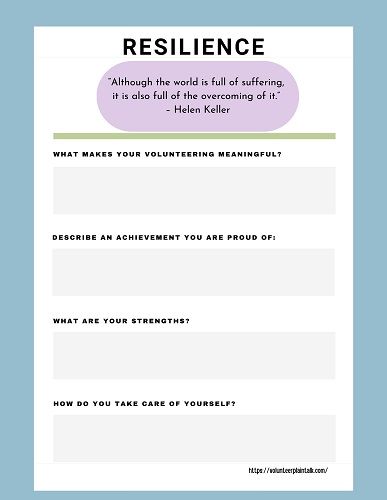
  • A Resilience Worksheet: Free Download

    Dare we ask volunteers, “how resilient are you?” Does nurturing a resilient mindset belong in volunteer meetings or in orientation? Is resilience in the face of change as crucial as policies, ethics, and the most valuable, urgent, significant, important phrase to throw at new volunteers; “by the way, we welcome donations too! And, here’s an envelope to take with you!”

    Discussing resilience and utilizing change scenarios when orienting or constructing workshops lays the groundwork for smooth change management down the road. It’s like a gift to your future self. It doesn’t matter if change is upheaval or small. Change upsets the status quo and we can nurture a “change is not the end of the world” mindset, so that when changes occur, volunteers are prepared to work through them.

    This free worksheet explores resilience and reframes this debilitating response to change: “Nothing will ever be the same.”

    page 1

    Hopefully, it will get your creative juices flowing and you will consider adding Resilience Nurturing to your volunteer mentoring.

    -Meridian

  • Volunteer Resilience

    In the last VPT podcast, Laura Rundell wisely chats about resilience, a subject we have been forced to examine in the past year. Laura asks: What is resilience? What masquerades as resilience? How do our volunteers show resilience?

    What can we learn from this year?

    We were unprepared for the magnitude of the pandemic and how it disrupted volunteerism. But, you know what? We, LoVols, deal with disruption all the time. Changes in volunteer assignments, policy tweaks, staff shuffling, new projects implemented, tasks taking precedent over other tasks, organizational restructuring, and then there’s the personal changes in volunteers’ lives that create disruption. We live in the Upheaval Hotel. (Too many volunteers answering that old add you forgot to remove in your room? I’ve got one on the 10th floor with explaining the new policy changes you might like better)

    Because volunteer resilience is key to not only surviving major disruptions, but key to surviving and thriving during more minor disruptions, we are knee-deep in encouraging resilience. Nurturing volunteer resilience is necessary, regardless of a pandemic or a change in policy. So, going forward, what can we learn from this experience?

    I recall a few years back, we had a near volunteer mutiny when a beloved staff member left in a hasty manner. It was not pretty. I was unprepared for the upheaval that followed. But through a series of dialogues, adjustments and extensive follow-ups that centered on resilience, the volunteers stayed. It proved to me that resilience is a mind-set we can help foster.

    How can we help volunteers be resilient?

    • Make change normal: Use change language and lay a foundation that says change is natural and an evolving strategy to move forward. Make the distinction from the need to adapt and pivot (change) on operational issues from the solid core values of your mission that remain foundational and say, for example, “we are adapting and learning to navigate the changes we must make to grow, but we never lose sight of our mission which is the foundation on which we operate.” Make sure volunteers know that the mission is their anchor.
    • Present change as an opportunity: Present change in a positive light by encouraging volunteers to think about opportunities such as, “now that we have to re-think our in-person services, let’s look at the opportunities to utilize different skills, find new talents.” Get volunteers to brainstorm, be part of the process. Change is received more readily when volunteers are part of the change process.
    • Connect to purpose: Offer stories of how the volunteers’ can-do attitude helps those being served. Tell volunteers how they inspire staff and clients to keep going. Use humor and inspiration as stress relief.
    • Debrief and reflect: Always elicit feedback. In change management, feedback is key to navigating change. Not once, but repeatedly, so when you hear the volunteers say, “We get it, you’re always asking how are we doing with these changes,” you’re on the right track. Reflection is a way to embrace the difficulties, to acknowledge the loss of status quo. Reflection is nonjudgmental and healing and allows for the volunteers to express their frustrations and loss. When I experienced the volunteer near mutiny, reflection gave the volunteers a space to grieve over losses without feeling judged. I learned so much by just listening to them.
    • Survivor attitude: Make surviving a badge of honor. We tell volunteers how special they are, so add surviving into that mix.
    • Introduce scenarios into training: I love scenarios because they apply knowledge to real situations. Adding a change scenario is a great way for volunteers to think about how they might act when change is inevitable and a great way to encourage resilience.
    • Admit the struggle: As a volunteer manager, you are good at being honest. Admit the “work in progress” because it’s easier to be resilient when you know everyone else is struggling to be resilient too. It’s the team mentality. We will get through this together.

    Resilience is not…

    Resilience is not forcing volunteers to accept the unreasonable without question. That’s being a door-mat. And it’s good to let volunteers know that you understand the difference between resilience and being taken advantage of and will work to make sure they are treated with respect. That way, when proper changes occur, they will likely be more resilient.

    Oh, and what about you? How’s your resilience holding up? Do you, as Laura says in the podcast, practice self-care and find joy in our profession? Do you seek out other volunteer professionals to vent to? Laura and I chat often, and I have to say, I get so much out of our chats. We’re not alone. We are strong and resilient. Finding another volunteer engagement professional to chat with, laugh with, cry with, or vent with is one of the greatest ways to steady a wobbling boat, to adjust your sails and take a moment to enjoy the journey.

    And feed your resilience.

    -Meridian